







Question: 4. [25 points] Consider a source (S) and a destination (D) connected through the network shown in the figure below. A path from S to
![4. [25 points] Consider a source (S) and a destination (D)](https://s3.amazonaws.com/si.experts.images/answers/2024/06/66787f782982a_98366787f77d83bf.jpg)
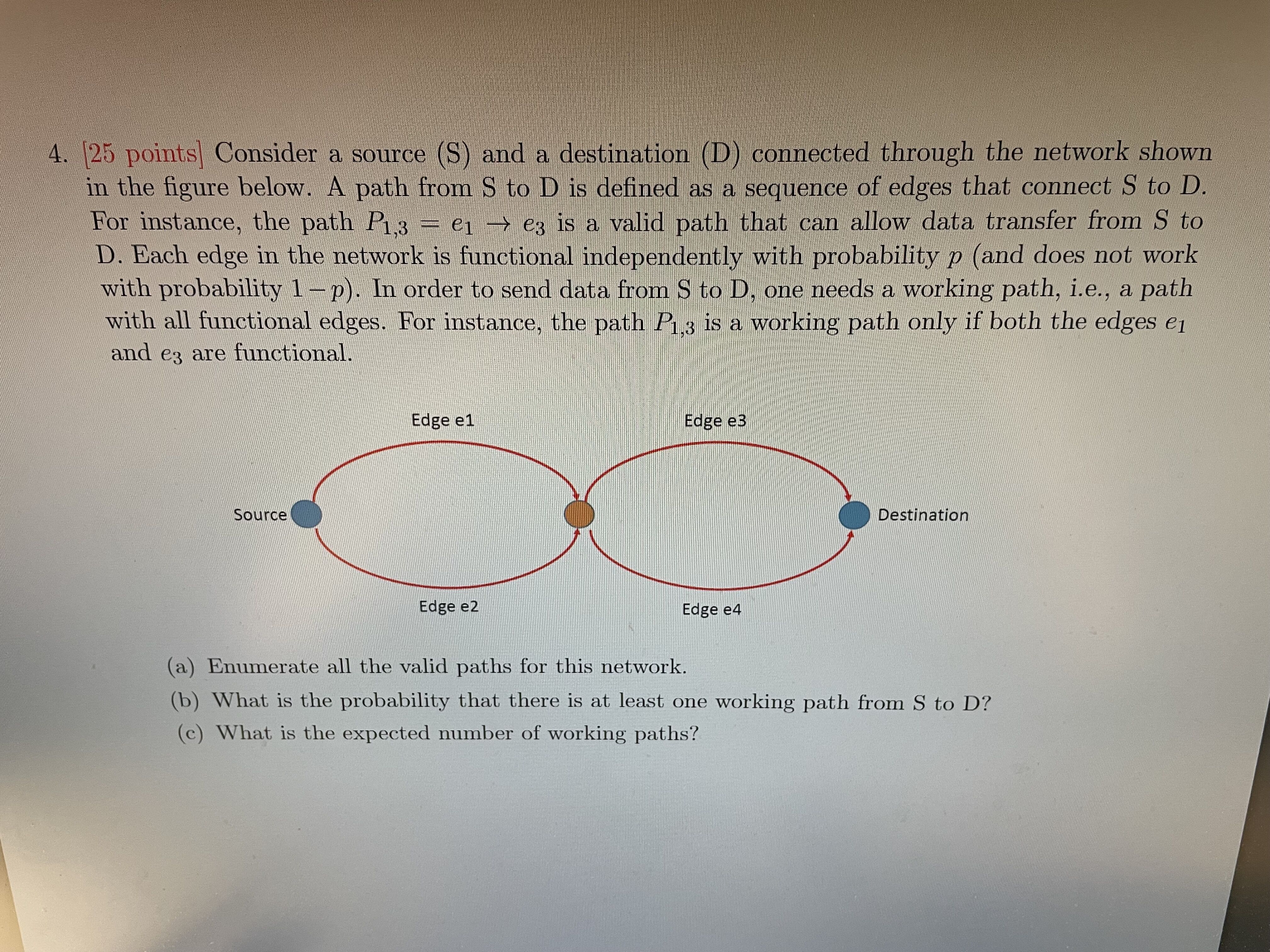
4. [25 points] Consider a source (S) and a destination (D) connected through the network shown in the figure below. A path from S to D is defined as a sequence of edges that connect S to D. For instance, the path P1,3 - e1 - eg is a valid path that can allow data transfer from S to D. Each edge in the network is functional independently with probability p (and does not work with probability 1-p). In order to send data from $ to D, one needs a working path, i.e., a path with all functional edges. For instance, the path P13 is a working path only if both the edges el and eg are functional. Edge e1 Edge e3 Source Destination Edge e2 Edge e4 (a) Enumerate all the valid paths for this network. (b) What is the probability that there is at least one working path from S to D? (c) What is the expected number of working paths
Step by Step Solution
There are 3 Steps involved in it

Get step-by-step solutions from verified subject matter experts
 Study Help