







Question: 4. (25 points) Let 0, 20, 40, 60 specify the timestamps of 4 consecutive packets during a talkspurt period of a VoIP application. Also,
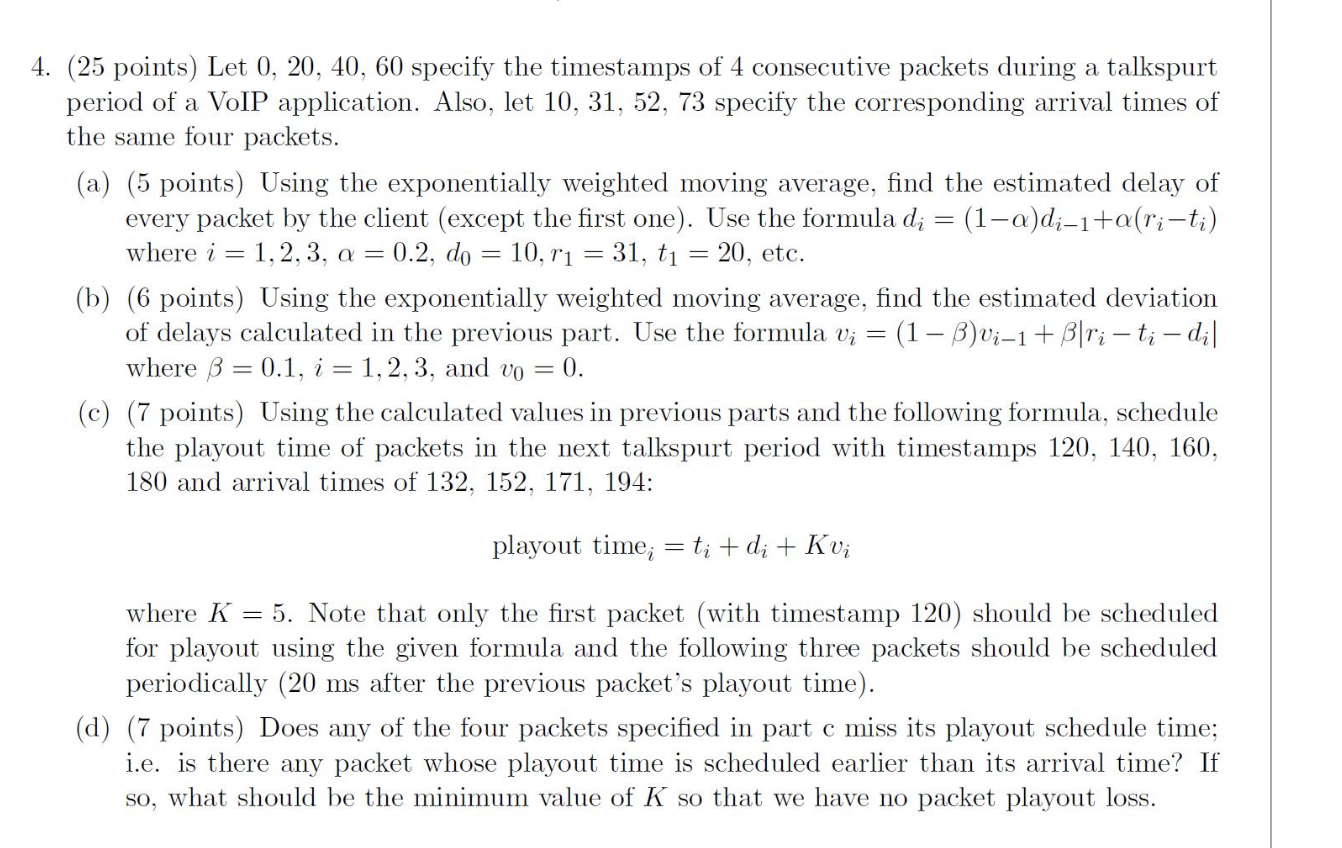
4. (25 points) Let 0, 20, 40, 60 specify the timestamps of 4 consecutive packets during a talkspurt period of a VoIP application. Also, let 10, 31, 52, 73 specify the corresponding arrival times of the same four packets. (a) (5 points) Using the exponentially weighted moving average, find the estimated delay of every packet by the client (except the first one). Use the formula di = (1-a)di-1+a(ri-ti) where i 1,2,3, a = 0.2, do 10, r = 31, t = 20, etc. = (b) (6 points) Using the exponentially weighted moving average, find the estimated deviation of delays calculated in the previous part. Use the formula v = (1-B)vi-1 + Briti di| where 30.1, i = 1, 2, 3, and vo = 0. (c) (7 points) Using the calculated values in previous parts and the following formula, schedule the playout time of packets in the next talkspurt period with timestamps 120, 140, 160, 180 and arrival times of 132, 152, 171, 194: playout time; = ti + di + Kvi where K = 5. Note that only the first packet (with timestamp 120) should be scheduled for playout using the given formula and the following three packets should be scheduled periodically (20 ms after the previous packet's playout time). (d) (7 points) Does any of the four packets specified in part c miss its playout schedule time; i.e. is there any packet whose playout time is scheduled earlier than its arrival time? If so, what should be the minimum value of K so that we have no packet playout loss.
Step by Step Solution
There are 3 Steps involved in it

Get step-by-step solutions from verified subject matter experts
 Study Help