







Question: 4) 3. (25 Points) Consider the production function: Y = ANK1-a (3) It is easy to show that the growth rate of output must be
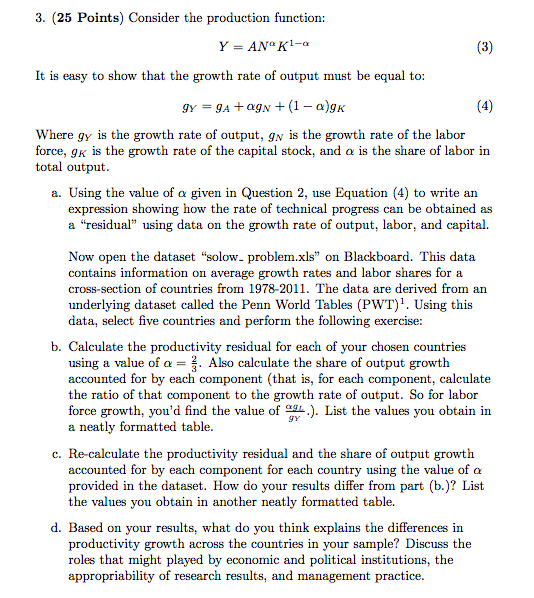
4) 3. (25 Points) Consider the production function: Y = ANK1-a (3) It is easy to show that the growth rate of output must be equal to: gy = 9A +agn + (1 - ag Where gy is the growth rate of output, gn is the growth rate of the labor force, 9K is the growth rate of the capital stock, and a is the share of labor in total output. a. Using the value of a given in Question 2, use Equation (4) to write an expression showing how the rate of technical progress can be obtained as a "residual" using data on the growth rate of output, labor, and capital. Now open the dataset "solow- problem.xls" on Blackboard. This data contains information on average growth rates and labor shares for a cross-section of countries from 1978-2011. The data are derived from an underlying dataset called the Penn World Tables (PWT)". Using this data, select five countries and perform the following exercise: b. Calculate the productivity residual for each of your chosen countries using a value of a = . Also calculate the share of output growth accounted for by each component (that is, for each component, calculate the ratio of that component to the growth rate of output. So for labor force growth, you'd find the value of ..). List the values you obtain in a neatly formatted table. c. Re-calculate the productivity residual and the share of output growth accounted for by each component for each country using the value of a provided in the dataset. How do your results differ from part (b.)? List the values you obtain in another neatly formatted table. d. Based on your results, what do you think explains the differences in productivity growth across the countries in your sample? Discuss the roles that might played by economic and political institutions, the appropriability of research results, and management practice. 9Y 4) 3. (25 Points) Consider the production function: Y = ANK1-a (3) It is easy to show that the growth rate of output must be equal to: gy = 9A +agn + (1 - ag Where gy is the growth rate of output, gn is the growth rate of the labor force, 9K is the growth rate of the capital stock, and a is the share of labor in total output. a. Using the value of a given in Question 2, use Equation (4) to write an expression showing how the rate of technical progress can be obtained as a "residual" using data on the growth rate of output, labor, and capital. Now open the dataset "solow- problem.xls" on Blackboard. This data contains information on average growth rates and labor shares for a cross-section of countries from 1978-2011. The data are derived from an underlying dataset called the Penn World Tables (PWT)". Using this data, select five countries and perform the following exercise: b. Calculate the productivity residual for each of your chosen countries using a value of a = . Also calculate the share of output growth accounted for by each component (that is, for each component, calculate the ratio of that component to the growth rate of output. So for labor force growth, you'd find the value of ..). List the values you obtain in a neatly formatted table. c. Re-calculate the productivity residual and the share of output growth accounted for by each component for each country using the value of a provided in the dataset. How do your results differ from part (b.)? List the values you obtain in another neatly formatted table. d. Based on your results, what do you think explains the differences in productivity growth across the countries in your sample? Discuss the roles that might played by economic and political institutions, the appropriability of research results, and management practice. 9Y
Step by Step Solution
There are 3 Steps involved in it

Get step-by-step solutions from verified subject matter experts
 Study Help