







Question: 4. (30 points, 10 each) Let X be a random variable denoting the number of apps installed in an iPhone. From a large random sample
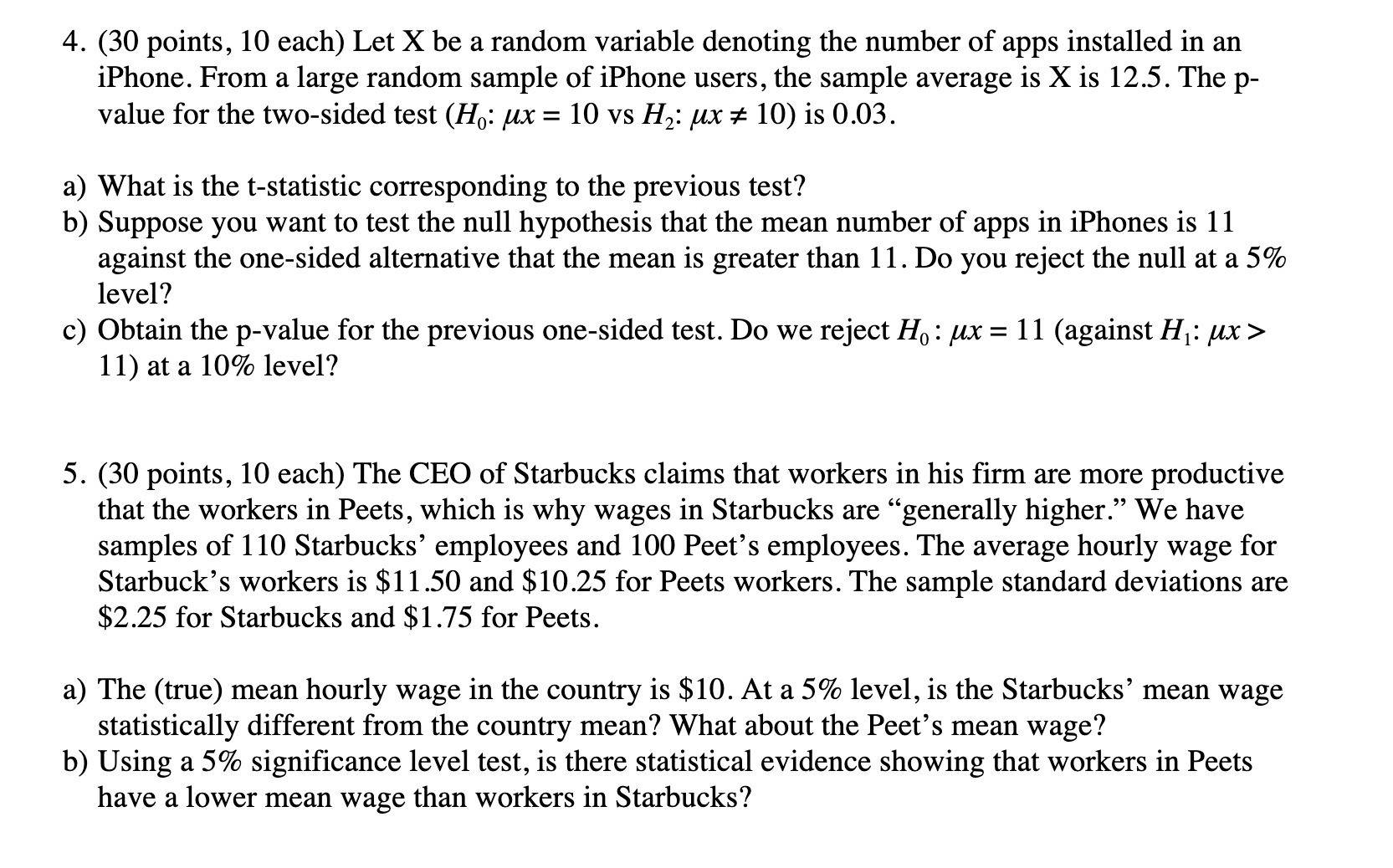
4. (30 points, 10 each) Let X be a random variable denoting the number of apps installed in an iPhone. From a large random sample of iPhone users, the sample average is X is 12.5. The p- value for the two-sided test (Ho: ux = 10 vs H2: ux # 10) is 0.03. a) What is the t-statistic corresponding to the previous test? b) Suppose you want to test the null hypothesis that the mean number of apps in iPhones is 11 against the one-sided alternative that the mean is greater than 11. Do you reject the null at a 5% level? c) Obtain the p-value for the previous one-sided test. Do we reject Ho: ux = 11 (against H1: ux> 11) at a 10% level? 5. (30 points, 10 each) The CEO of Starbucks claims that workers in his firm are more productive that the workers in Peets, which is why wages in Starbucks are "generally higher." We have samples of 110 Starbucks' employees and 100 Peet's employees. The average hourly wage for Starbuck's workers is $11.50 and $10.25 for Peets workers. The sample standard deviations are $2.25 for Starbucks and $1.75 for Peets. a) The (true) mean hourly wage in the country is $10. At a 5% level, is the Starbucks' mean wage statistically different from the country mean? What about the Peet's mean wage? b) Using a 5% significance level test, is there statistical evidence showing that workers in Peets have a lower mean wage than workers in Starbucks
Step by Step Solution
There are 3 Steps involved in it

Get step-by-step solutions from verified subject matter experts
 Study Help