



Question: 4. (40 pts) Circular City Model with Various Mergers. Four firms, labelled 1, 2, 3, and 4 are located equidistant from each other around a
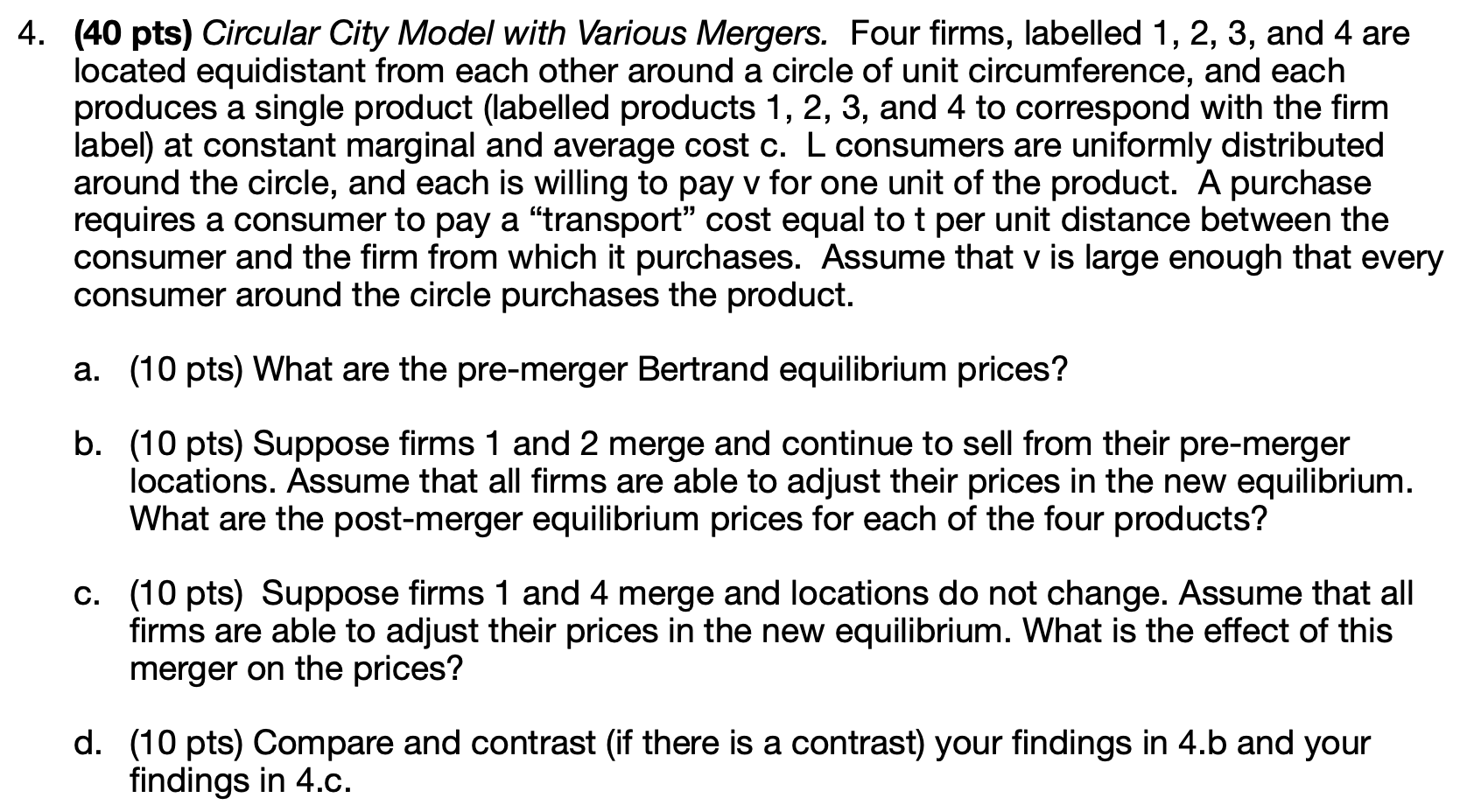

4. (40 pts) Circular City Model with Various Mergers. Four firms, labelled 1, 2, 3, and 4 are located equidistant from each other around a circle of unit circumference, and each produces a single product (labelled products 1, 2, 3, and 4 to correspond with the firm label) at constant marginal and average cost c. L consumers are uniformly distributed around the circle, and each is willing to pay v for one unit of the product. A purchase requires a consumer to pay a "transport" cost equal to t per unit distance between the consumer and the firm from which it purchases. Assume that v is large enough that every consumer around the circle purchases the product. a. (10 pts) What are the pre-merger Bertrand equilibrium prices? b. (10 pts) Suppose firms 1 and 2 merge and continue to sell from their pre-merger locations. Assume that all firms are able to adjust their prices in the new equilibrium. What are the post-merger equilibrium prices for each of the four products? c. (10 pts) Suppose firms 1 and 4 merge and locations do not change. Assume that all firms are able to adjust their prices in the new equilibrium. What is the effect of this merger on the prices? d. (10 pts) Compare and contrast (if there is a contrast) your findings in 4.b and your findings in 4.c. Question 4c indicates that firms 1 and 4 merge. What was meant there was that two firms that are not adjacent to each other merge, that is, firms 1 and 3 or 2 and 4 would merge if the firms were ordered from lowest to highest in either the clockwise or counterclockwise direction. Please assume in 4c that the merging firms are not adjacent to each other. 4. (40 pts) Circular City Model with Various Mergers. Four firms, labelled 1, 2, 3, and 4 are located equidistant from each other around a circle of unit circumference, and each produces a single product (labelled products 1, 2, 3, and 4 to correspond with the firm label) at constant marginal and average cost c. L consumers are uniformly distributed around the circle, and each is willing to pay v for one unit of the product. A purchase requires a consumer to pay a "transport" cost equal to t per unit distance between the consumer and the firm from which it purchases. Assume that v is large enough that every consumer around the circle purchases the product. a. (10 pts) What are the pre-merger Bertrand equilibrium prices? b. (10 pts) Suppose firms 1 and 2 merge and continue to sell from their pre-merger locations. Assume that all firms are able to adjust their prices in the new equilibrium. What are the post-merger equilibrium prices for each of the four products? c. (10 pts) Suppose firms 1 and 4 merge and locations do not change. Assume that all firms are able to adjust their prices in the new equilibrium. What is the effect of this merger on the prices? d. (10 pts) Compare and contrast (if there is a contrast) your findings in 4.b and your findings in 4.c. Question 4c indicates that firms 1 and 4 merge. What was meant there was that two firms that are not adjacent to each other merge, that is, firms 1 and 3 or 2 and 4 would merge if the firms were ordered from lowest to highest in either the clockwise or counterclockwise direction. Please assume in 4c that the merging firms are not adjacent to each other
Step by Step Solution
There are 3 Steps involved in it

Get step-by-step solutions from verified subject matter experts