







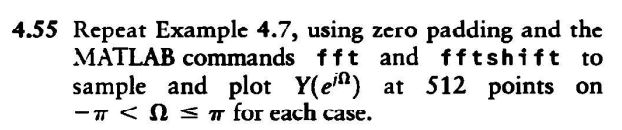
Question: 4 . 5 5 repeat Example 4 . 7 , using zero padding and the MATLAB commands fft and fftshift to sample and plot Y
repeat Example using zero padding and the MATLAB commands fft and fftshift to sample and plot Yen at points on pi Omega pi for each case.
Repeat Example using zero padding and the
MATLAB commands and fftshift to
sample and plot at points on
for each case. Example Application: Windowing Data It is common in dataprocessing ap
plications to have access only to a portion of a data record. In this example, we use the
multiplication property to analyze the effect of truncating a signal on the DTFT Consid
er the signal
Evaluate the effect of computing the DTFT using only the values
Solution: The DTFT of is obtained from the FS coefficients of and Eq as
which consists of impulses at and Now define a signal
where
Multiplication of by is termed windowing, since it simulates viewing through
a window. The window selects the values of centered on We
compare the DTFTs of and to establish the effect of windowing.
The discretetime multiplication property Eq implies that
where the DTFT of the window is given by
We see that windowing introduces replicas of centered at the frequencies and
instead of the impulses that are present in We may view this state of affairs
as a smearing or broadening of the original impulses: The energy in is now smeared
over a band centered on the frequencies of the cosines. The extent of the smearing depends
on the width of the mainlobe of which is given by See Figure
Figure ac depicts for several decreasing values of If is large
enough so that the width of the mainlobe of is small relative to the separation be
tween the frequencies and then is a fairly good approximation to
This case is depicted in Fig. a using However, as decreases and
the mainlobe width becomes about the same as the separation between frequencies
and the peaks associated with each shifted version of begin to overlap and
merge into a single peak. This merging is illustrated in Fig. b and c by using the val
ues and respectively.
Step by Step Solution
There are 3 Steps involved in it
1 Expert Approved Answer
Step: 1 Unlock

Question Has Been Solved by an Expert!
Get step-by-step solutions from verified subject matter experts
Step: 2 Unlock
Step: 3 Unlock
 Study Help