Question: 4. (5 points) Use queueing theory. In the following systems assume that each server has capacity 1 and all times are exponential distributions unless otherwise
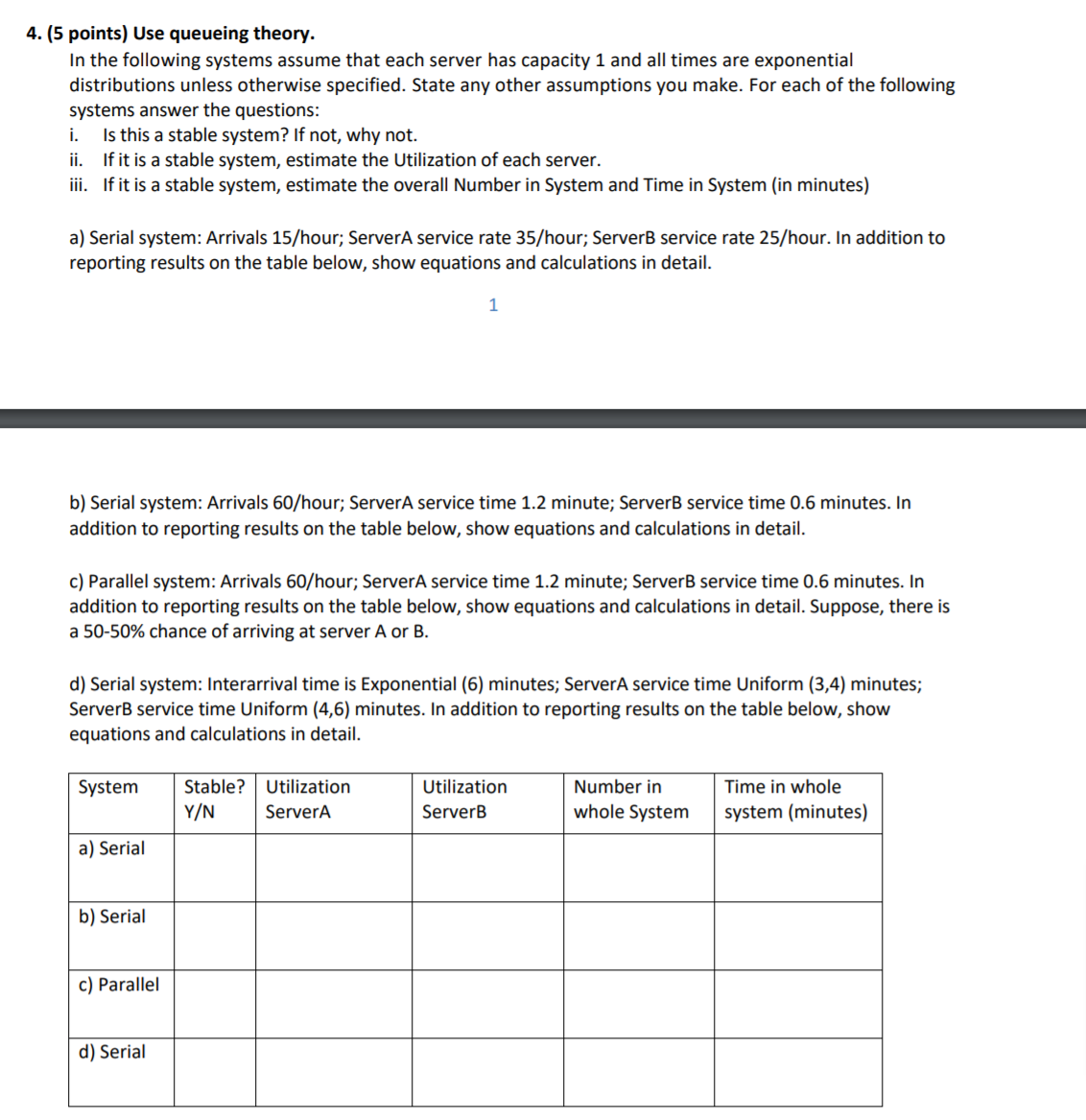
4. (5 points) Use queueing theory. In the following systems assume that each server has capacity 1 and all times are exponential distributions unless otherwise specified. State any other assumptions you make. For each of the following systems answer the questions: i. Is this a stable system? If not, why not. ii. If it is a stable system, estimate the Utilization of each server. iii. If it is a stable system, estimate the overall Number in System and Time in System (in minutes) a) Serial system: Arrivals 15/hour; ServerA service rate 35/hour; ServerB service rate 25/hour. In addition to reporting results on the table below, show equations and calculations in detail. 1 b) Serial system: Arrivals 60/hour; ServerA service time 1.2 minute; ServerB service time 0.6 minutes. In addition to reporting results on the table below, show equations and calculations in detail. c) Parallel system: Arrivals 60/hour; ServerA service time 1.2 minute; ServerB service time 0.6 minutes. In addition to reporting results on the table below, show equations and calculations in detail. Suppose, there is a 50-50% chance of arriving at server A or B. d) Serial system: Interarrival time is Exponential (6) minutes; ServerA service time Uniform (3,4) minutes; ServerB service time Uniform (4,6) minutes. In addition to reporting results on the table below, show equations and calculations in detail. System Stable? Y/N Utilization ServerA Utilization Serverb Number in whole System Time in whole system (minutes) a) Serial b) Serial c) Parallel d) Serial 4. (5 points) Use queueing theory. In the following systems assume that each server has capacity 1 and all times are exponential distributions unless otherwise specified. State any other assumptions you make. For each of the following systems answer the questions: i. Is this a stable system? If not, why not. ii. If it is a stable system, estimate the Utilization of each server. iii. If it is a stable system, estimate the overall Number in System and Time in System (in minutes) a) Serial system: Arrivals 15/hour; ServerA service rate 35/hour; ServerB service rate 25/hour. In addition to reporting results on the table below, show equations and calculations in detail. 1 b) Serial system: Arrivals 60/hour; ServerA service time 1.2 minute; ServerB service time 0.6 minutes. In addition to reporting results on the table below, show equations and calculations in detail. c) Parallel system: Arrivals 60/hour; ServerA service time 1.2 minute; ServerB service time 0.6 minutes. In addition to reporting results on the table below, show equations and calculations in detail. Suppose, there is a 50-50% chance of arriving at server A or B. d) Serial system: Interarrival time is Exponential (6) minutes; ServerA service time Uniform (3,4) minutes; ServerB service time Uniform (4,6) minutes. In addition to reporting results on the table below, show equations and calculations in detail. System Stable? Y/N Utilization ServerA Utilization Serverb Number in whole System Time in whole system (minutes) a) Serial b) Serial c) Parallel d) Serial









 Study Help