







Question: 4) 5) Redo 3) with all the same values (e.g., same investment opportunities) except assume that the investment now requires I = 150 (instead of
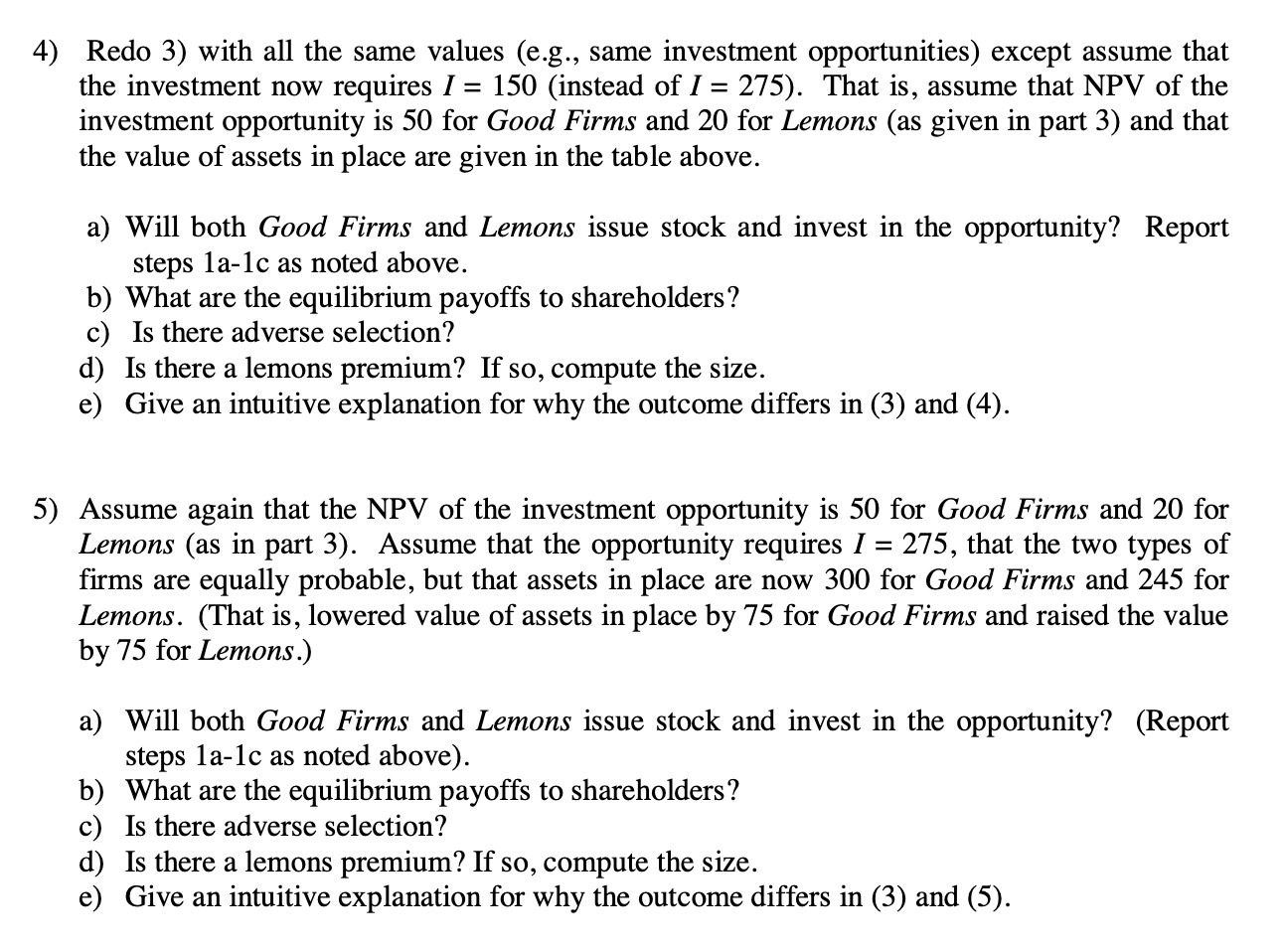
4) 5) Redo 3) with all the same values (e.g., same investment opportunities) except assume that the investment now requires I = 150 (instead of I = 275). That is, assume that NPV of the investment opportunity is 50 for Good Firms and 20 for Lemons (as given in part 3) and that the value of assets in place are given in the table above. a) Will both Good Firms and Lemons issue stock and invest in the opportunity? Report steps lalc as noted above. b) What are the equilibrium payoffs to shareholders? c) Is there adverse selection? d) Is there a lemons premium? If so, compute the size. e) Give an intuitive explanation for why the outcome differs in (3) and (4). Assume again that the NPV of the investment opportunity is 50 for Good Firms and 20 for Lemons (as in part 3). Assume that the opportunity requires I = 275, that the two types of rms are equally probable, but that assets in place are now 300 for Good Firms and 245 for Lemons. (That is, lowered value of assets in place by 75 for Good Firms and raised the value by 75 for Lemons.) a) Will both Good Firms and Lemons issue stock and invest in the opportunity? (Report steps la-lc as noted above). b) What are the equilibrium payoffs to shareholders? c) Is there adverse selection? d) Is there a lemons premium? If so, compute the size. e) Give an intuitive explanation for why the outcome differs in (3) and
Step by Step Solution
There are 3 Steps involved in it

Get step-by-step solutions from verified subject matter experts
 Study Help