







Question: 4. (9 points) Consider a random sample Y1. .., Y, of size n where each is i.i.d which means E (Y) = My and Var
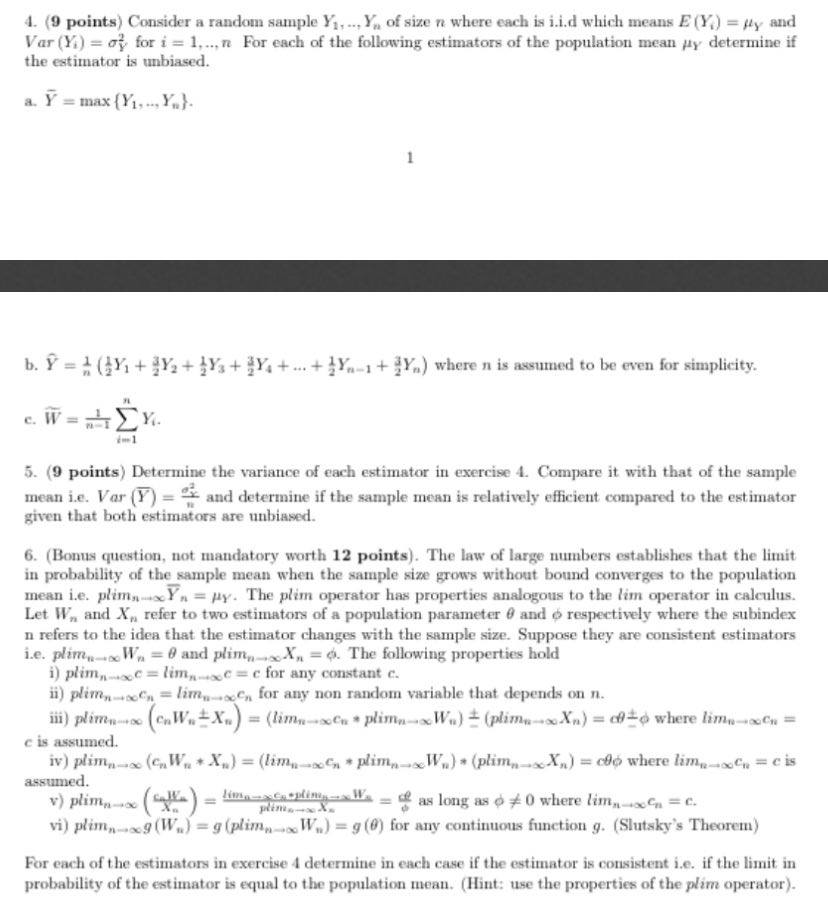
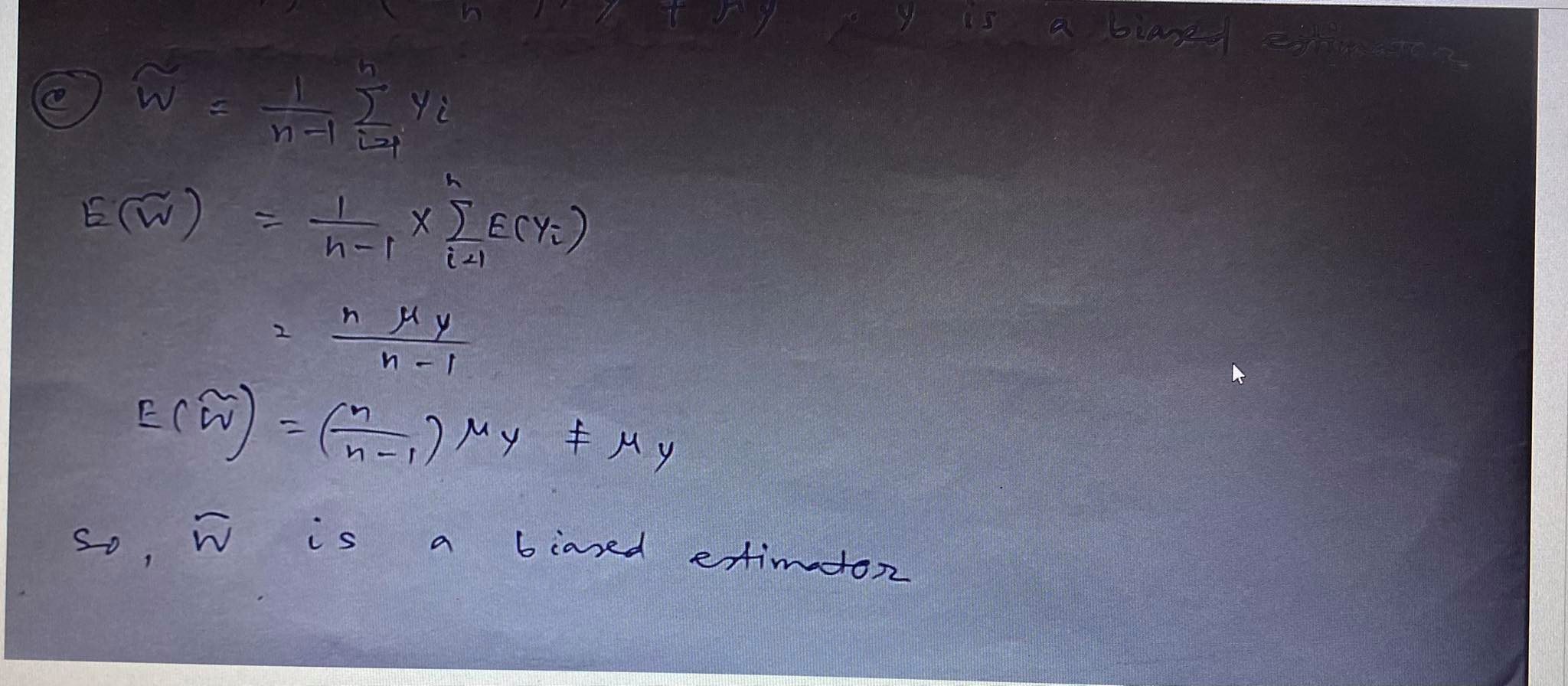
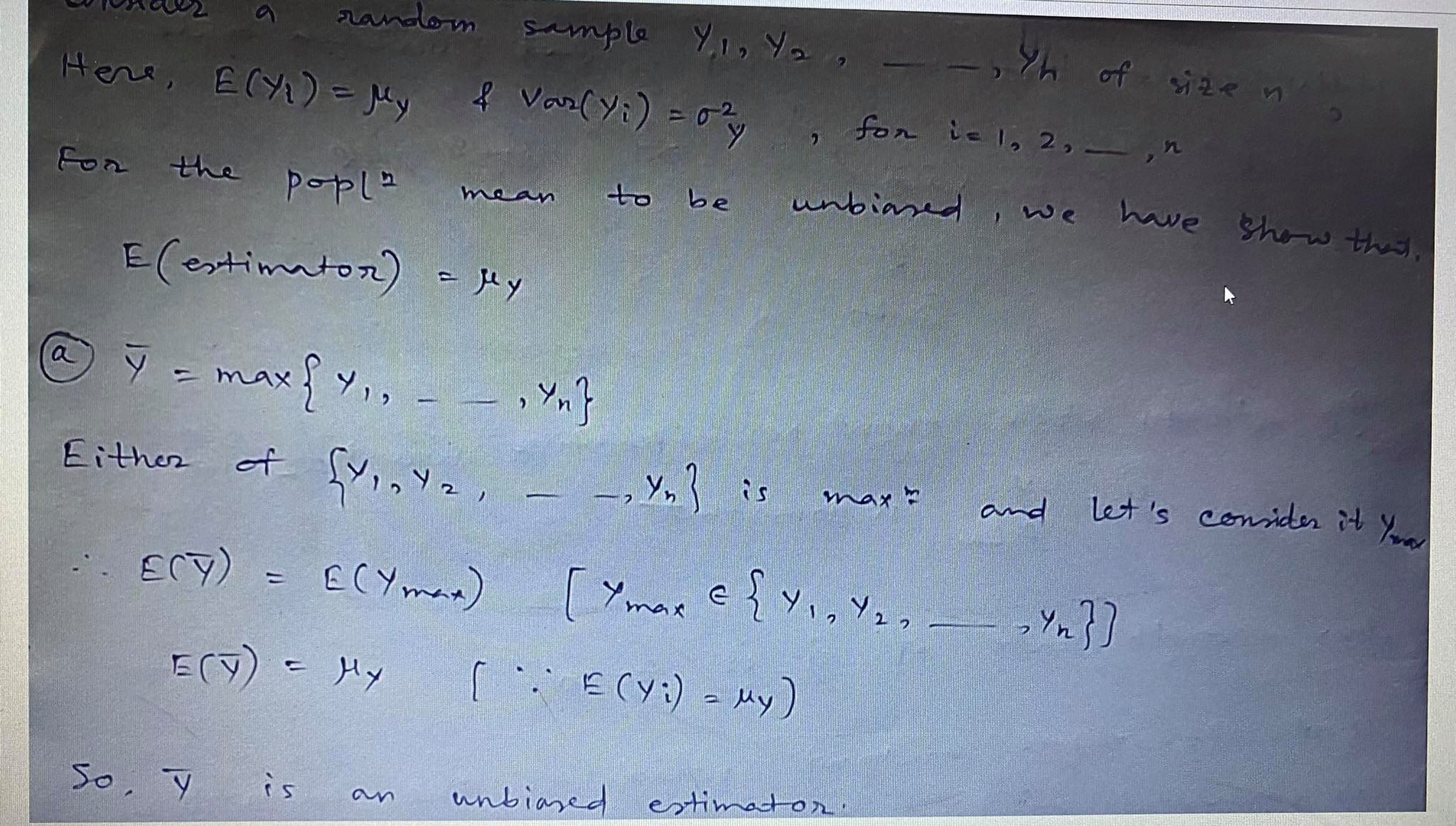
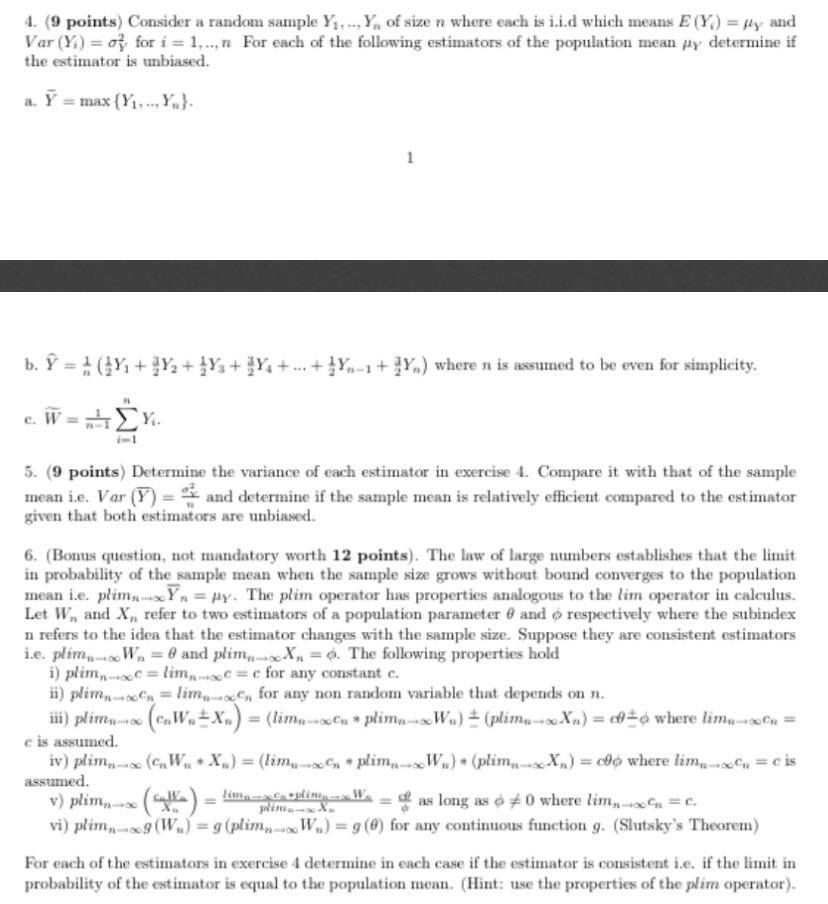
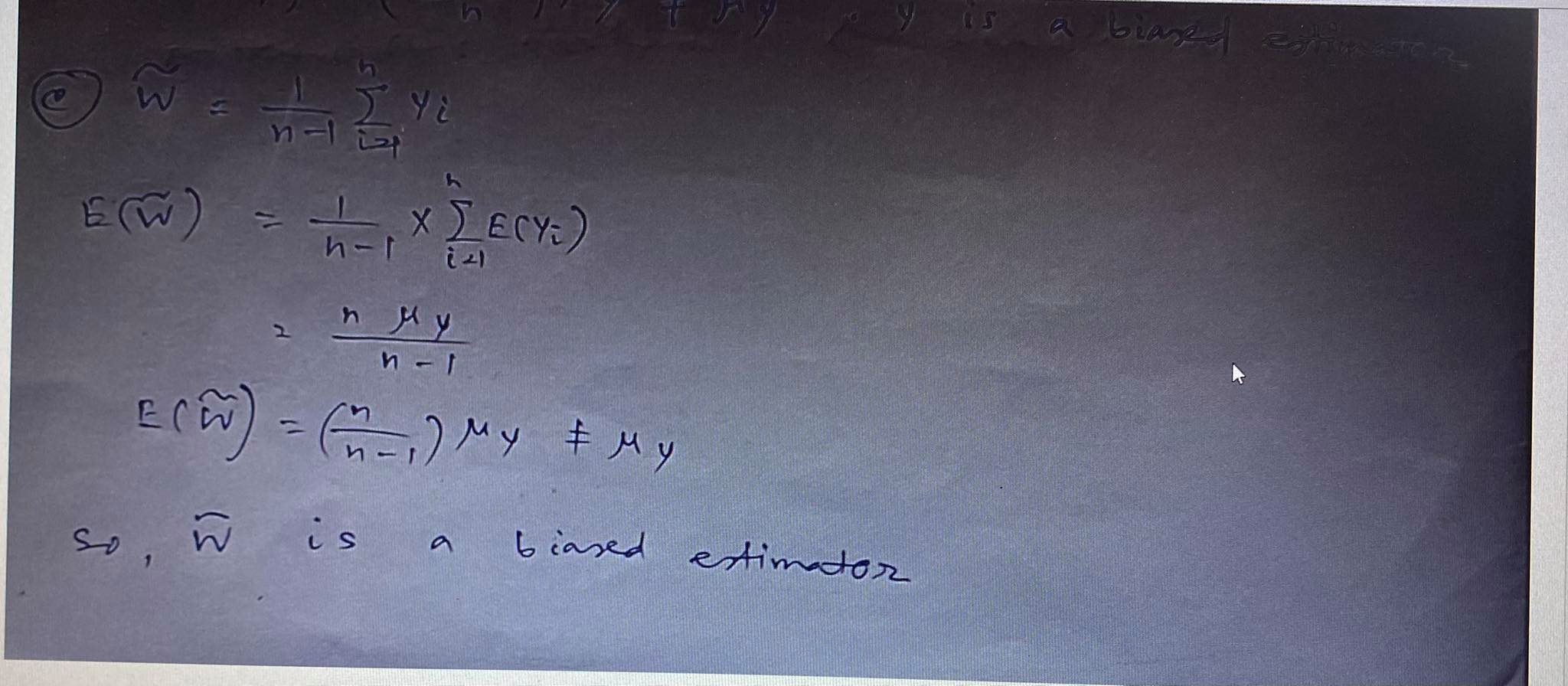
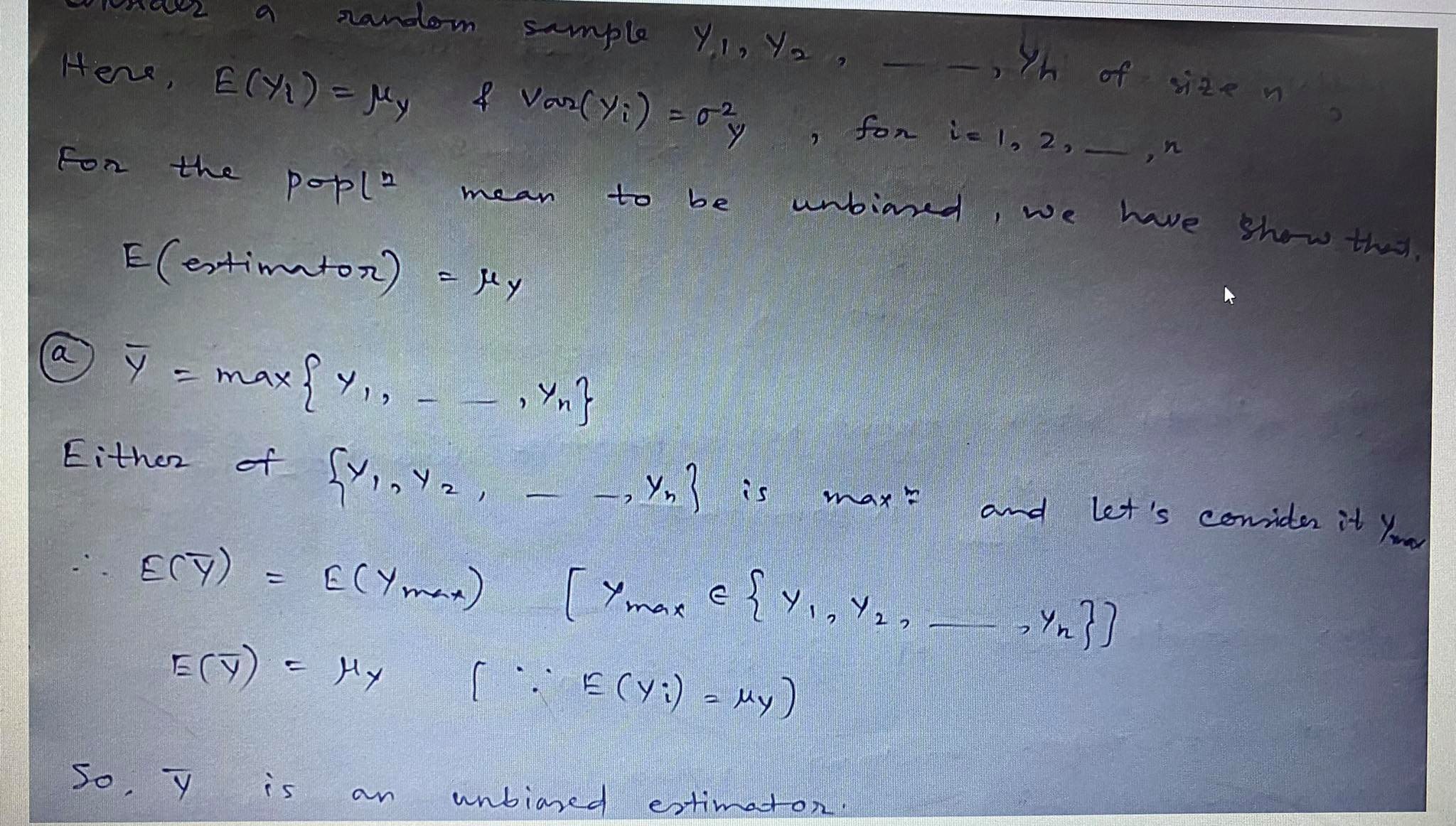
4. (9 points) Consider a random sample Y1. .., Y, of size n where each is i.i.d which means E (Y) = My and Var (Yi) = of for i = 1,.., n For each of the following estimators of the population mean py determine if the estimator is unbiased. a. Y = max {Y1, .., Y.). b. Y = 1 ( Y,+ Y,+ ;Ya+ ;Y.+ ...+ ;Ym-1 + ;Ym) where n is assumed to be even for simplicity. c. W= LEY 5. (9 points) Determine the variance of each estimator in exercise 4. Compare it with that of the sample mean i.e. Var (Y) = + and determine if the sample mean is relatively efficient compared to the estimator given that both estimators are unbiased. 6. (Bonus question, not mandatory worth 12 points). The law of large numbers establishes that the limit in probability of the sample mean when the sample size grows without bound converges to the population mean i.e. plim,-In = py. The plim operator has properties analogous to the lim operator in calculus. Let W,, and X,, refer to two estimators of a population parameter 0 and o respectively where the subindex n refers to the idea that the estimator changes with the sample size. Suppose they are consistent estimators i.e. plim, -.W. = 0 and plim,-.. X,, = 6. The following properties hold i) plim, c = lim, .. =c for any constant c. ii) plim, -. = lim. ...Ca for any non random variable that depends on n. iii) plim... ( cnWn = X. ) = (limn-xen * plimn-xW.) = (plime-.x.Xn) = of= where lim.-.acn = c is assumed. iv) plim, ... (c.W. * X.) = (lim.-.(, * plim,-.xW.)* (plim, ... X,.) = coo where lim, -...C. = c is assumed. v) plim. . = Jimmy cacoding. We = of as long as of # 0 where lim,...n = c. vi) plim, .x9 (W.) = g(plim, .W..) = g (0) for any continuous function g. (Slutsky's Theorem) For each of the estimators in exercise 4 determine in each case if the estimator is consistent i.e. if the limit in probability of the estimator is equal to the population mean. (Hint: use the properties of the plim operator).\fa random sample 7 1,42, -- 1/h of size n Here , E ( yi ) = My 4 var (yi ) = 02 , for is l, 2 , - , n For the popl? mean to be unbiased, we have show thes. K E ( estimator ) - My a y = maxfy , , _, yn} Either of Ly, ,Yz, _-, ym) is max? and let's consider it you . ' . Ery ) = E (Ymax ) [ 7 max ( { Y 1 , Y 2 , - , yn] ] E ( y ) = My [ .. E ( y : ) - My ) So y is an unbiased estimator
Step by Step Solution
There are 3 Steps involved in it

Get step-by-step solutions from verified subject matter experts
 Study Help