







Question: 4. (a) A botanist is working on classifying trees as deciduous (lose their leaves in winter) or not. Describe in detail the process of constructing
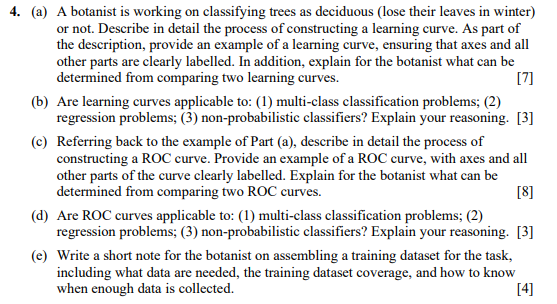
4. (a) A botanist is working on classifying trees as deciduous (lose their leaves in winter) or not. Describe in detail the process of constructing a learning curve. As part of the description, provide an example of a learning curve, ensuring that axes and all other parts are clearly labelled. In addition, explain for the botanist what can be determined from comparing two learning curves. [7] (6) Are learning curves applicable to: (1) multi-class classification problems; (2) regression problems; (3) non-probabilistic classifiers? Explain your reasoning. [3] (c) Referring back to the example of Part (a), describe in detail the process of constructing a ROC curve. Provide an example of a ROC curve, with axes and all other parts of the curve clearly labelled. Explain for the botanist what can be determined from comparing two ROC curves. [8] (d) Are ROC curves applicable to: (1) multi-class classification problems; (2) regression problems; (3) non-probabilistic classifiers? Explain your reasoning. [3] (e) Write a short note for the botanist on assembling a training dataset for the task, including what data are needed, the training dataset coverage, and how to know when enough data is collected. [4] 4. (a) A botanist is working on classifying trees as deciduous (lose their leaves in winter) or not. Describe in detail the process of constructing a learning curve. As part of the description, provide an example of a learning curve, ensuring that axes and all other parts are clearly labelled. In addition, explain for the botanist what can be determined from comparing two learning curves. [7] (6) Are learning curves applicable to: (1) multi-class classification problems; (2) regression problems; (3) non-probabilistic classifiers? Explain your reasoning. [3] (c) Referring back to the example of Part (a), describe in detail the process of constructing a ROC curve. Provide an example of a ROC curve, with axes and all other parts of the curve clearly labelled. Explain for the botanist what can be determined from comparing two ROC curves. [8] (d) Are ROC curves applicable to: (1) multi-class classification problems; (2) regression problems; (3) non-probabilistic classifiers? Explain your reasoning. [3] (e) Write a short note for the botanist on assembling a training dataset for the task, including what data are needed, the training dataset coverage, and how to know when enough data is collected. [4]
Step by Step Solution
There are 3 Steps involved in it

Get step-by-step solutions from verified subject matter experts
 Study Help