







Question: 4 . ( a ) A separately excited DC motor with motor constant of ( 0 . 2 mathrm { ~V } /
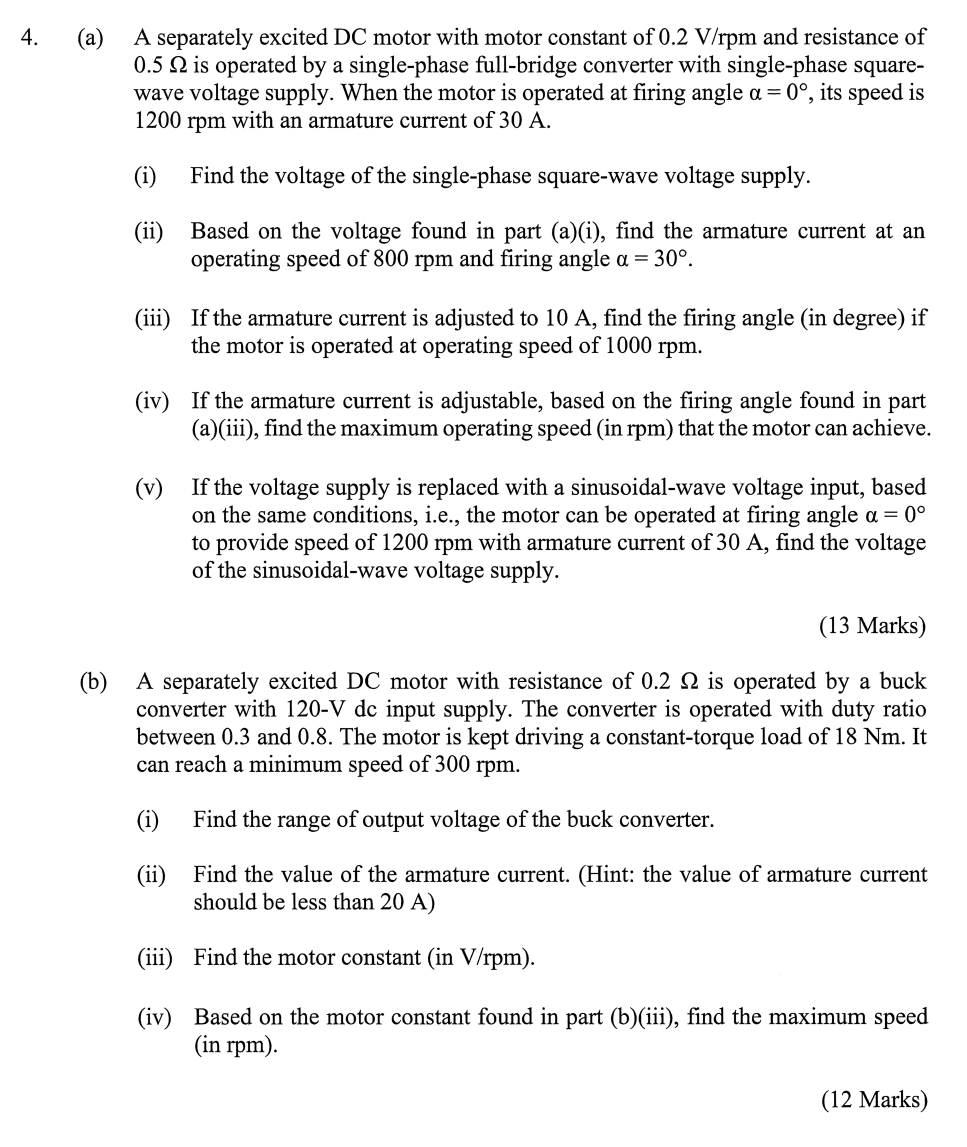
a A separately excited DC motor with motor constant of mathrm~Vmathrmrpm and resistance of Omega is operated by a singlephase fullbridge converter with singlephase squarewave voltage supply. When the motor is operated at firing angle alphacirc its speed is rpm with an armature current of A
i Find the voltage of the singlephase squarewave voltage supply.
ii Based on the voltage found in part ai find the armature current at an operating speed of rpm and firing angle alphacirc
iii If the armature current is adjusted to A find the firing angle in degree if the motor is operated at operating speed of rpm
iv If the armature current is adjustable, based on the firing angle found in part aiii find the maximum operating speed in rpm that the motor can achieve.
v If the voltage supply is replaced with a sinusoidalwave voltage input, based on the same conditions, ie the motor can be operated at firing angle alphacirc to provide speed of rpm with armature current of A find the voltage of the sinusoidalwave voltage supply.
Marks
b A separately excited DC motor with resistance of Omega is operated by a buck converter with mathrmV dc input supply. The converter is operated with duty ratio between and The motor is kept driving a constanttorque load of Nm It can reach a minimum speed of rpm
i Find the range of output voltage of the buck converter.
ii Find the value of the armature current. Hint: the value of armature current should be less than A
iii Find the motor constant in Vrpm
iv Based on the motor constant found in part biii find the maximum speed in rpm
Step by Step Solution
There are 3 Steps involved in it
1 Expert Approved Answer
Step: 1 Unlock

Question Has Been Solved by an Expert!
Get step-by-step solutions from verified subject matter experts
Step: 2 Unlock
Step: 3 Unlock
 Study Help