



Question: 4. A. B.5. A. B. ACTIVITY 13.1 Demonstrating Isotonic and Isometric Contractions A Isotonic Muscle Contractions: Concentric and Eccentric Nearly all muscular activities (e.g., lifting,
4. A. B.5. A. B.
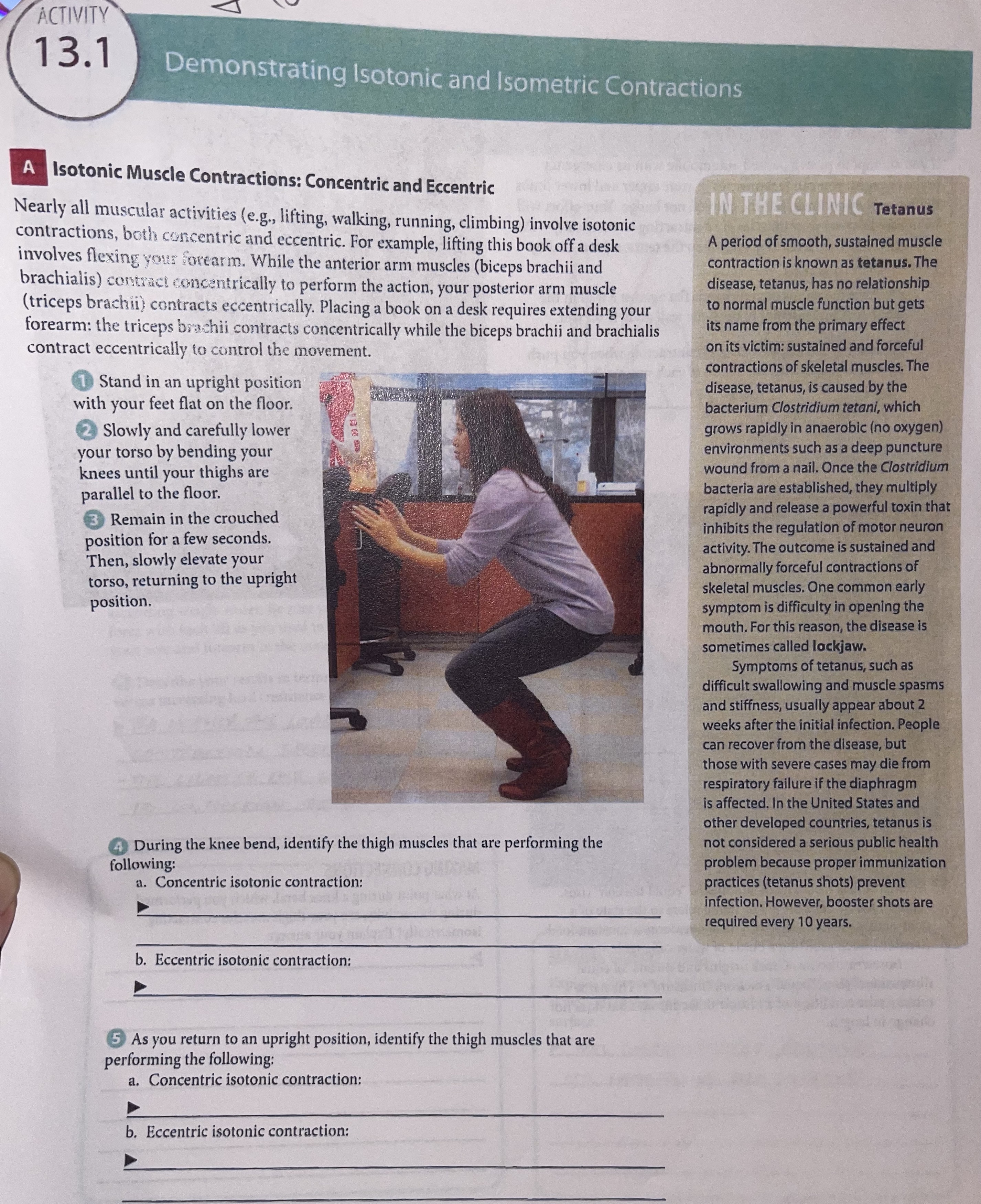
ACTIVITY 13.1 Demonstrating Isotonic and Isometric Contractions A Isotonic Muscle Contractions: Concentric and Eccentric Nearly all muscular activities (e.g., lifting, walking, running, climbing) involve isotonic IN THE CLINIC Tetanus contractions, both concentric and eccentric. For example, lifting this book off a desk A period of smooth, sustained muscle involves flexing your forearm. While the anterior arm muscles (biceps brachii and contraction is known as tetanus. The brachialis) contract concentrically to perform the action, your posterior arm muscle disease, tetanus, has no relationship (triceps brachii) contracts eccentrically. Placing a book on a desk requires extending your to normal muscle function but gets forearm: the triceps brachii contracts concentrically while the biceps brachii and brachialis its name from the primary effect contract eccentrically to control the movement. on its victim: sustained and forceful 1 Stand in an upright position contractions of skeletal muscles. The disease, tetanus, is caused by the with your feet flat on the floor. bacterium Clostridium tetani, which 2 Slowly and carefully lower grows rapidly in anaerobic (no oxygen) your torso by bending your environments such as a deep puncture knees until your thighs are wound from a nail. Once the Clostridium parallel to the floor. bacteria are established, they multiply 3 Remain in the crouched rapidly and release a powerful toxin that position for a few seconds. inhibits the regulation of motor neuron Then, slowly elevate your activity. The outcome is sustained and torso, returning to the upright abnormally forceful contractions of skeletal muscles. One common early position. symptom is difficulty in opening the mouth. For this reason, the disease is sometimes called lockjaw. Symptoms of tetanus, such as difficult swallowing and muscle spasms and stiffness, usually appear about 2 weeks after the initial infection. People can recover from the disease, but those with severe cases may die from respiratory failure if the diaphragm is affected. In the United States and other developed countries, tetanus is 4 During the knee bend, identify the thigh muscles that are performing the not considered a serious public health following: problem because proper immunization a. Concentric isotonic contraction: practices (tetanus shots) prevent infection. However, booster shots are required every 10 years. b. Eccentric isotonic contraction: 5 As you return to an upright position, identify the thigh muscles that are performing the following: a. Concentric isotonic contraction: b. Eccentric isotonic contraction
Step by Step Solution
There are 3 Steps involved in it

Get step-by-step solutions from verified subject matter experts