







Question: 4.) A particular system is modeled by ??????+?????+????=??(??) with ??(0)=??0 and ???(0)=??0 Where ??(??) represents the displacement of mass from equilibrium, ??(??) is an applied
4.) A particular system is modeled by
??????+?????+????=??(??) with ??(0)=??0 and ???(0)=??0
Where ??(??) represents the displacement of mass from equilibrium, ??(??) is an applied force and ??0 and ??0 are initial position and initial velocity of the mass.
a.) If the measured response of the unforced system with ??=5 kg is ????(??)=2?????cos????3?1.0472?
i.) What are the numerical values for the damping co-efficient ?? and spring constant ?? for the system?
ii.) What are the units of ?? and ??? Assume that time is measured in seconds and that position is measured in meters.
b.) What initial conditions were required to give the measured response in (a)? In other words, what are the values of ??0 and ??0?
c.) Estimate how long you would have to wait for the transient solution ???? to decay away to less than 1% of its original value.
d.) If a forcing function, ??(??)=10sin(4??), is applied, what is the frequency of the steady periodic solution? Explain.
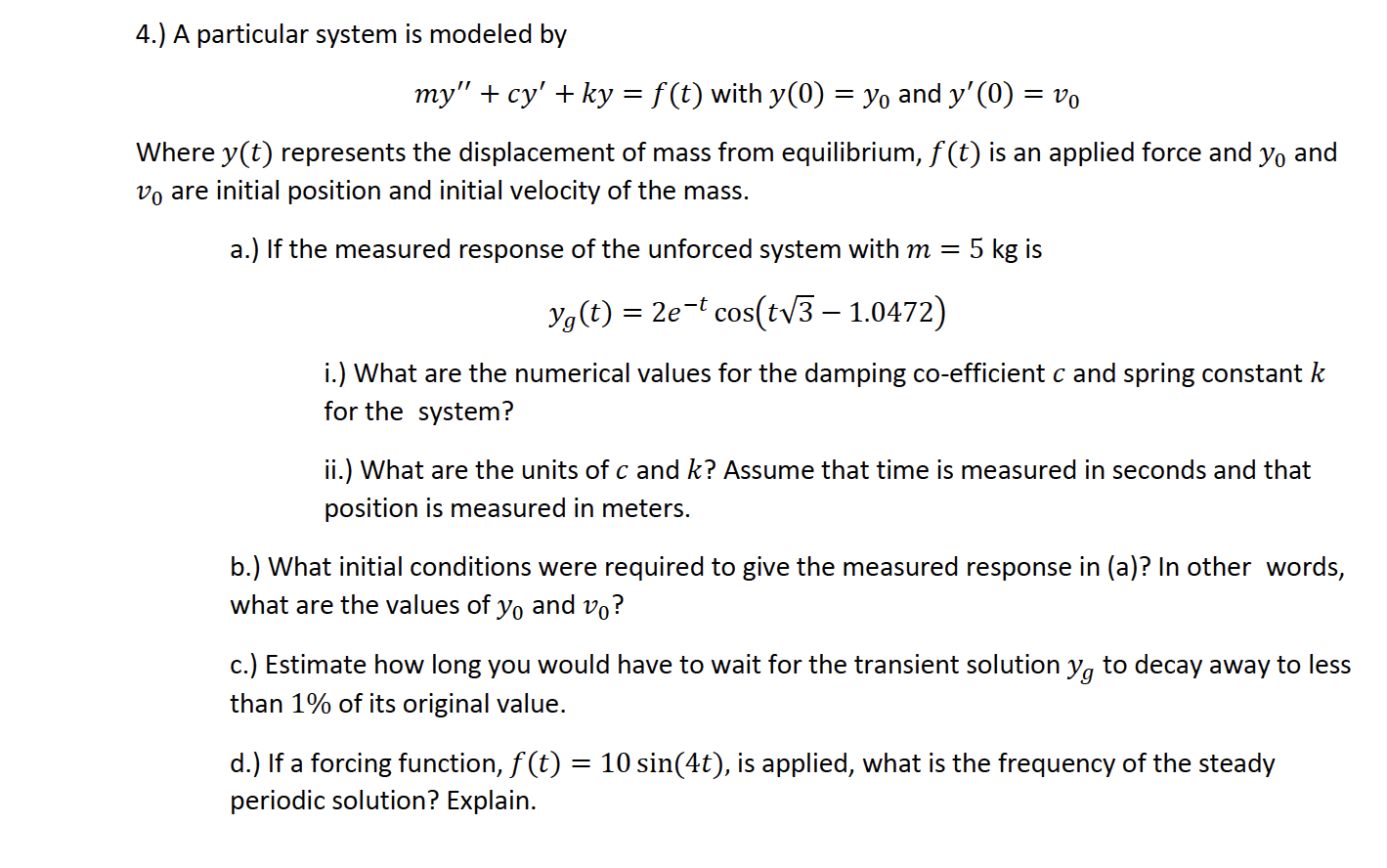
4.) A particular system is modeled by my\" + cy' + ky = f(t) with 31(0) = yo and y'(0) = 120 Where y(t) represents the displacement of mass from equilibrium, f(t) is an applied force and yo and 120 are initial position and initial velocity of the mass. a.) If the measured response of the unforced system with m = 5 kg is yga) = 2et cos(t\\/ 1.0472) i.) What are the numerical values for the damping co-efficient c and spring constant k for the system? ii.) What are the units of c and k? Assume that time is measured in seconds and that position is measured in meters. b.) What initial conditions were required to give the measured response in (a)? In other words, what are the values of yo and 120? c.) Estimate how long you would have to wait for the transient solution 379 to decay away to less than 1% of its original value. d.) If a forcing function, f(t) = 10 sin(4t), is applied, what is the frequency of the steady periodic solution? Explain
Step by Step Solution
There are 3 Steps involved in it

Get step-by-step solutions from verified subject matter experts
 Study Help