







Question: 4. A process can leave the Running state when a) It adds zero to the contents of the general register R1 b) I/O Operation on
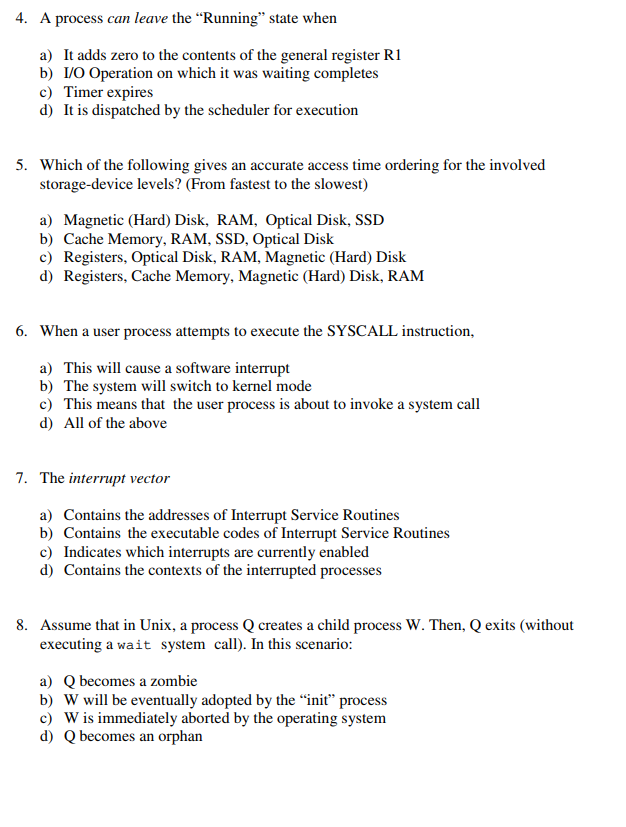
4. A process can leave the "Running" state when a) It adds zero to the contents of the general register R1 b) I/O Operation on which it was waiting completes c) Timer expires d) It is dispatched by the scheduler for execution 5. Which of the following gives an accurate access time ordering for the involved storage-device levels? (From fastest to the slowest) a) Magnetic (Hard) Disk, RAM, Optical Disk, SSD b) Cache Memory, RAM, SSD, Optical Disk c) Registers, Optical Disk, RAM, Magnetic (Hard) Disk d) Registers, Cache Memory, Magnetic (Hard) Disk, RAM 6. When a user process attempts to execute the SYSCALL instruction, a) This will cause a software interrupt b) The system will switch to kernel mode c) This means that the user process is about to invoke a system call d) All of the above 7. The interrupt vector a) Contains the addresses of Interrupt Service Routines b) Contains the executable codes of Interrupt Service Routines c) Indicates which interrupts are currently enabled d) Contains the contexts of the interrupted processes 8. Assume that in Unix, a process Q creates a child process W. Then, Q exits (without executing a wait system call). In this scenario a) Q becomes a zombie b) W will be eventually adopted by the "ini" process c) W is immediately aborted by the operating system d) Q becomes an orphan
Step by Step Solution
There are 3 Steps involved in it

Get step-by-step solutions from verified subject matter experts
 Study Help