







Question: 4. A proposal for a Smart car seat operates by detecting the weight of the passenger and comparing against various thresholds. If the weight
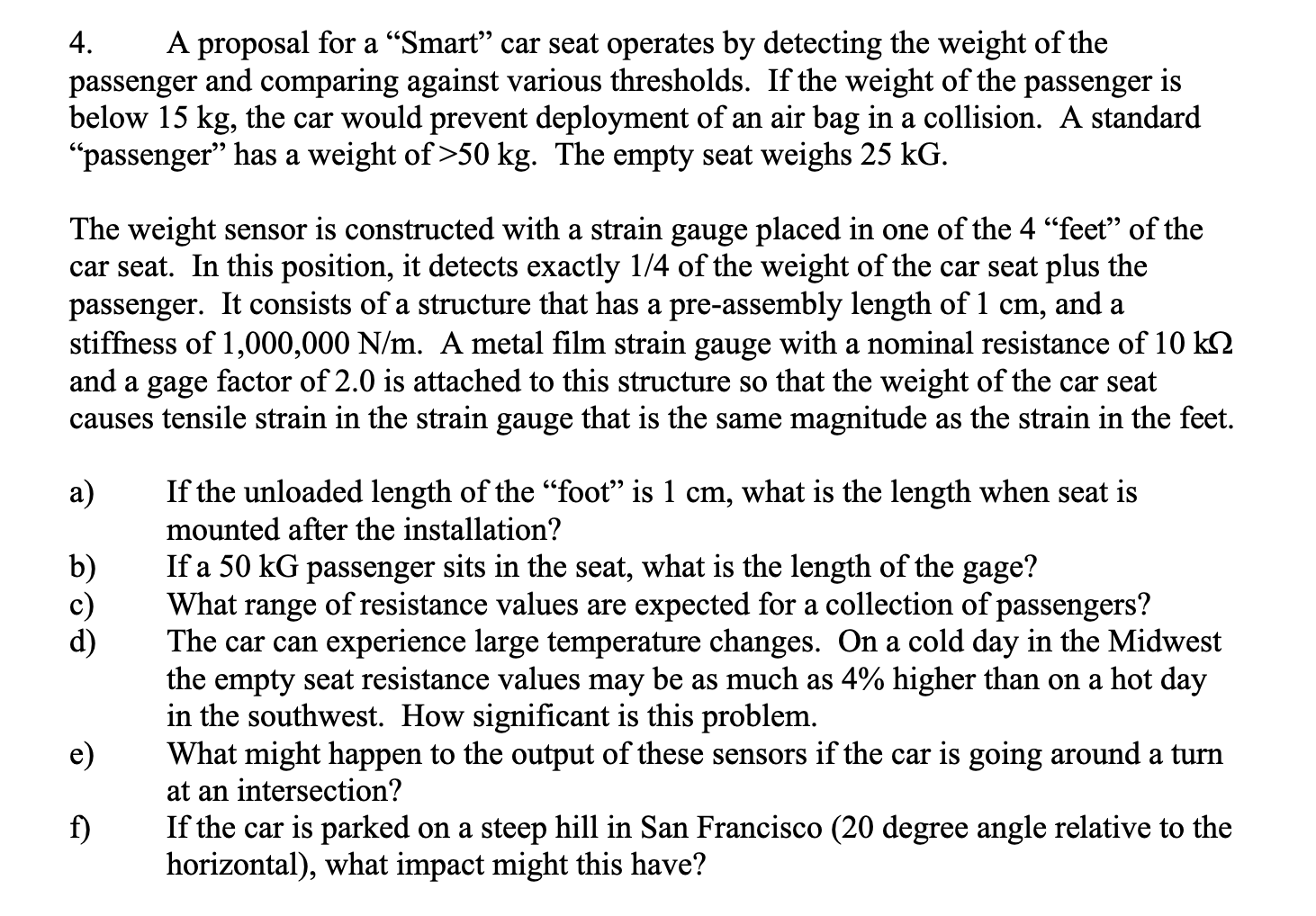
4. A proposal for a Smart car seat operates by detecting the weight of the passenger and comparing against various thresholds. If the weight of the passenger is below 15 kg, the car would prevent deployment of an air bag in a collision. A standard "passenger" has a weight of >50 kg. The empty seat weighs 25 kG. The weight sensor is constructed with a strain gauge placed in one of the 4 feet of the car seat. In this position, it detects exactly 1/4 of the weight of the car seat plus the passenger. It consists of a structure that has a pre-assembly length of 1 cm, and a stiffness of 1,000,000 N/m. A metal film strain gauge with a nominal resistance of 10 k and a gage factor of 2.0 is attached to this structure so that the weight of the car seat causes tensile strain in the strain gauge that is the same magnitude as the strain in the feet. a) If the unloaded length of the "foot" is 1 cm, what is the length when seat is mounted after the installation? 308 f) If a 50 kG passenger sits in the seat, what is the length of the gage? What range of resistance values are expected for a collection of passengers? The car can experience large temperature changes. On a cold day in the Midwest the empty seat resistance values may be as much as 4% higher than on a hot day in the southwest. How significant is this problem. What might happen to the output of these sensors if the car is going around a turn at an intersection? If the car is parked on a steep hill in San Francisco (20 degree angle relative to the horizontal), what impact might this have?
Step by Step Solution
There are 3 Steps involved in it

Get step-by-step solutions from verified subject matter experts
 Study Help