







Question: 4. A sequence of numbers is a function from the natural numbers to the reals, ie. f : N ? R. IIowever, often rather than
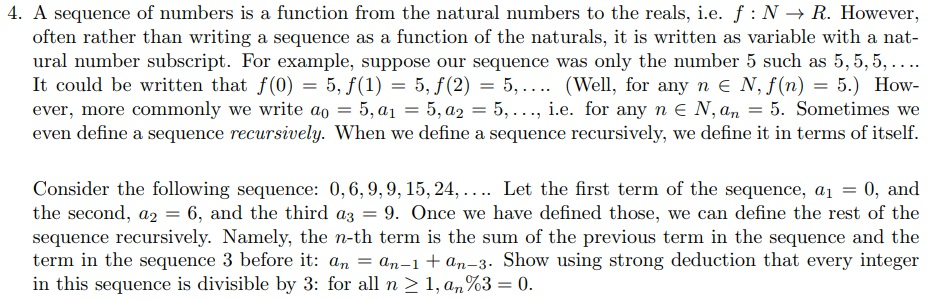
4. A sequence of numbers is a function from the natural numbers to the reals, ie. f : N ? R. IIowever, often rather than writing a sequence as a function of the naturals, it is written as variable with a nat- ural number subscript. For example, suppose our sequence was only the number 5 such as 5,5,5, It could be written that f(0) 5,f(1) 5,f(2) , (Well, for any n E N,f(n) = 5.) How- ever, more commonly we write ao = 5, al = 5, ?? = 5, , i.e. for any n E N, an-5. Sometimes we even define a sequence recursively. When we define a sequence recursively, we define it in terms of itself. Consider the following sequence: 0,6,9,9, 15,24, Let the first term of the sequence, a 0, and the second, a2 6, and the third as -9. Once we have defined those, we can define the rest of the sequence recursively. Namely, the n-th term is the sum of the previous term in the sequence and the term in the sequence 3 before it: an - an-1 + an-3. Show using strong deduction that every integer in this sequence is divisible by 3: for all n > 1, an%3--0
Step by Step Solution
There are 3 Steps involved in it

Get step-by-step solutions from verified subject matter experts
 Study Help