





Question: 4. ACTIVE (I ) and Reactive Power sensitivity dialysis. Keeping all other variables constant, change the active power P of load on Bus 3 &
4. ACTIVE (I ) and Reactive Power sensitivity
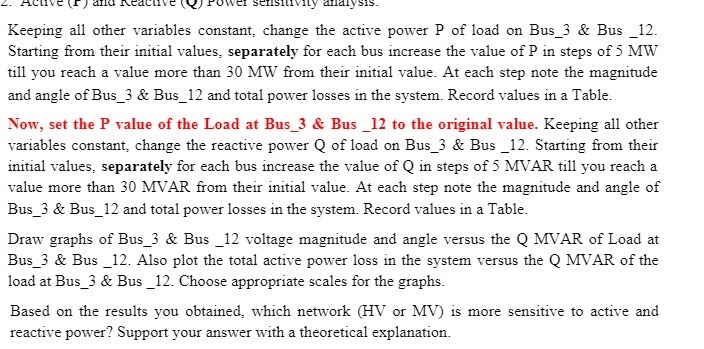
4. ACTIVE (I ) and Reactive Power sensitivity dialysis. Keeping all other variables constant, change the active power P of load on Bus 3 & Bus _12. Starting from their initial values, separately for each bus increase the value of P in steps of 5 MW till you reach a value more than 30 MW from their initial value. At each step note the magnitude and angle of Bus_3 & Bus_12 and total power losses in the system. Record values in a Table. Now, set the P value of the Load at Bus _3 & Bus _12 to the original value. Keeping all other variables constant, change the reactive power Q of load on Bus_3 & Bus _12. Starting from their initial values, separately for each bus increase the value of Q in steps of 5 MVAR till you reach a value more than 30 MVAR from their initial value. At each step note the magnitude and angle of Bus_3 & Bus_12 and total power losses in the system. Record values in a Table. Draw graphs of Bus_3 & Bus _12 voltage magnitude and angle versus the Q MVAR of Load at Bus_3 & Bus _12. Also plot the total active power loss in the system versus the Q MVAR of the load at Bus_3 & Bus _12. Choose appropriate scales for the graphs. Based on the results you obtained, which network (HV or MV) is more sensitive to active and reactive power? Support your answer with a theoretical explanation

Step by Step Solution

There are 3 Steps involved in it

1 Expert Approved Answer
Step: 1 Unlock blur-text-image

Question Has Been Solved by an Expert!

Get step-by-step solutions from verified subject matter experts

Step: 2 Unlock
Step: 3 Unlock

Students Have Also Explored These Related Mathematics Questions!