







Question: 4. Answer (a), (b), (c) and (d). (a) Briefly, what two key methods are available for determining the rate law of a reaction? 17 marks]
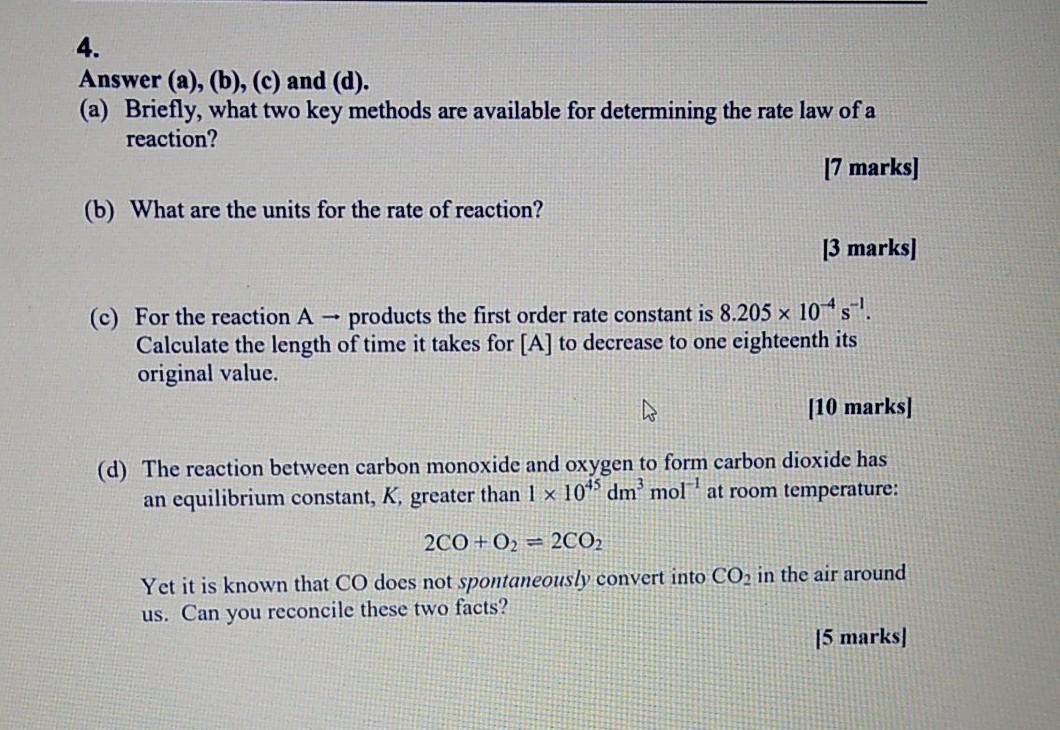
4. Answer (a), (b), (c) and (d). (a) Briefly, what two key methods are available for determining the rate law of a reaction? 17 marks] (b) What are the units for the rate of reaction? [3 marks] (c) For the reaction A -- products the first order rate constant is 8.205 x 1045-'. Calculate the length of time it takes for (A) to decrease to one eighteenth its original value. [10 marks] (d) The reaction between carbon monoxide and oxygen to form carbon dioxide has an equilibrium constant, K, greater than 1 x 10⁴ dm' mol' at room temperature: 2CO + O2 = 2CO2 Yet it is known that CO does not spontaneously convert into CO2 in the air around us. Can you reconcile these two facts? 15 marks)
Step by Step Solution
There are 3 Steps involved in it

Get step-by-step solutions from verified subject matter experts
 Study Help