





Question: 4. As discussed in class, the engineering discipline, Industrial Engineering (IE) A. came to existence after Industrial Revolution, much earlier than Mechanical Engineering B. came
4. As discussed in class, the engineering

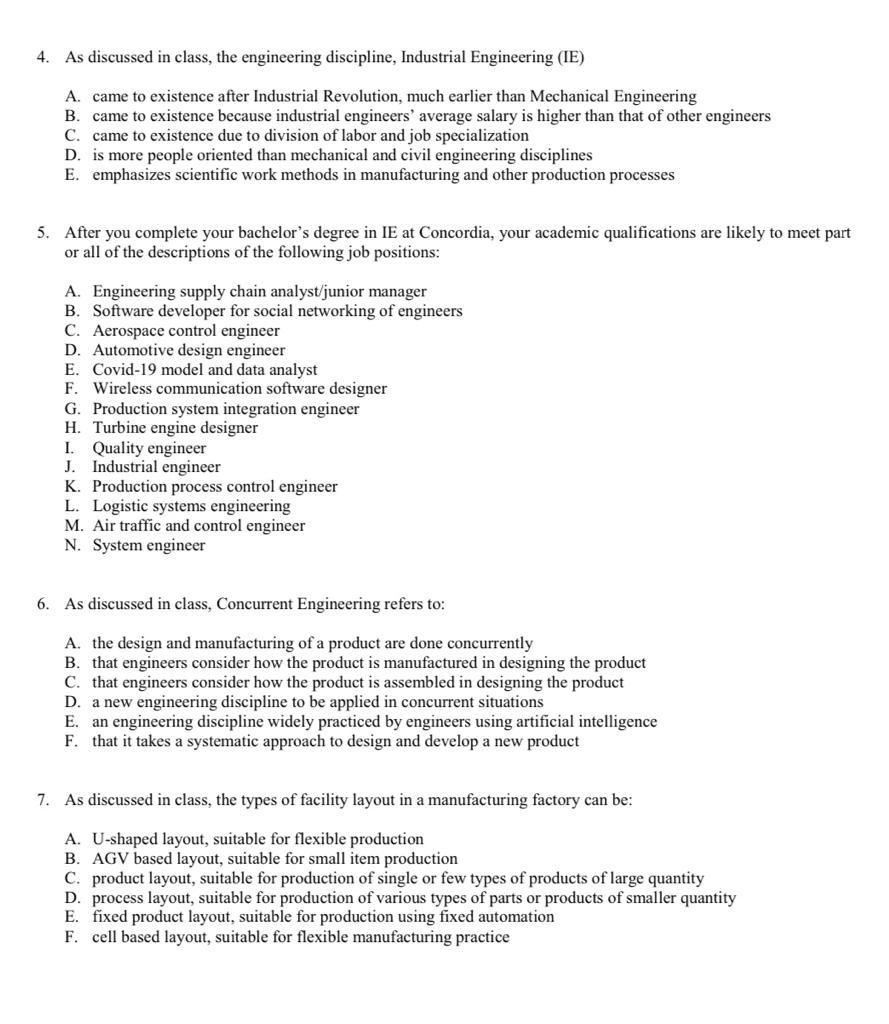
4. As discussed in class, the engineering discipline, Industrial Engineering (IE) A. came to existence after Industrial Revolution, much earlier than Mechanical Engineering B. came to existence because industrial engineers' average salary is higher than that of other engineers C. came to existence due to division of labor and job specialization D. is more people oriented than mechanical and civil engineering disciplines E. emphasizes scientific work methods in manufacturing and other production processes 5. After you complete your bachelor's degree in IE at Concordia, your academic qualifications are likely to meet part or all of the descriptions of the following job positions: A. Engineering supply chain analyst/junior manager B. Software developer for social networking of engineers C. Aerospace control engineer D. Automotive design engineer E. Covid-19 model and data analyst F. Wireless communication software designer G. Production system integration engineer H. Turbine engine designer I. Quality engineer J. Industrial engineer K. Production process control engineer L. Logistic systems engineering M. Air traffic and control engineer N. System engineer 6. As discussed in class, Concurrent Engineering refers to: A. the design and manufacturing of a product are done concurrently B. that engineers consider how the product is manufactured in designing the product C. that engineers consider how the product is assembled in designing the product D. a new engineering discipline to be applied in concurrent situations E. an engineering discipline widely practiced by engineers using artificial intelligence F. that it takes a systematic approach to design and develop a new product 7. As discussed in class, the types of facility layout in a manufacturing factory can be: A. U-shaped layout, suitable for flexible production B. AGV based layout, suitable for small item production C. product layout, suitable for production of single or few types of products of large quantity D. process layout, suitable for production of various types of parts or products of smaller quantity E. fixed product layout, suitable for production using fixed automation F. cell based layout, suitable for flexible manufacturing practice

Step by Step Solution

There are 3 Steps involved in it

1 Expert Approved Answer
Step: 1 Unlock blur-text-image

Question Has Been Solved by an Expert!

Get step-by-step solutions from verified subject matter experts

Step: 2 Unlock
Step: 3 Unlock

Students Have Also Explored These Related General Management Questions!