







Question: 4. Choosing a basis to make interpolation easy. In this question, we consider the situation where we have discrete-time signals, which we view as vectors
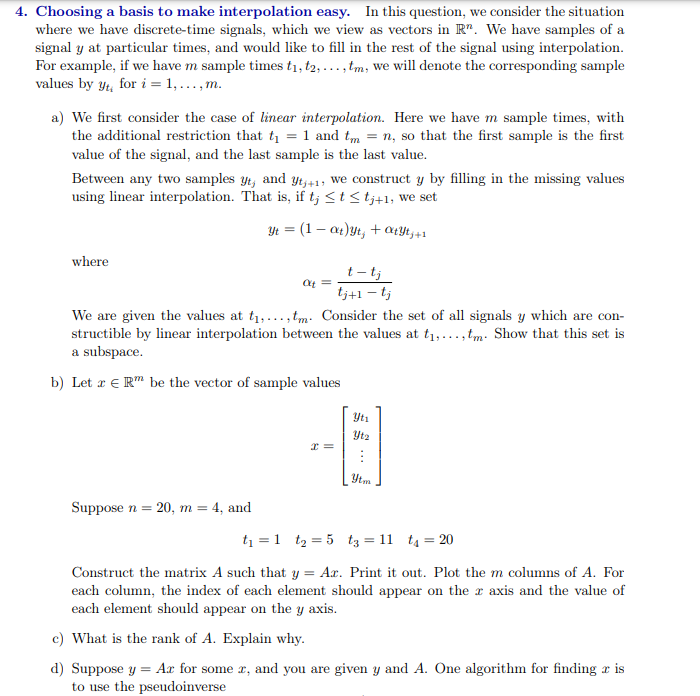
4. Choosing a basis to make interpolation easy. In this question, we consider the situation where we have discrete-time signals, which we view as vectors in R". We have samples of a signal y at particular times, and would like to fill in the rest of the signal using interpolation. For example, if we have m sample times t, t2, ..., tm, we will denote the corresponding sample values by yt, for i = 1, ..., m. a) We first consider the case of linear interpolation. Here we have m sample times, with the additional restriction that t = 1 and tm = n, so that the first sample is the first value of the signal, and the last sample is the last value. Between any two samples yt, and yt;+1, we construct y by filling in the missing values using linear interpolation. That is, if t; St Stj+1, we set yt = (1 - 0)y, +tYt;+1 where t-ti tj+1 - tj We are given the values at t1, ..., tm. Consider the set of all signals y which are con- structible by linear interpolation between the values at t,..., tm. Show that this set is a subspace. b) Let x ER" be the vector of sample values at = yti Yt2 2= Ytm Suppose n = 20, m = 4, and t1 =1 t2 = 5 t; = 11 ta = 20 Construct the matrix A such that y = Ar. Print it out. Plot the m columns of A. For each column, the index of each element should appear on the x axis and the value of each element should appear on the y axis. c) What is the rank of A. Explain why. d) Suppose y = Ar for some r, and you are given y and A. One algorithm for finding r is to use the pseudoinverse 4. Choosing a basis to make interpolation easy. In this question, we consider the situation where we have discrete-time signals, which we view as vectors in R". We have samples of a signal y at particular times, and would like to fill in the rest of the signal using interpolation. For example, if we have m sample times t, t2, ..., tm, we will denote the corresponding sample values by yt, for i = 1, ..., m. a) We first consider the case of linear interpolation. Here we have m sample times, with the additional restriction that t = 1 and tm = n, so that the first sample is the first value of the signal, and the last sample is the last value. Between any two samples yt, and yt;+1, we construct y by filling in the missing values using linear interpolation. That is, if t; St Stj+1, we set yt = (1 - 0)y, +tYt;+1 where t-ti tj+1 - tj We are given the values at t1, ..., tm. Consider the set of all signals y which are con- structible by linear interpolation between the values at t,..., tm. Show that this set is a subspace. b) Let x ER" be the vector of sample values at = yti Yt2 2= Ytm Suppose n = 20, m = 4, and t1 =1 t2 = 5 t; = 11 ta = 20 Construct the matrix A such that y = Ar. Print it out. Plot the m columns of A. For each column, the index of each element should appear on the x axis and the value of each element should appear on the y axis. c) What is the rank of A. Explain why. d) Suppose y = Ar for some r, and you are given y and A. One algorithm for finding r is to use the pseudoinverse
Step by Step Solution
There are 3 Steps involved in it

Get step-by-step solutions from verified subject matter experts
 Study Help