







Question: 4. Collaborative: We define the Escape Problem as follows. We are given a directed graph G V, E) (picture a network of roads.) A certain
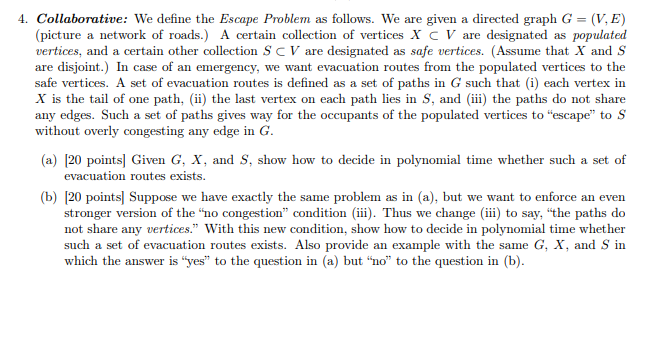
4. Collaborative: We define the Escape Problem as follows. We are given a directed graph G V, E) (picture a network of roads.) A certain collection of vertices X C V are designated as populated vertices, and a certain other collection S c V are designated as safe vertices. (Assume that X and S are disjoint.) In case of an emergency, we want evacuation routes from the populated vertices to the safe vertices. A set of evacuation routes is defined as a set of paths in G such that (i) each vertex in X is the tail of one path, (ii) the last vertex on each path lies in S, and (iii the paths do not share any edges. Such a set of paths gives way for the occupants of the populated vertices to "escape" to S without overly congesting any edge in G (a) [20 pointsl Given G, X, and S, show how to decide in polynomial time whether such a set of evacuation routes exists (b) [20 pointsl Suppose we have exactly the same problem as in (a), but we want to enforce an even stronger version of the "no congestion" condition (iii). Thus we change ii) to say, "the paths do not share any vertices." With this new condition, show how to decide in polynomial time whether such a set of evacuation routes exists. Also provide an example with the same G, X, and S in which the answer is 'yes" to the question in (a) but "no" to the question in (b)
Step by Step Solution
There are 3 Steps involved in it

Get step-by-step solutions from verified subject matter experts
 Study Help