





Question: 4) Consider a 2-period model that we studied in a class. Household receives e, units of consumption goods at period 1 and e2 units of
 4) Consider a 2-period model that we studied in a class.

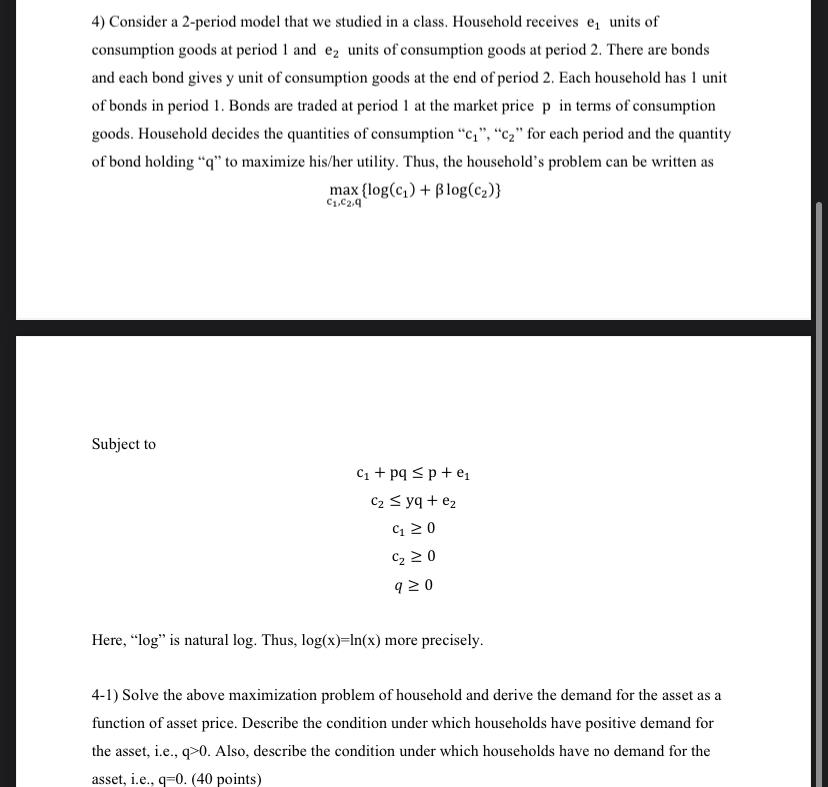
4) Consider a 2-period model that we studied in a class. Household receives e, units of consumption goods at period 1 and e2 units of consumption goods at period 2. There are bonds and each bond gives y unit of consumption goods at the end of period 2. Each household has 1 unit of bonds in period 1. Bonds are traded at period 1 at the market price p in terms of consumption goods. Household decides the quantities of consumption "C", "c2" for each period and the quantity of bond holding q" to maximize his/her utility. Thus, the household's problem can be written as max (log(C1) + Blog(cz)} C1,C2,4 Subject to C1 + pq 0. Also, describe the condition under which households have no demand for the asset, i.e., q=0. (40 points) 4) Consider a 2-period model that we studied in a class. Household receives e, units of consumption goods at period 1 and e2 units of consumption goods at period 2. There are bonds and each bond gives y unit of consumption goods at the end of period 2. Each household has 1 unit of bonds in period 1. Bonds are traded at period 1 at the market price p in terms of consumption goods. Household decides the quantities of consumption "C", "c2" for each period and the quantity of bond holding q" to maximize his/her utility. Thus, the household's problem can be written as max (log(C1) + Blog(cz)} C1,C2,4 Subject to C1 + pq 0. Also, describe the condition under which households have no demand for the asset, i.e., q=0. (40 points)

Step by Step Solution

There are 3 Steps involved in it

1 Expert Approved Answer
Step: 1 Unlock blur-text-image
Question Has Been Solved by an Expert!

Get step-by-step solutions from verified subject matter experts

Step: 2 Unlock
Step: 3 Unlock

Students Have Also Explored These Related Finance Questions!