







Question: 4. Consider a duopoly game in which two firms simultaneously and independently select prices. Assume that prices cannot be negative. Let p, denote the price

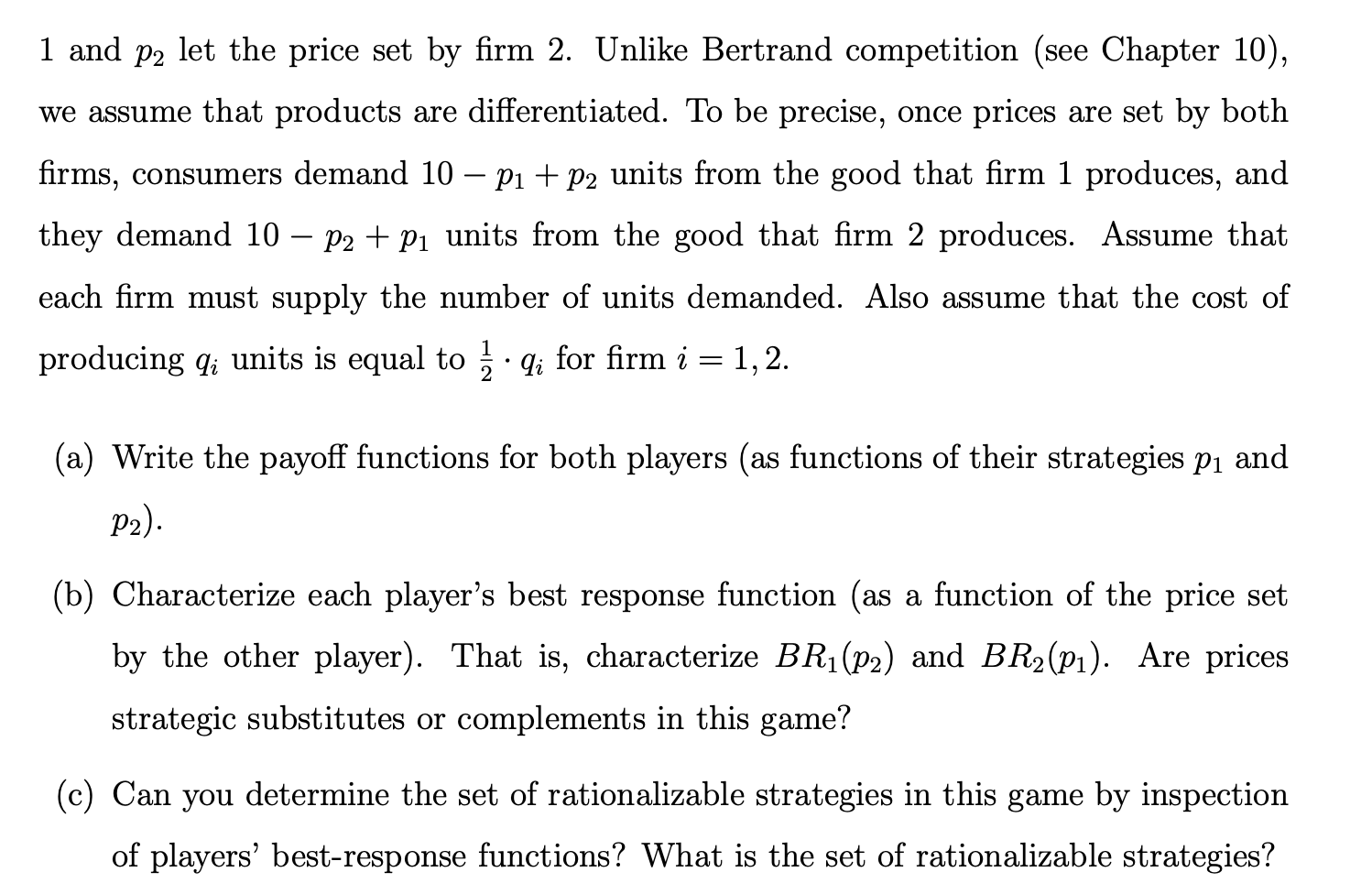
4. Consider a duopoly game in which two firms simultaneously and independently select prices. Assume that prices cannot be negative. Let p, denote the price set by firm1 and p2 let the price set by rm 2. Unlike Bertrand competition (see Chapter 10), we assume that products are differentiated. To be precise, once prices are set by both rms, consumers demand 10 191 + 292 units from the good that rm 1 produces, and they demand 10 192 + 191 units from the good that rm 2 produces. Assume that each rm must supply the number of units demanded. Also assume that the cost of producing q,- units is equal to % - q,- for rm 2' = 1, 2. (a) Write the payoff functions for both players (as functions of their strategies p1 and P2)- (b) Characterize each player's best response function (as a function of the price set by the other player). That is, characterize BR1(p2) and BR2(p1). Are prices strategic substitutes or complements in this game? (c) Can you determine the set of rationalizable strategies in this game by inspection of players\" bestresponse functions? What is the set of rationalizable strategies
Step by Step Solution
There are 3 Steps involved in it

Get step-by-step solutions from verified subject matter experts
 Study Help