







Question: 4. Consider a numerical example using the Solow growth model. Suppose that F(K,N) = K9 NOS with d = 0.1, s = 0.2, n =
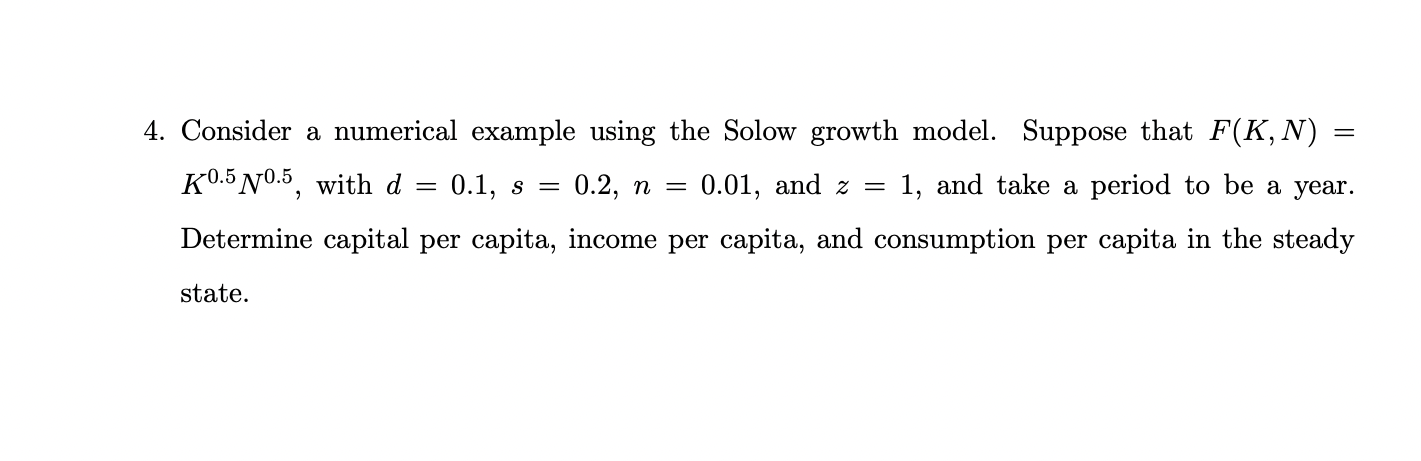
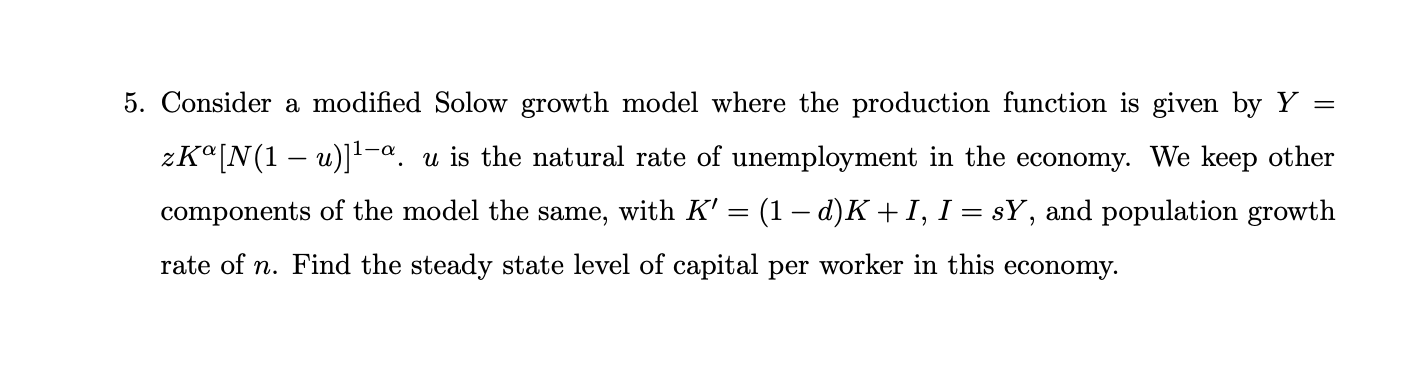
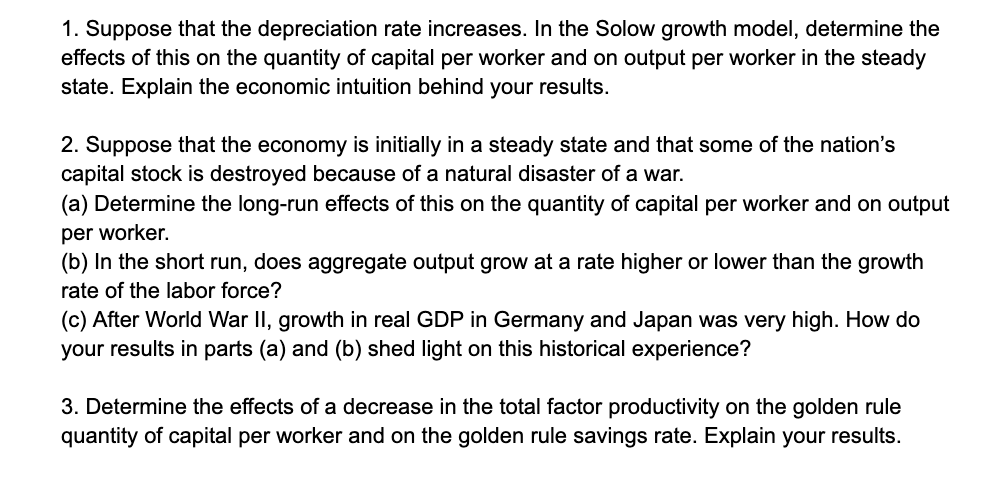
4. Consider a numerical example using the Solow growth model. Suppose that F(K,N) = K9 NOS with d = 0.1, s = 0.2, n = 0.01, and z = 1, and take a period to be a year. Determine capital per capita, income per capita, and consumption per capita in the steady state. 5. Consider a modified Solow growth model where the production function is given by Y = zK%*[N(1 u)]'. u is the natural rate of unemployment in the economy. We keep other components of the model the same, with K' = (1 d)K + I, I = sY, and population growth rate of n. Find the steady state level of capital per worker in this economy. 1. Suppose that the depreciation rate increases. In the Solow growth model, determine the effects of this on the quantity of capital per worker and on output per worker in the steady state. Explain the economic intuition behind your results. 2. Suppose that the economy is initially in a steady state and that some of the nation's capital stock is destroyed because of a natural disaster of a war. (a) Determine the long-run effects of this on the quantity of capital per worker and on output per worker. (b) In the short run, does aggregate output grow at a rate higher or lower than the growth rate of the labor force? (c) After World War Il, growth in real GDP in Germany and Japan was very high. How do your results in parts (a) and (b) shed light on this historical experience? 3. Determine the effects of a decrease in the total factor productivity on the golden rule quantity of capital per worker and on the golden rule savings rate. Explain your results
Step by Step Solution
There are 3 Steps involved in it

Get step-by-step solutions from verified subject matter experts
 Study Help