



Question: 4. Consider a person's decision problem in trying to decide how many children to have. Although she cares about children and would like to have
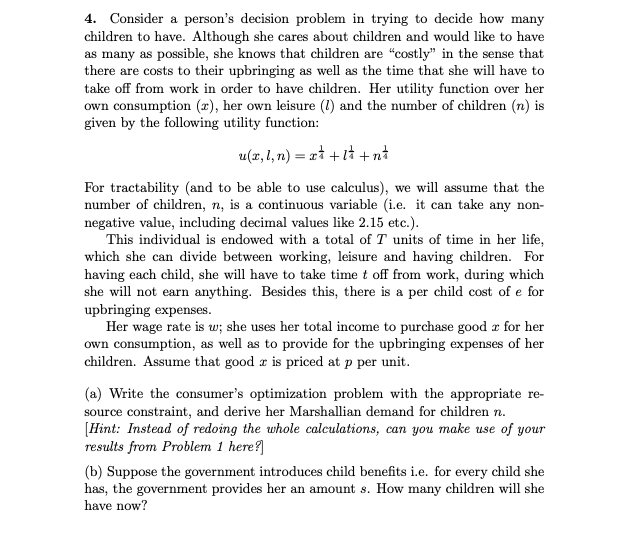
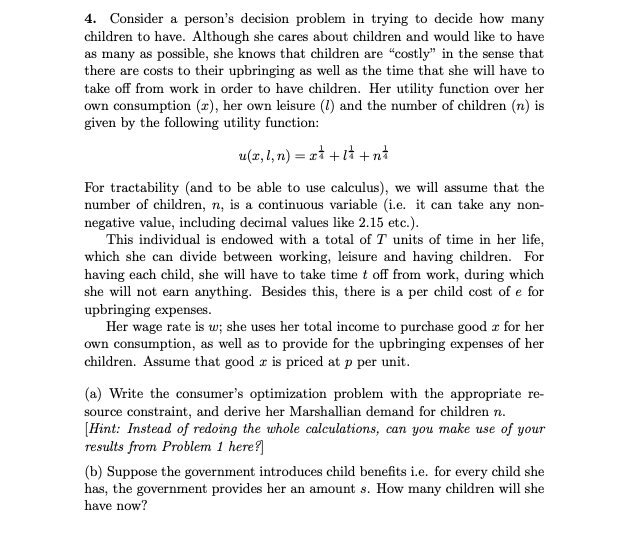
4. Consider a person's decision problem in trying to decide how many children to have. Although she cares about children and would like to have as many as possible, she knows that children are "costly" in the sense that there are costs to their upbringing as well as the time that she will have to take off from work in order to have children. Her utility function over her own consumption (x), her own leisure () and the number of children (n) is given by the following utility function: u(x, l, n)= at +lint For tractability (and to be able to use calculus), we will assume that the number of children, n, is a continuous variable (i.e. it can take any non- negative value, including decimal values like 2.15 etc.). This individual is endowed with a total of T units of time in her life, which she can divide between working, leisure and having children. For having each child, she will have to take time t off from work, during which she will not earn anything. Besides this, there is a per child cost of e for upbringing expenses. Her wage rate is w; she uses her total income to purchase good r for her own consumption, as well as to provide for the upbringing expenses of her children. Assume that good & is priced at p per unit. (a) Write the consumer's optimization problem with the appropriate re- source constraint, and derive her Marshallian demand for children n. Hint: Instead of redoing the whole calculations, can you make use of your results from Problem 1 here?] (b) Suppose the government introduces child benefits i.e. for every child she has, the government provides her an amount s. How many children will she have now
Step by Step Solution
There are 3 Steps involved in it

Get step-by-step solutions from verified subject matter experts