





Question: 4. Consider data from Aseffa et al. (1998) that examines the prevalence of HIV among women visiting health care clinics in northwest Ethiopia. Along with
4. Consider data from Aseffa et al. (1998) that

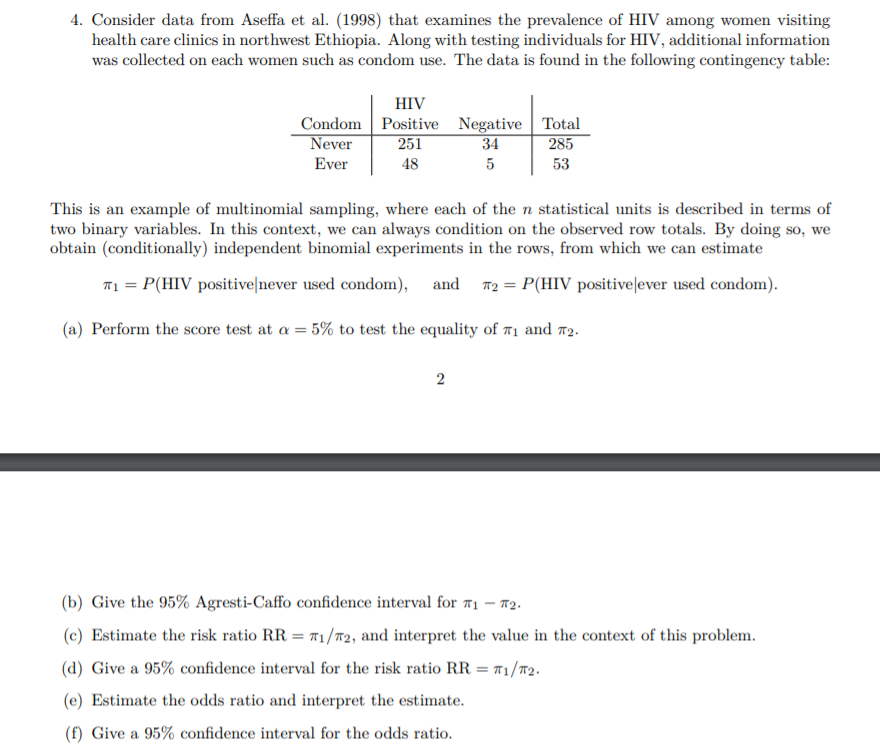
4. Consider data from Aseffa et al. (1998) that examines the prevalence of HIV among women visiting health care clinics in northwest Ethiopia. Along with testing individuals for HIV, additional information was collected on each women such as condom use. The data is found in the following contingency table: HIV Condom Positive Negative Total Never 251 34 285 Ever 48 5 53 This is an example of multinomial sampling, where each of the n statistical units is described in terms of two binary variables. In this context, we can always condition on the observed row totals. By doing so, we obtain (conditionally) independent binomial experiments in the rows, from which we can estimate 71 = P(HIV positive never used condom), and 72 = P(HIV positivelever used condom). (a) Perform the score test at a = 5% to test the equality of 71 and 72. 2 (b) Give the 95% Agresti-Caffo confidence interval for 71 72. (c) Estimate the risk ratio RR = T1/T2, and interpret the value in the context of this problem. (d) Give a 95% confidence interval for the risk ratio RR = 71/72. (e) Estimate the odds ratio and interpret the estimate. (f) Give a 95% confidence interval for the odds ratio. 4. Consider data from Aseffa et al. (1998) that examines the prevalence of HIV among women visiting health care clinics in northwest Ethiopia. Along with testing individuals for HIV, additional information was collected on each women such as condom use. The data is found in the following contingency table: HIV Condom Positive Negative Total Never 251 34 285 Ever 48 5 53 This is an example of multinomial sampling, where each of the n statistical units is described in terms of two binary variables. In this context, we can always condition on the observed row totals. By doing so, we obtain (conditionally) independent binomial experiments in the rows, from which we can estimate 71 = P(HIV positive never used condom), and 72 = P(HIV positivelever used condom). (a) Perform the score test at a = 5% to test the equality of 71 and 72. 2 (b) Give the 95% Agresti-Caffo confidence interval for 71 72. (c) Estimate the risk ratio RR = T1/T2, and interpret the value in the context of this problem. (d) Give a 95% confidence interval for the risk ratio RR = 71/72. (e) Estimate the odds ratio and interpret the estimate. (f) Give a 95% confidence interval for the odds ratio

Step by Step Solution

There are 3 Steps involved in it

1 Expert Approved Answer
Step: 1 Unlock blur-text-image

Question Has Been Solved by an Expert!

Get step-by-step solutions from verified subject matter experts

Step: 2 Unlock
Step: 3 Unlock

Students Have Also Explored These Related General Management Questions!