







Question: 4. Consider the following encryption scheme. K chooses a key uniformly at random from {0, 1}. To encrypt an nl bit message P, Ek
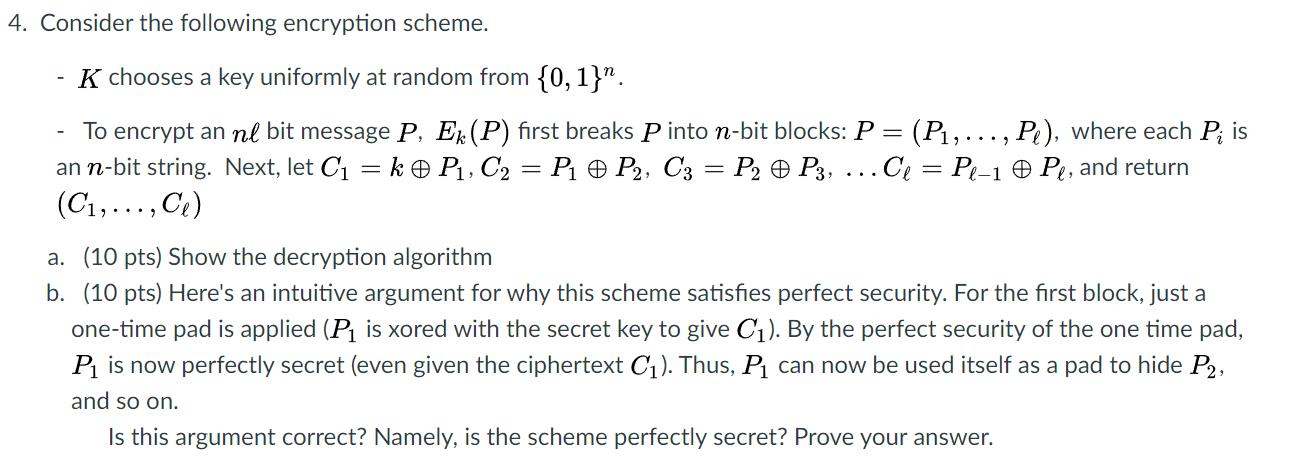
4. Consider the following encryption scheme. K chooses a key uniformly at random from {0, 1}. To encrypt an nl bit message P, Ek (P) first breaks Pinto n-bit blocks: P = (P,..., P), where each P is an n-bit string. Next, let C = k P, C = P P, C3 = P P3, Ce = Pe-1 Pe, and return (C,..., Ce) - a. (10 pts) Show the decryption algorithm b. (10 pts) Here's an intuitive argument for why this scheme satisfies perfect security. For the first block, just a one-time pad is applied (P is xored with the secret key to give C). By the perfect security of the one time pad, P is now perfectly secret (even given the ciphertext C). Thus, P can now be used itself as a pad to hide P2, and so on. Is this argument correct? Namely, is the scheme perfectly secret? Prove your answer.
Step by Step Solution
There are 3 Steps involved in it

Get step-by-step solutions from verified subject matter experts
 Study Help