







Question: 4. Consider the same setting as above, but now suppose that tutoring cannot be randomly assigned. Instead, only the worst students get tutors, i.e., everyone
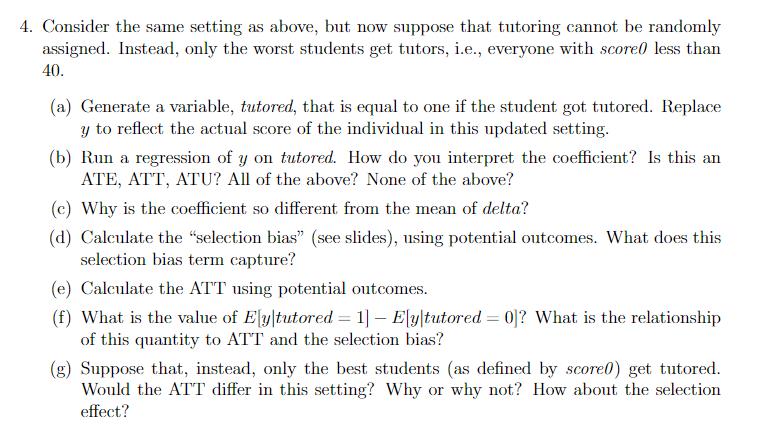
4. Consider the same setting as above, but now suppose that tutoring cannot be randomly assigned. Instead, only the worst students get tutors, i.e., everyone with scored less than 40. (a) Generate a variable, tutored, that is equal to one if the student got tutored. Replace y to reflect the actual score of the individual in this updated setting. (b) Run a regression of y on tutored. How do you interpret the coefficient? Is this an ATE, ATT, ATU? All of the above? None of the above? (c) Why is the coefficient so different from the mean of delta? (d) Calculate the "selection bias" (see slides), using potential outcomes. What does this selection bias term capture? (e) Calculate the ATT using potential outcomes. (f) What is the value of Elytutored = 1) - Elytutored =0)? What is the relationship of this quantity to ATT and the selection bias? (g) Suppose that, instead, only the best students (as defined by score( ) get tutored. Would the ATT differ in this setting? Why or why not? How about the selection effect
Step by Step Solution
There are 3 Steps involved in it

Get step-by-step solutions from verified subject matter experts
 Study Help