Question: 4. De-bias review system using EM. [Bonus, 10 points] In this question, we will develop an algorithm to remove individual reviewer's bias from their score.
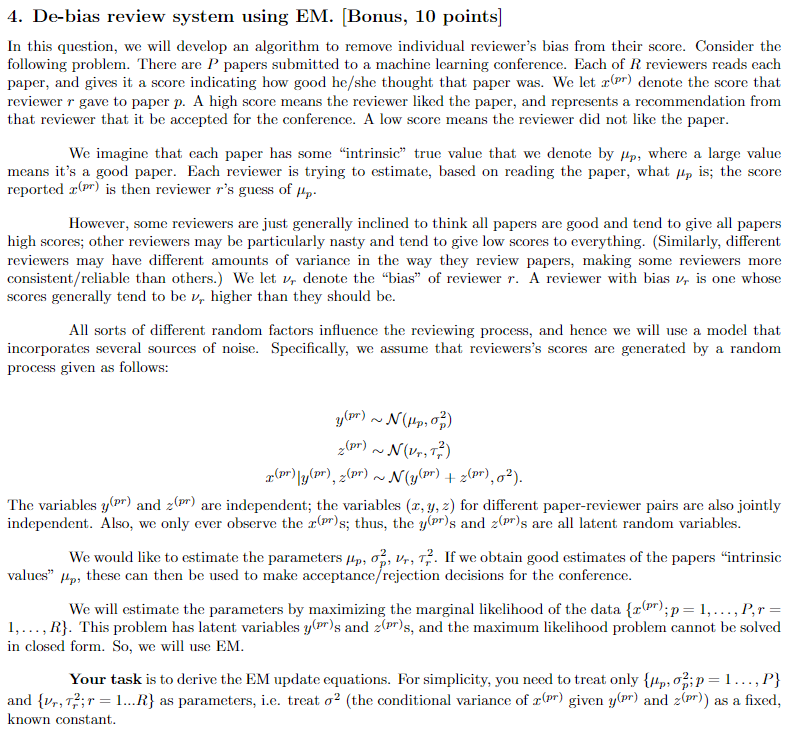
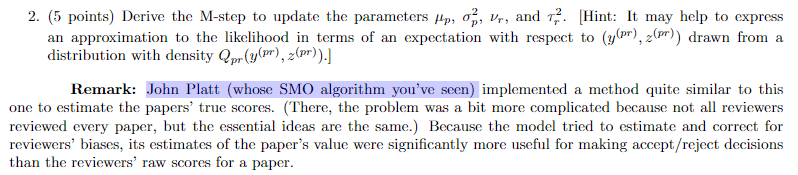
4. De-bias review system using EM. [Bonus, 10 points] In this question, we will develop an algorithm to remove individual reviewer's bias from their score. Consider the following problem. There are P papers submitted to a machine learning conference. Each of R reviewers reads each paper, and gives it a score indicating how good he/she thought that paper was. We let (?") denote the score that reviewer r gave to paper p. A high score means the reviewer liked the paper, and represents a recommendation from that reviewer that it be accepted for the conference. A low score means the reviewer did not like the paper. We imagine that each paper has some "intrinsic" true value that we denote by #, where a large value means it's a good paper. Each reviewer is trying to estimate, based on reading the paper, what My is; the score reported r() is then reviewer r's guess of #p- However, some reviewers are just generally inclined to think all papers are good and tend to give all papers high scores; other reviewers may be particularly nasty and tend to give low scores to everything. (Similarly, different reviewers may have different amounts of variance in the way they review papers, making some reviewers more consistent/reliable than others.) We let , denote the "bias" of reviewer r. A reviewer with bias , is one whose scores generally tend to be y, higher than they should be. All sorts of different random factors influence the reviewing process, and hence we will use a model that incorporates several sources of noise. Specifically, we assume that reviewers's scores are generated by a random process given as follows: (pr) ~ N ( /p, (? ) 2 ( pr ) ~ N (vr, 7? ) r( pr ) | y ( Pr ) , = ( PT ) ~ N ( y( pr ) + = ( PT) , 2). The variables y(PT) and 2() are independent; the variables (r, y, 2) for different paper-reviewer pairs are also jointly independent. Also, we only ever observe the r()s; thus, the y(PT)s and 2(27)s are all latent random variables. We would like to estimate the parameters up, Op, vr, 75. If we obtain good estimates of the papers "intrinsic values" /p, these can then be used to make acceptance/rejection decisions for the conference. We will estimate the parameters by maximizing the marginal likelihood of the data {r(); p = 1, . .., P,r = 1, ..., RJ. This problem has latent variables y()s and 2(Pr)s, and the maximum likelihood problem cannot be solved in closed form. So, we will use EM. Your task is to derive the EM update equations. For simplicity, you need to treat only {/, of;p = 1..., P} and { vr, 72;r =1...R} as parameters, i.e. treat o (the conditional variance of r() given y(or) and z() ) as a fixed, known constant.2. (5 points) Derive the M-step to update the parameters Ap, Op, vr, and 75. Hint: It may help to express an approximation to the likelihood in terms of an expectation with respect to (y(7), 2()) drawn from a distribution with density Qpr(y(or), 2(pr)).] Remark: John Platt (whose SMO algorithm you've seen) implemented a method quite similar to this one to estimate the papers' true scores. (There, the problem was a bit more complicated because not all reviewers reviewed every paper, but the essential ideas are the same.) Because the model tried to estimate and correct for reviewers' biases, its estimates of the paper's value were significantly more useful for making accept/reject decisions than the reviewers' raw scores for a paper.1. Derive the E-step (5 points) (a) The joint distribution p(y(PT), 2(7), x()) has the form of a multivariate Gaussian density. Find its as- sociated mean vector and covariance matrix in terms of the parameters , o2, v., 12 and o2. Hint: Recognize that r() can be written as r() = y(or) + 2(pr) + (m), where e() ~ N(0, 02) is independent Gaussian noise.(b) Derive an expression for Qpr(8'|0) = Ellogp(y(PT), 2(PT), x())|x(PT), 0] using the conditional distribution p(y(er), z(pr)(x()) (E-step) (Hint, you may use the rules for conditioning on subsets of jointly Gaussian random variables.)
Step by Step Solution
There are 3 Steps involved in it
1 Expert Approved Answer
Step: 1 Unlock
Question Has Been Solved by an Expert!
Get step-by-step solutions from verified subject matter experts
Step: 2 Unlock
Step: 3 Unlock
Students Have Also Explored These Related Mathematics Questions!