







Question: 4) Determine whether each statement is always true, always false, or sometimes true. If the statement is always true, then give an example of it
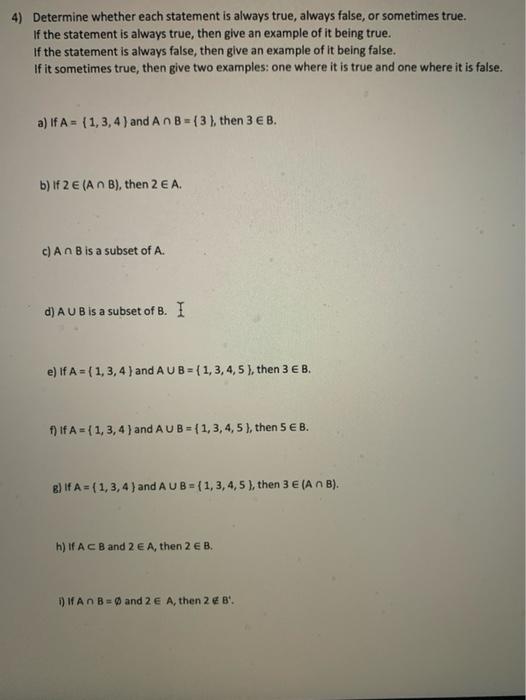
4) Determine whether each statement is always true, always false, or sometimes true. If the statement is always true, then give an example of it being true. If the statement is always false, then give an example of it being false. If it sometimes true, then give two examples: one where it is true and one where it is false. a) If A = (1,3,4 ) and An B = (3), then 3 B. b) If 2 E (ANB), then 2 E A. c) An Bis a subset of A. d) AU B is a subset of B. I e) If A=1,3,4 ) and AU B = {1,3,4,5), then 3 B. f) If A = {1, 3, 4 ) and AUB= 1,3,4,5), then 5 B. B) If A = (1,3,4 ) and AU B = {1,3,4,5), then 3 E (ANB). h) IfACB and 2 E A, then 2 B. WAN B = 0 and 2 A, then 2 B
Step by Step Solution
There are 3 Steps involved in it

Get step-by-step solutions from verified subject matter experts
 Study Help