



Question: 4. Discrete distributions: binomial An experiment consists of n = 6 identical trials. Each trial can end in a success (3) or failure (F) The
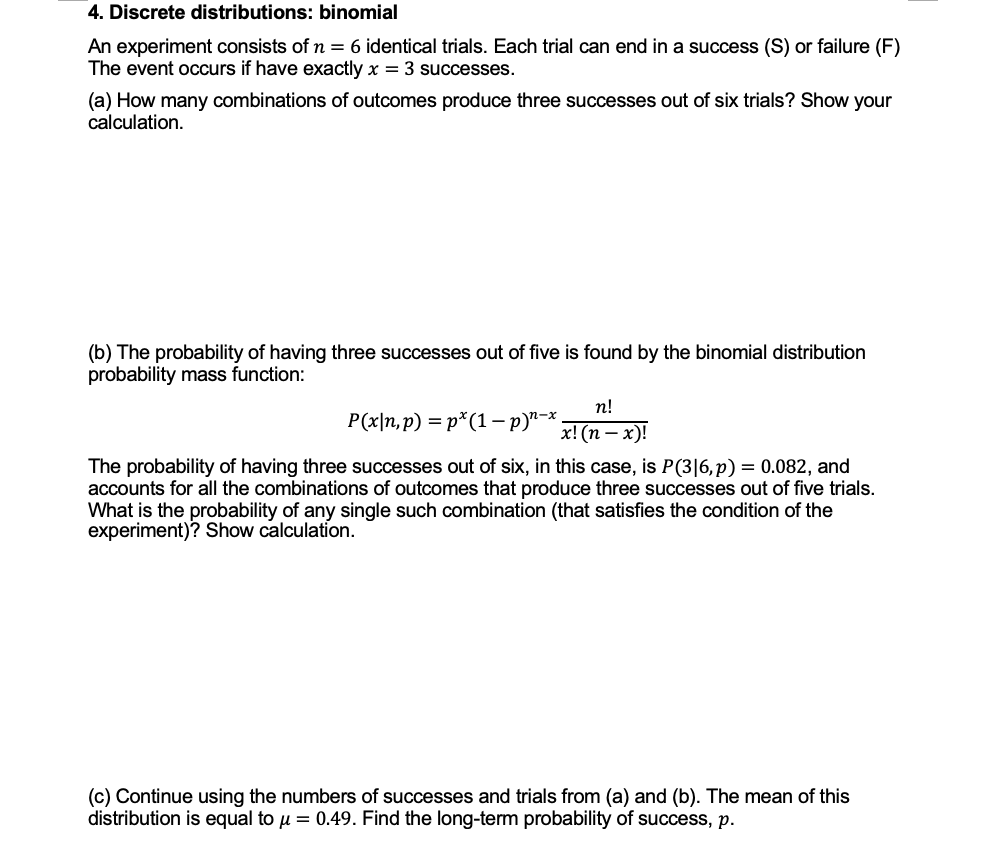
4. Discrete distributions: binomial An experiment consists of n = 6 identical trials. Each trial can end in a success (3) or failure (F) The event occurs if have exactly 2: = 3 successes. (a) How many combinations of outcomes produce three successes out of six trials? Show your calculation. (b) The probability of having three successes out of ve is found by the binomial distribution probability mass function: it! \"xi\": 1') = px \"Firm The probability of having three successes out of six, in this case, is P(3|6, p) = 0.082, and accounts for all the combinations of outcomes that produce three successes out of ve trials. What is the probability of any single such combination (that satises the condition of the experiment)? Show calculation. (c) Continue using the numbers of successes and trials from (a) and (b). The mean of this distribution is equal to ,u = 0.4-9. Find the long-term probability of success, 39
Step by Step Solution
There are 3 Steps involved in it

Get step-by-step solutions from verified subject matter experts