







Question: 4: Dr. Adler hints at possibilities for future studies in the above paragraph. What explanatory variables does he give? a. What response variable does he
4:
Dr. Adler hints at possibilities for future studies in the above paragraph. What explanatory variables does he give?
a.
What response variable does he list, and why is it a response variable.
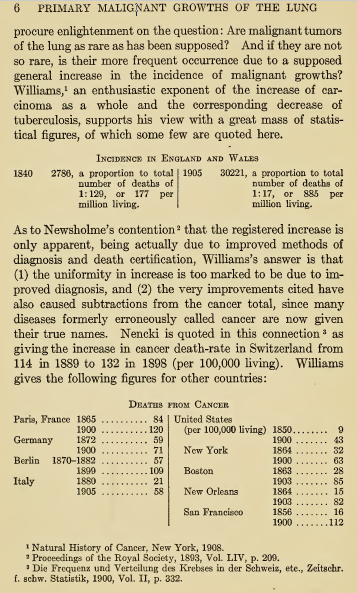
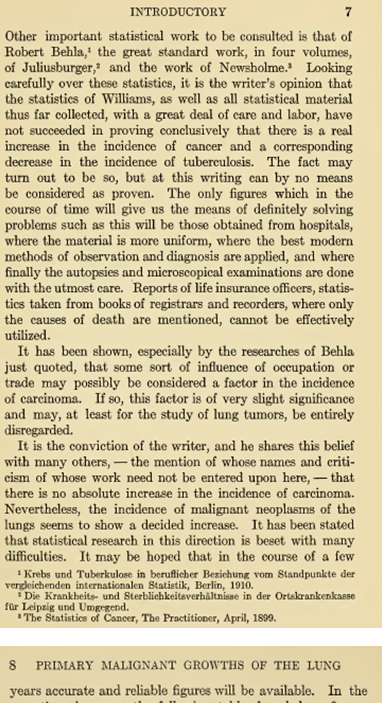
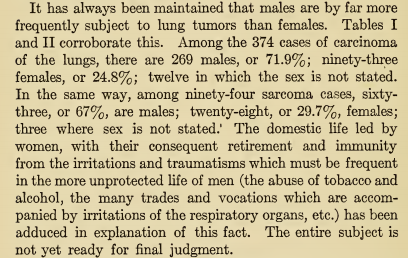
6 PRIMARY MALIGNANT GROWTHS OF THE LUNG procure enlightenment on the question: Are malignant tumors of the lung as rare as has been supposed? And if they are not so rare, is their more frequent occurrence due to a supposed general increase in the incidence of malignant growths? Williams, 1 an enthusiastic exponent of the increase of carcinoma as a whole and the corresponding decrease of tuberculosis, supports his view with a great mass of statistical figures, of which some few are quoted here. As to Newsholme's contention 2 that the registered increase is only apparent, being actually due to improved methods of diagnosis and death certification, Williams's answer is that (1) the uniformity in increase is too marked to be due to improved diagnosis, and (2) the very improvements cited have also caused subtractions from the cancer total, since many diseases formerly erroneously called cancer are now given their true names. Nencki is quoted in this connection 3 as giving the increase in cancer death-rate in Switzerland from 114 in 1889 to 132 in 1898 (per 100,000 living). Williams gives the following figures for other countries: I Natural History of Cancer, New York, 1908. 2 Proceedings of the Royal Society, 1893, Vol. LIV, p. 200. "Die Frequens und Verteilung des Krebses in der Sehweiz, ete., Zeitschr. f. schw. Statietik, 1900, Vol. II, p. 332 . INTRODUCTORY 7 Other important statistical work to be consulted is that of Robert Behla, 1 the great standard work, in four volumes, of Juliusburger, 2 and the work of Newsholme.3 Looking carefully over these statistics, it is the writer's opinion that the statistics of Williams, as well as all statistical material thus far collected, with a great deal of care and labor, have not succeeded in proving conclusively that there is a real increase in the incidence of cancer and a corresponding decrease in the incidence of tuberculosis. The fact may turn out to be so, but at this writing can by no means be considered as proven. The only figures which in the course of time will give us the means of definitely solving problems such as this will be those obtained from hospitals, where the material is more uniform, where the best modern methods of observation and diagnosis are applied, and where finally the autopsies and microscopical examinations are done with the utmost care. Reports of life insurance officers, statistics taken from books of registrars and recorders, where only the causes of death are mentioned, cannot be effectively utilized. It has been shown, especially by the researches of Behla just quoted, that some sort of influence of occupation or trade may possibly be considered a factor in the incidence of carcinoma. If so, this factor is of very slight significance and may, at least for the study of lung tumors, be entirely disregarded. It is the conviction of the writer, and he shares this belief with many others, - the mention of whose names and criticism of whose work need not be entered upon here, - that there is no absolute increase in the incidence of carcinoma. Nevertheless, the incidence of malignant neoplasms of the lungs seems to show a decided increase. It has been stated that statistical research in this direction is beset with many difficulties. It may be hoped that in the course of a few ' Krebs und Tuberkulose in beruflicher Berichung rom Standpunkte der vergleichenden internationalen Statiatik, Berlin, 1910. 'Dje Krankbeits- und Sterblichkeiltsverhltnisse in der Ortakrankenkasse for Leiprig und Umgerend. "The Statistics of Cancer, The Practitioner, April, 1899. 8 PRIMARY MALIGNANT GROWTHS OF THE LUNG years accurate and reliable figures will be available. In the It has always been maintained that males are by far more frequently subject to lung tumors than females. Tables I and II corroborate this. Among the 374 cases of carcinoma of the lungs, there are 269 males, or 71.9%; ninety-three females, or 24.8%; twelve in which the sex is not stated. In the same way, among ninety-four sareoma cases, sixtythree, or 67%, are males; twenty-eight, or 29.7%, females; three where sex is not stated.' The domestic life led by women, with their consequent retirement and immunity from the irritations and traumatisms which must be frequent in the more unprotected life of men (the abuse of tobacco and alcohol, the many trades and vocations which are accompanied by irritations of the respiratory organs, etc.) has been adduced in explanation of this fact. The entire subject is not yet ready for final judgment
Step by Step Solution
There are 3 Steps involved in it

Get step-by-step solutions from verified subject matter experts
 Study Help