







Question: 4. Draw the stack diagram of this program at the point right after CPU finishes the first 4 instructions of function bar) as follows: bar:
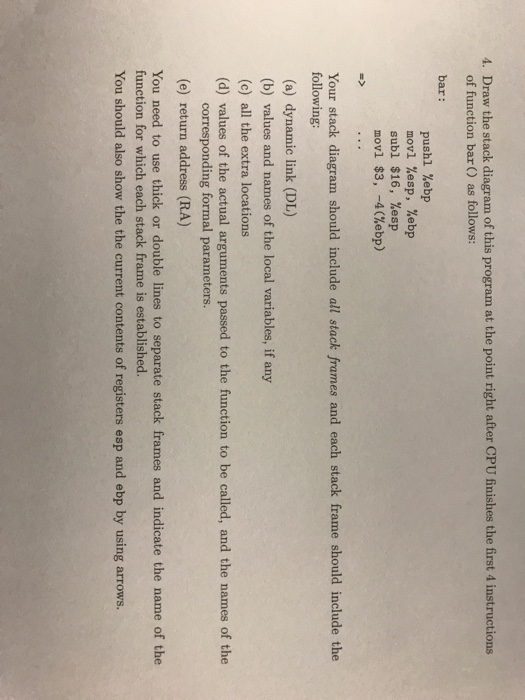
4. Draw the stack diagram of this program at the point right after CPU finishes the first 4 instructions of function bar) as follows: bar: pushl %ebp movl %esp, %ebp subl $16, %esp movl $3, -4Chebp) Your stack diagram should include all stack frames and each stack frame should include the following: (a) dynamic link (DL) (b) values and names of the local variables, if any (c) all the extra locations (d) values of the actual arguments passed to the function to be called, and the names of the corresponding formal parameters. (e) return address (RA) You need to use thick or double lines to separate stack frames and indicate the name of the function for which each stack frame is established. You should also show the the current contents of registers esp and ebp by using arrows. 4. Draw the stack diagram of this program at the point right after CPU finishes the first 4 instructions of function bar) as follows: bar: pushl %ebp movl %esp, %ebp subl $16, %esp movl $3, -4Chebp) Your stack diagram should include all stack frames and each stack frame should include the following: (a) dynamic link (DL) (b) values and names of the local variables, if any (c) all the extra locations (d) values of the actual arguments passed to the function to be called, and the names of the corresponding formal parameters. (e) return address (RA) You need to use thick or double lines to separate stack frames and indicate the name of the function for which each stack frame is established. You should also show the the current contents of registers esp and ebp by using arrows
Step by Step Solution
There are 3 Steps involved in it

Get step-by-step solutions from verified subject matter experts
 Study Help