



Question: 4 Expectations Students should understand how price changes affect their purchasing power. Students should become aware that there may be strategies for dealing with price
4
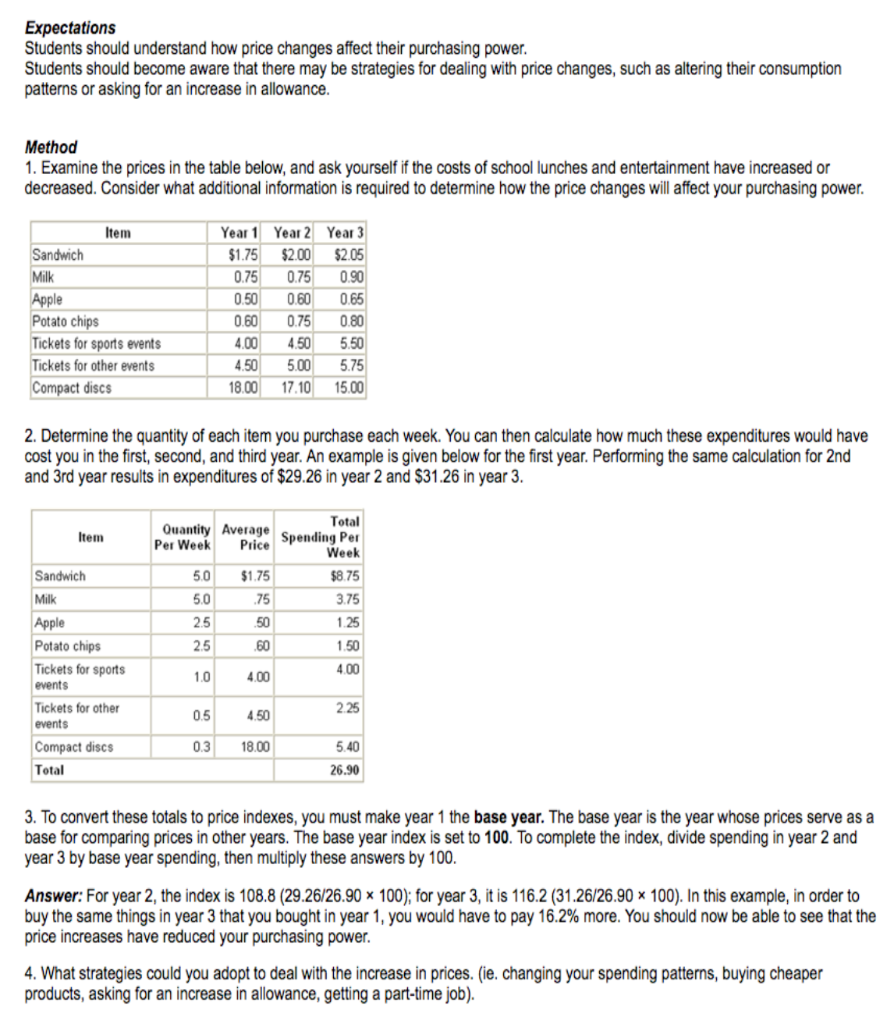
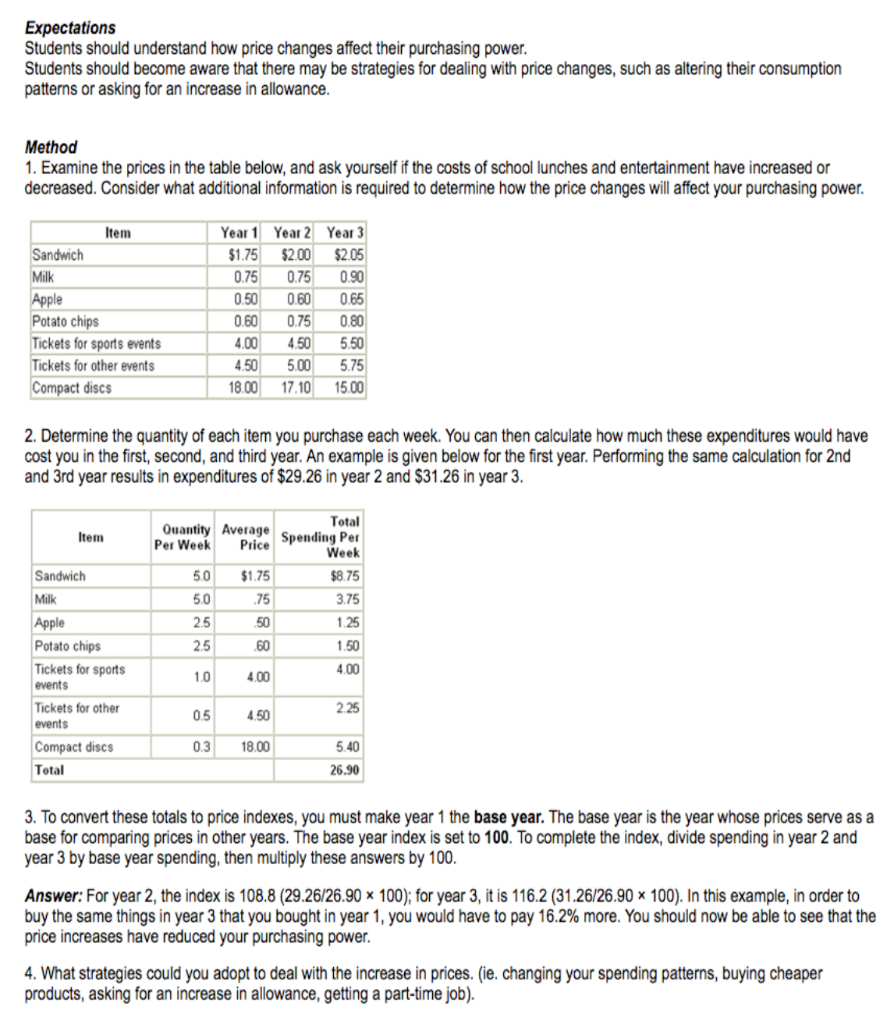
Expectations Students should understand how price changes affect their purchasing power. Students should become aware that there may be strategies for dealing with price changes, such as altering their consumption patterns or asking for an increase in allowance. Method 1. Examine the prices in the table below, and ask yourself if the costs of school lunches and entertainment have increased or decreased. Consider what additional information is required to determine how the price changes will affect your purchasing power. Item Year 1 Year 2 Year 3 Sandwich $1.75 $2.00 $2.05 Milk 0.75 0.75 0.90 Apple 0.50 0.60 0.65 Potato chips 0.60 0.75 0.80 Tickets for sports events 4.00 4.50 5.50 Tickets for other events 4.50 5.00 5.75 Compact discs 18.00 17.10 15.00 2. Determine the quantity of each item you purchase each week. You can then calculate how much these expenditures would have cost you in the first, second, and third year. An example is given below for the first year. Performing the same calculation for 2nd and 3rd year results in expenditures of $29.26 in year 2 and $31.26 in year 3. Total Item Quantity Average Per Week Price Spending Per Week Sandwich 5.0 $1.75 $8.75 Milk 5.0 .75 3.75 Apple 2.5 .50 1.25 Potato chips 2.5 .60 1.50 Tickets for sports 4.00 4.00 1.0 events Tickets for other 2.25 0.5 4.50 events Compact discs 0.3 18.00 5.40 Total 26.90 3. To convert these totals to price indexes, you must make year 1 the base year. The base year is the year whose prices serve as a base for comparing prices in other years. The base year index is set to 100. To complete the index, divide spending in year 2 and year 3 by base year spending, then multiply these answers by 100. Answer: For year 2, the index is 108.8 (29.26/26.90 x 100); for year 3, it is 116.2 (31.26/26.90 x 100). In this example, in order to buy the same things in year 3 that you bought in year 1, you would have to pay 16.2% more. You should now be able to see that the price increases have reduced your purchasing power. 4. What strategies could you adopt to deal with the increase in prices. (ie. changing your spending patterns, buying cheaper products, asking for an increase in allowance, getting a part-time job)
Step by Step Solution
There are 3 Steps involved in it

Get step-by-step solutions from verified subject matter experts