



Question: 4. Financial Analysis 15 marks 4.1 3-Year Pro-forma Income Statement (15t to 3 year on monthly basis) 4.2 3-Year Pro-forma Cash Flow Statement (1st to
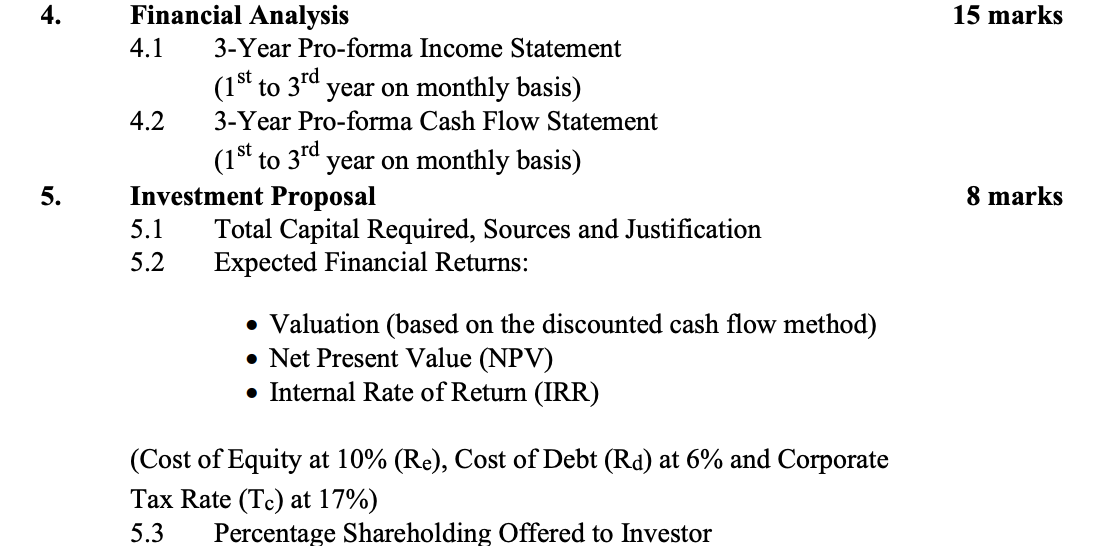
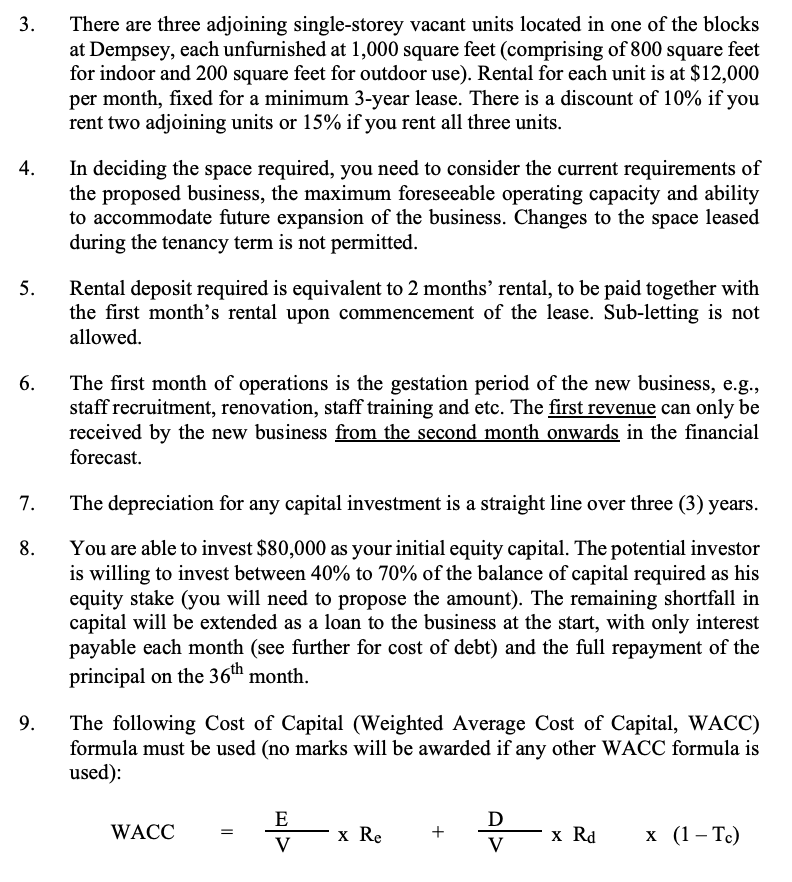
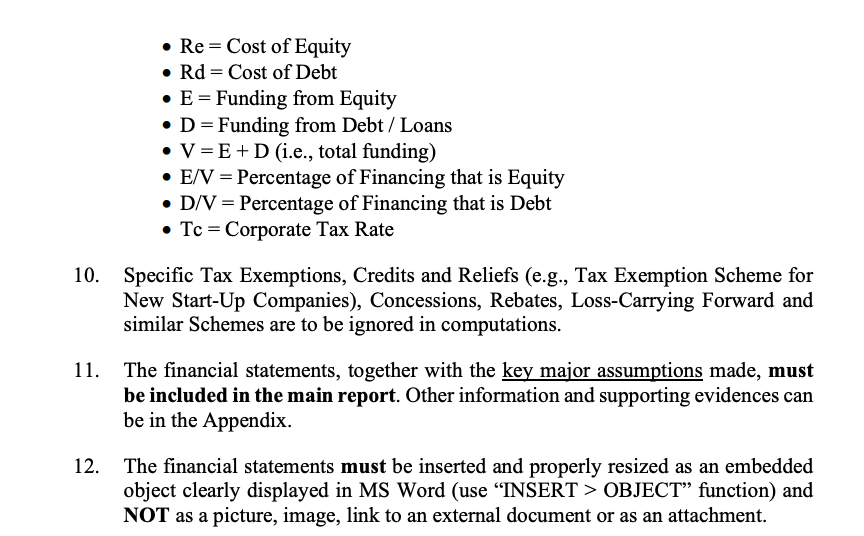
4. Financial Analysis 15 marks 4.1 3-Year Pro-forma Income Statement (15t to 3" year on monthly basis) 4.2 3-Year Pro-forma Cash Flow Statement (1st to 30 year on monthly basis) 5. Investment Proposal 8 marks 5.1 Total Capital Required, Sources and Justification 5.2 Expected Financial Returns: . Valuation (based on the discounted cash flow method) Net Present Value (NPV) . Internal Rate of Return (IRR) (Cost of Equity at 10% (Re), Cost of Debt (Rd) at 6% and Corporate Tax Rate (Tc) at 17%) 5.3 Percentage Shareholding Offered to InvestorThere are three adjoining single-storey vacant units located in one of the blocks at Dempsey, each unfurnished at 1,000 square feet (comprising of 800 square feet for indoor and 200 square feet for outdoor use). Rental for each unit is at $12,000 per month, xed for a minimum 3-year lease. There is a discount of 10% if you rent two adjoining units or 15% if you rent all three units. In deciding the space required, you need to consider the current requirements of the proposed business, the maximum foreseeable operating capacity and ability to accommodate future expansion of the business. Changes to the space leased during the tenancy term is not permitted. Rental deposit required is equivalent to 2 months' rental, to be paid together with the rst month's rental upon commencement of the lease. Sub-letting is not allowed. The first month of operations is the gestation period of the new business, e. g., staff recruitment, renovation, staff training and etc. The rst revenue can only be received by the new business from the second month onwards in the financial forecast. The depreciation for any capital investment is a straight line over three (3) years. You are able to invest $80,000 as your initial equity capital. The potential investor is willing to invest between 40% to 70% of the balance of capital required as his equity stake (you will need to propose the amount). The remaining shortfall in capital will be extended as a loan to the business at the start, with only interest payable each month (see further for cost of debt) and the full repayment of the principal on the 36th month. The following Cost of Capital (Weighted Average Cost of Capital, WACC) formula must be used (no marks will be awarded if any other WACC formula is used): E D WACC v xRC + v de x(1Tc) . Re = Cost of Equity . Rd = Cost of Debt . E = Funding from Equity . D = Funding from Debt / Loans . V = E + D (i.e., total funding) . E/V = Percentage of Financing that is Equity . D/V = Percentage of Financing that is Debt . To = Corporate Tax Rate 10. Specific Tax Exemptions, Credits and Reliefs (e.g., Tax Exemption Scheme for New Start-Up Companies), Concessions, Rebates, Loss-Carrying Forward and similar Schemes are to be ignored in computations. 11. The financial statements, together with the key major assumptions made, must be included in the main report. Other information and supporting evidences can be in the Appendix. 12. The financial statements must be inserted and properly resized as an embedded object clearly displayed in MS Word (use "INSERT > OBJECT" function) and NOT as a picture, image, link to an external document or as an attachment
Step by Step Solution
There are 3 Steps involved in it

Get step-by-step solutions from verified subject matter experts