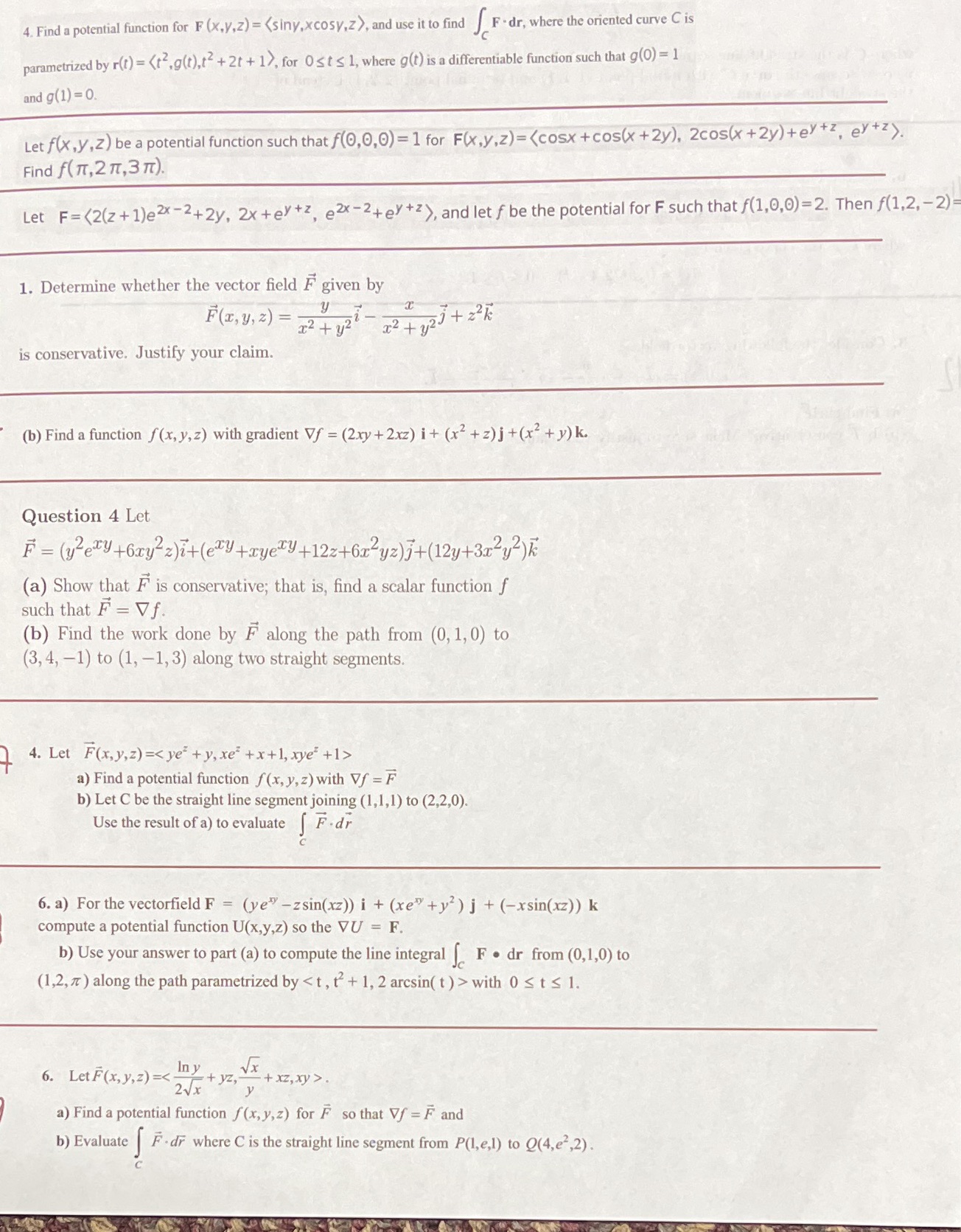
Question: 4. Find a potential function for F (x.y,z) = , and use it to find F - dr, where the oriented curve C is parametrizationt),t2
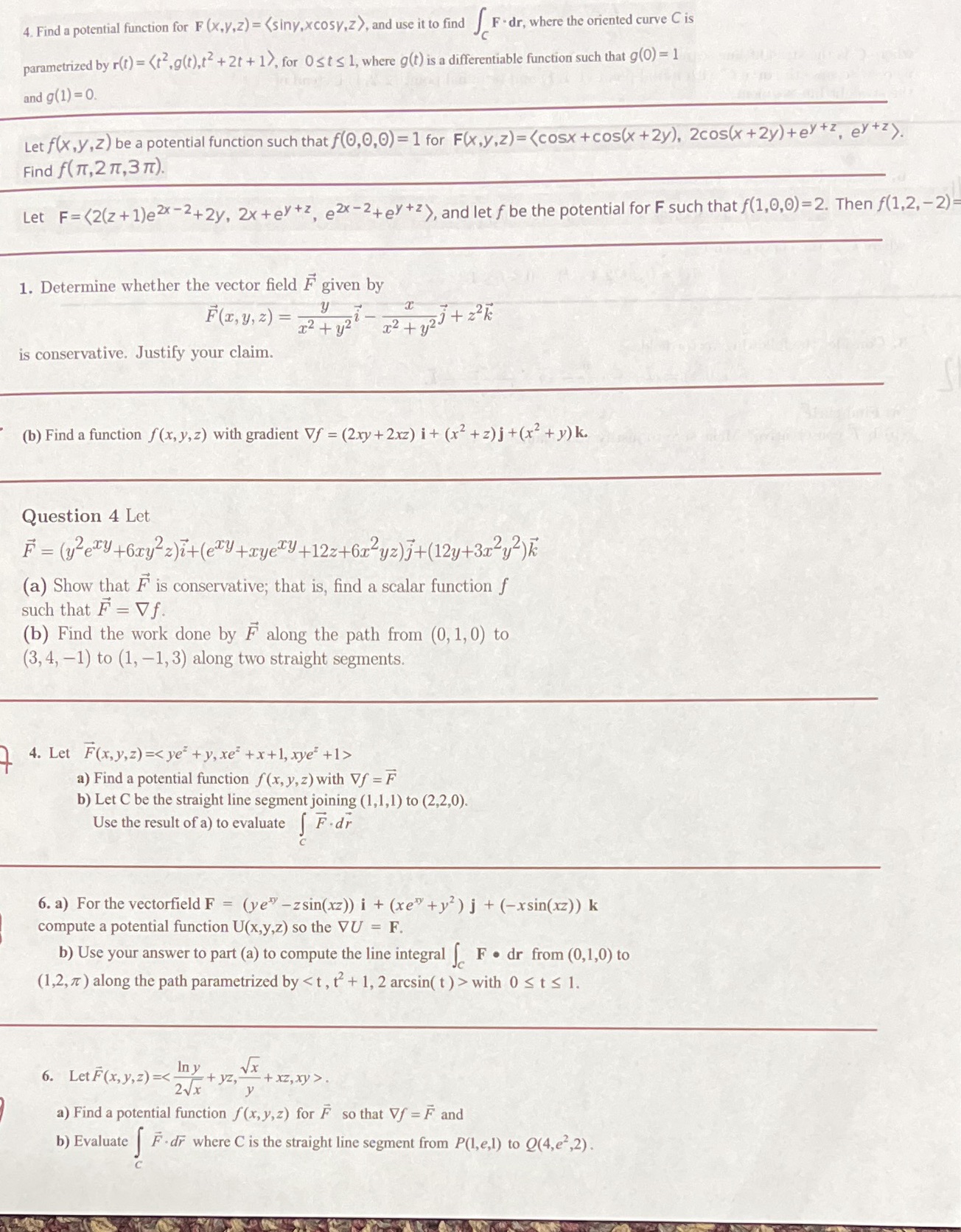
4. Find a potential function for F (x.y,z) = , and use it to find F - dr, where the oriented curve C is parametrizationt),t2 +2t + 17, for Osts 1, where g(t) is a differentiable function such that g(0) = 1 and g(1) = 0. Let f(x, y,z) be a potential function such that f(0, 0,0) = 1 for F(x,y.z)=, and let f be the potential for F such that f(1,0,0)=2. Then f(1,2, -2) 1. Determine whether the vector field F given by F (x, y, z ) = 72 + 12 - x2 + 123 + 2 2 k is conservative. Justify your claim. (b) Find a function f(x, y, z) with gradient Vf = (2xy + 2xz) i+ (x2 +z)j +(x2 +y)k. Question 4 Let F = (yzery+6ry?z)it(eTy+xyely+122+612yz)j+(12y+312y2) k (a) Show that F is conservative; that is, find a scalar function f such that F = Vf. (b) Find the work done by F along the path from (0, 1, 0) to (3, 4, -1) to (1, -1, 3) along two straight segments. 4. Let F(x, y, z) = a) Find a potential function f(x, y, z) with VS = F b) Let C be the straight line segment joining (1, 1, 1) to (2,2,0). Use the result of a) to evaluate [ F.dr 6. a) For the vectorfield F = (ye" -zsin(xz)) i + (xe>+y? ) j + (-xsin(xz)) k compute a potential function U(x,y,z) so the VU = F. b) Use your answer to part (a) to compute the line integral F . dr from (0, 1,0) to (1,2, 7 ) along the path parametrizationcsin(t ) > with 0 S t s 1. 6. Let F (x, y, z) =. a) Find a potential function f (x, y,z) for F so that Vf = F and b) Evaluate F. dr where C is the straight line segment from P(1, e,1) to O(4, et,2)









 Study Help