



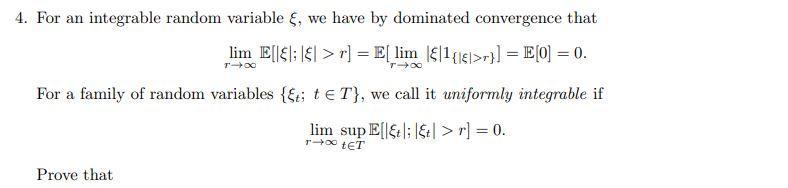
Question: 4. For an integrable random variable , we have by dominated convergence that limrE[;>r]=E[limr1{>r}]=E[0]=0. For a family of random variables {t;tT}, we call it uniformly
![convergence that limrE[;>r]=E[limr1{>r}]=E[0]=0. For a family of random variables {t;tT}, we call](https://dsd5zvtm8ll6.cloudfront.net/si.experts.images/questions/2024/09/66f804addd3e5_15766f804ad850c1.jpg)
4. For an integrable random variable , we have by dominated convergence that limrE[;>r]=E[limr1{>r}]=E[0]=0. For a family of random variables {t;tT}, we call it uniformly integrable if limrsuptTE[t;t>r]=0 Prove that (b) if there exists a function G:R+R+which is increasing and such that G(x)/x as x and suptTE[G(t)]r]=E[limr1{>r}]=E[0]=0. For a family of random variables {t;tT}, we call it uniformly integrable if limrsuptTE[t;t>r]=0 Prove that (b) if there exists a function G:R+R+which is increasing and such that G(x)/x as x and suptTE[G(t)]
Step by Step Solution
There are 3 Steps involved in it
1 Expert Approved Answer
Step: 1 Unlock

Question Has Been Solved by an Expert!
Get step-by-step solutions from verified subject matter experts
Step: 2 Unlock
Step: 3 Unlock