Question: 4. For each division use the data tables provided in Appendix B to estimate how each strategy fares in terms of metrics. Provide a one-page
4. For each division use the data tables provided in Appendix B to estimate how each strategy fares in terms of metrics. Provide a one-page summary of the essential results of the various data tables you have been provided and what it means in practice.
Methods of Recruiting Available
There are five primary methods of recruiting store associates used at Tanglewood in Washington and Oregon. For additional information regarding these sources of recruiting check Staffing Organizations, Chapter 5, where advantages and disadvantages of each method are described in greater detail. All of the specific strategies for recruiting are supplemented with media-based and in-store solicitations for employment. The media based strategy includes internet banner advertising, social media messages, and in-store signs informing patrons of potential job availability.
Applicant Initiated
The most traditional method for recruiting used by Tanglewood is through applicantinitiated processes. Job applications are completed through either the internet or an automated telephone process. This allows interested individuals to apply without actually having to go into the stores. Paper applications are still available at stores as well. Media expenses are a combination of initially setting up a contact with a media outlet, developing an advertisement, and the price of processing materials and interviews for each applicant.
Referrals
Employees are encouraged to refer their friends to apply for work at Tanglewood as well. The referral process is enhanced by providing current employees with $100 for each friend they refer who is hired. Referral expenses are a combination of creating and maintaining records, the price of processing materials and interviews for each applicant, and the payment for each individual who is hired.
Kiosk
An alternative method of recruiting that minimizes processing costs is to have a computerized kiosk in the main entrance to the stores. The kiosks look somewhat like ATM machines, and feature a fully functioning keyboard and touch-screens. Unlike media advertisements and internet applications, the kiosks provide opportunities for applicants to also briefly interact with store employees after they complete their materials. Because the entire application process is completed electronically and scored automatically, there is no material cost, although there is still an initial processing and interview cost. Each kiosk costs approximately $40,000.
State Job Services
In urban markets with higher pools of availability of unemployed individuals, state job services have also been used occasionally to find new applicants. The employment service is provided with a set of qualifications required for work, and the employment services agency assists in providing initial screening and hiring recommendations. Training is partially subsidized through tax incentives. In areas which have less centralized population, the job service option is less feasible. Essentially, the cost of the job service is for creating and maintaining an initial contact, with other costs being roughly half of those for traditional media sites.
Staffing Agency
One method that has been explored recently is the use of an external staffing agency. Essentially, this is outsourcing the actual selection of candidates to StoreStaff, which is a large organization that specializes in locating workers for the retail industry. Many organizations use StoreStaff to find temporary employees, or provide trial employment to StoreStaff employees as part of a temporary-to-permanent arrangement, but for Tanglewood, individuals recruited through StoreStaff are directly hired as part of the core workforce. Because StoreStaff provides some training to their pool of candidates, they are less expensive to train, but the overhead costs of providing money to StoreStaff for locating and screening these candidates does make this method quite costly.
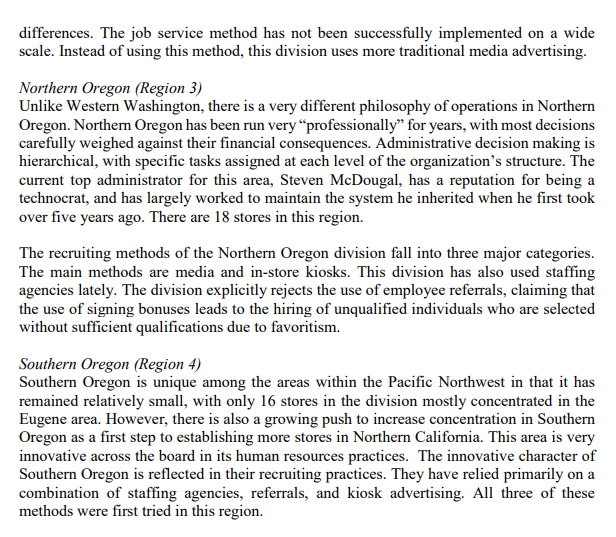
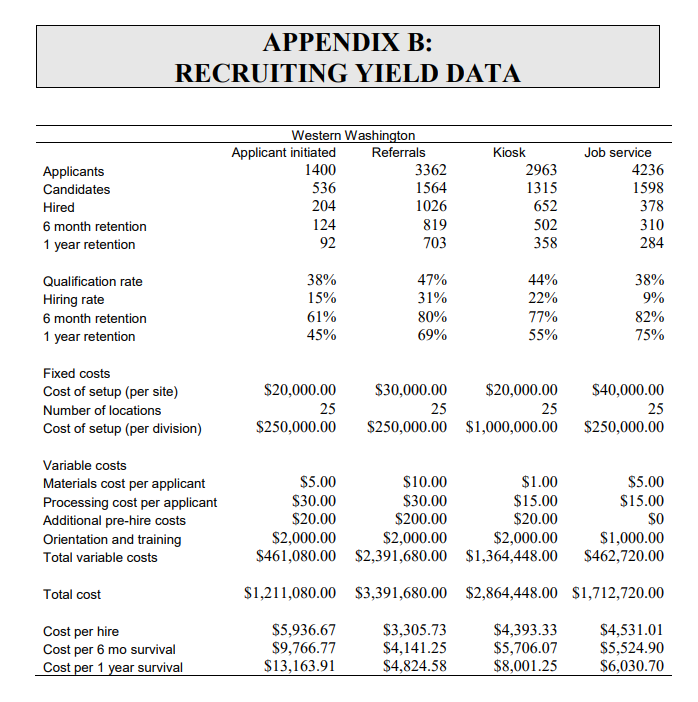
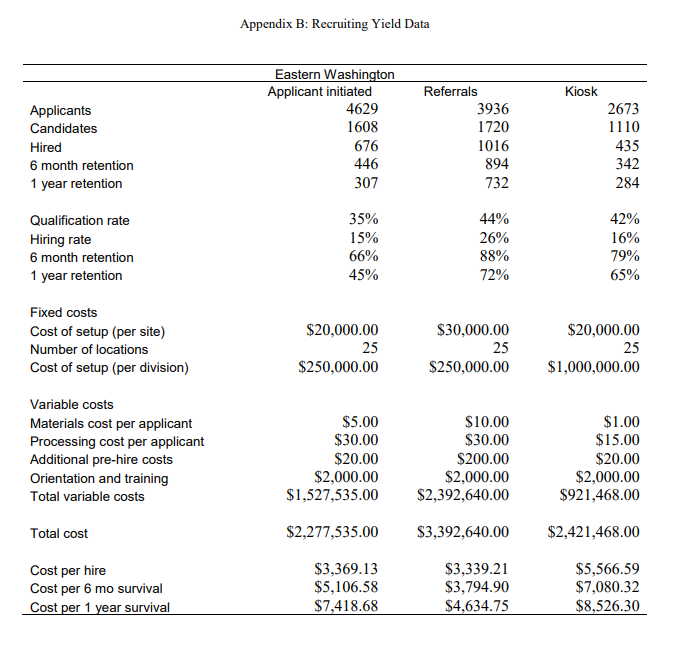
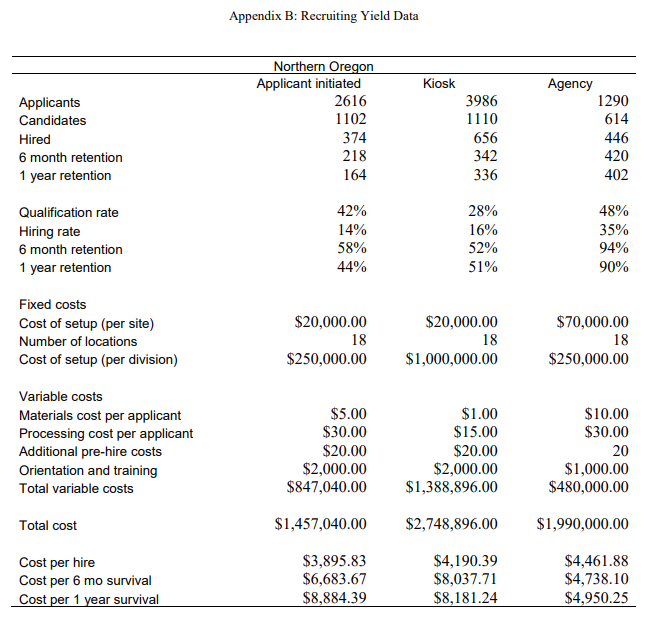
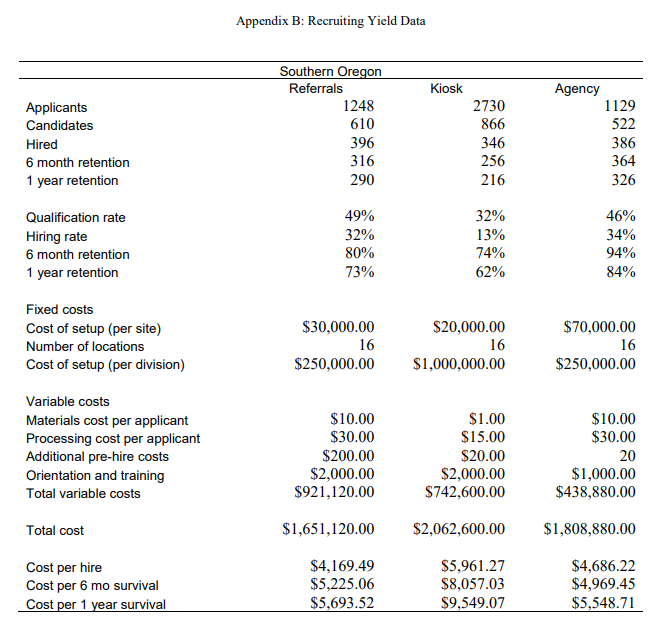
The Situation at Tanglewood - Four Regions, Four Recruitment Policies As noted in the introduction, decision making for staffing activities has recently become centralized within the staffing services division. A major question that arises as a result of this consolidation is how to determine which HR policies should be left in the hands of each individual location, and how much should be taken over by corporate HR. The recruiting function is of particular interest since there is such wide dispersion in how individuals are recruited. Data is available from the divisions in the form of numerical estimates of costs per individual processed, employee retention, performance on a pre-hire work-sample test which is given to all employees, and some informal interview data. Tanglewood Department stores were first established in the western area of Washington and then moved southwards into Oregon, then spread eastwards into the Rocky Mountain States. Many of the policies implemented in the Western Washington locations were applied directly in the Rocky Mountain States. However, because the initial expansion was less well-coordinated, there is substantial variety in the staffing policies being followed in the stores in Washington and Oregon. Western Washington (Region 1) It has historically been the largest and most profitable area, with a total of 25 stores in the region centered around Seattle. In fitting with the organization's founding philosophy, the stores in Western Washington are run largely autonomously. The current head of the Western Washington division advocates a philosophy of individual autonomy and empowerment. Generally this division has been viewed as highly committed to the core corporate culture, although this passion for the mission has sometimes meant paying less attention to careful management of financial concerns. Because of its size and the large amounts of financial resources available, leadership of this division has been one of the most powerful positions within the organization. Western Washington uses a variety of recruiting methods. The primary methods of recruiting are referrals from current employees. In the Seattle area, the division also makes heavy use of job services. Over time traditional media methods of recruiting have been reduced, but are still used occasionally. Finally, to fill in those positions that are not met with the other three methods, the kiosk method is used. Eastern Washington (Region 2) This was where the company began. The split of Washington into Eastern and Western divisions came early in the store's history, but their physical proximity and high overlap between management across the areas has led to very similar management styles. The Eastern Washington division is approximately the same size as Western Washington, with 25 total stores. However, with the exception of the area around Spokane, the majority of this area is much more rural. To a large extent, the Eastern Washington division pioneered all the policies used by Western Washington, although the overall policies have been tempered by geographical differences. The job service method has not been successfully implemented on a wide scale. Instead of using this method, this division uses more traditional media advertising. Northern Oregon (Region 3) Unlike Western Washington, there is a very different philosophy of operations in Northern Oregon. Northern Oregon has been run very professionally" for years, with most decisions carefully weighed against their financial consequences. Administrative decision making is hierarchical, with specific tasks assigned at each level of the organization's structure. The current top administrator for this area, Steven McDougal, has a reputation for being a technocrat, and has largely worked to maintain the system he inherited when he first took over five years ago. There are 18 stores in this region. The recruiting methods of the Northern Oregon division fall into three major categories. The main methods are media and in-store kiosks. This division has also used staffing agencies lately. The division explicitly rejects the use of employee referrals, claiming that the use of signing bonuses leads to the hiring of unqualified individuals who are selected without sufficient qualifications due to favoritism. Southern Oregon (Region 4) Southern Oregon is unique among the areas within the Pacific Northwest in that it has remained relatively small, with only 16 stores in the division mostly concentrated in the Eugene area. However, there is also a growing push to increase concentration in Southern Oregon as a first step to establishing more stores in Northern California. This area is very innovative across the board in its human resources practices. The innovative character of Southern Oregon is reflected in their recruiting practices. They have relied primarily on a combination of staffing agencies, referrals, and kiosk advertising. All three of these methods were first tried in this region. APPENDIX B: RECRUITING YIELD DATA Applicants Candidates Hired 6 month retention 1 year retention Western Washington Applicant initiated Referrals 1400 3362 536 1564 204 1026 124 819 703 Kiosk 2963 1315 652 502 358 Job service 4236 1598 378 310 284 92 Qualification rate Hiring rate 6 month retention 1 year retention 38% 15% 61% 45% 47% 31% 80% 69% 44% 22% 77% 55% 38% 9% 82% 75% Fixed costs Cost of setup (per site) Number of locations Cost of setup (per division) $20,000.00 25 $250,000.00 $30,000.00 $20,000.00 25 25 $250,000.00 $1,000,000.00 $40,000.00 25 $250,000.00 Variable costs Materials cost per applicant Processing cost per applicant Additional pre-hire costs Orientation and training Total variable costs $5.00 $10.00 $1.00 $30.00 $30.00 $15.00 $20.00 $200.00 $20.00 $2,000.00 $2,000.00 $2,000.00 $461,080.00 $2,391,680.00 $1,364,448.00 $5.00 $15.00 $0 $1,000.00 $462,720.00 Total cost $1,211,080.00 $3,391,680.00 $2,864,448.00 $1,712,720.00 Cost per hire Cost per 6 mo survival Cost per 1 year survival $5,936.67 $9,766.77 $13,163.91 $3,305.73 $4,141.25 $4,824.58 $4,393.33 $5,706.07 $8,001.25 $4,531.01 $5,524.90 $6,030.70 Appendix B: Recruiting Yield Data Kiosk Applicants Candidates Hired 6 month retention 1 year retention Eastern Washington Applicant initiated 4629 1608 676 446 307 Referrals 3936 1720 1016 894 732 2673 1110 435 342 284 Qualification rate Hiring rate 6 month retention 1 year retention 35% 15% 66% 45% 44% 26% 88% 72% 42% 16% 79% 65% Fixed costs Cost of setup (per site) Number of locations Cost of setup (per division) $20,000.00 25 $250,000.00 $30,000.00 25 $250,000.00 $20,000.00 25 $1,000,000.00 Variable costs Materials cost per applicant Processing cost per applicant Additional pre-hire costs Orientation and training Total variable costs $5.00 $30.00 $20.00 $2,000.00 $1,527,535.00 $10.00 $30.00 $200.00 $2,000.00 $2,392,640.00 $1.00 $15.00 $20.00 $2,000.00 $921,468.00 Total cost $2,277,535.00 $3,392,640.00 $2,421,468.00 Cost per hire Cost per 6 mo survival Cost per 1 year survival $3,369.13 $5,106.58 $7,418.68 $3,339.21 $3,794.90 $4,634.75 $5,566.59 $7,080.32 $8,526.30 Appendix B: Recruiting Yield Data Kiosk Applicants Candidates Hired 6 month retention 1 year retention Northern Oregon Applicant initiated 2616 1102 374 218 164 3986 1110 656 342 336 Agency 1290 614 446 420 402 Qualification rate Hiring rate 6 month retention 1 year retention 42% 14% 58% 44% 28% 16% 52% 51% 48% 35% 94% 90% Fixed costs Cost of setup (per site) Number of locations Cost of setup (per division) $20,000.00 18 $250,000.00 $20,000.00 18 $1,000,000.00 $70,000.00 18 $250,000.00 Variable costs Materials cost per applicant Processing cost per applicant Additional pre-hire costs Orientation and training Total variable costs $5.00 $30.00 $20.00 $2,000.00 $847,040.00 $1.00 $15.00 $20.00 $2,000.00 $1,388,896.00 $10.00 $30.00 20 $1,000.00 $480,000.00 Total cost $1,457,040.00 $2,748,896.00 $1,990,000.00 Cost per hire Cost per 6 mo survival Cost per 1 year survival $3,895.83 $6,683.67 $8,884.39 $4,190.39 $8,037.71 $8,181.24 $4,461.88 $4,738.10 $4,950.25 Appendix B: Recruiting Yield Data Kiosk Applicants Candidates Hired 6 month retention 1 year retention Southern Oregon Referrals 1248 610 396 316 290 2730 866 346 256 216 Agency 1129 522 386 364 326 Qualification rate Hiring rate 6 month retention 1 year retention 49% 32% 80% 73% 32% 13% 74% 62% 46% 34% 94% 84% Fixed costs Cost of setup (per site) Number of locations Cost of setup (per division) $30,000.00 16 $250,000.00 $20,000.00 16 $1,000,000.00 $70,000.00 16 $250,000.00 $10.00 $30.00 Variable costs Materials cost per applicant Processing cost per applicant Additional pre-hire costs Orientation and training Total variable costs $10.00 $30.00 $200.00 $2,000.00 $921,120.00 $1.00 $15.00 $20.00 $2,000.00 $742,600.00 20 $1,000.00 $438,880.00 Total cost $1,651,120.00 $2,062,600.00 $1,808,880.00 Cost per hire Cost per 6 mo survival Cost per 1 year survival $4,169.49 $5,225.06 $5,693.52 $5,961.27 $8,057.03 $9,549.07 $4,686.22 $4,969.45 $5,548.71









 Study Help