







Question: 4. Given two linear payoff functions V7(a1,s) = 3s + 20,000 Vt(a,,s) = -2s + 65,000 Assume that the business has assigned the following mf
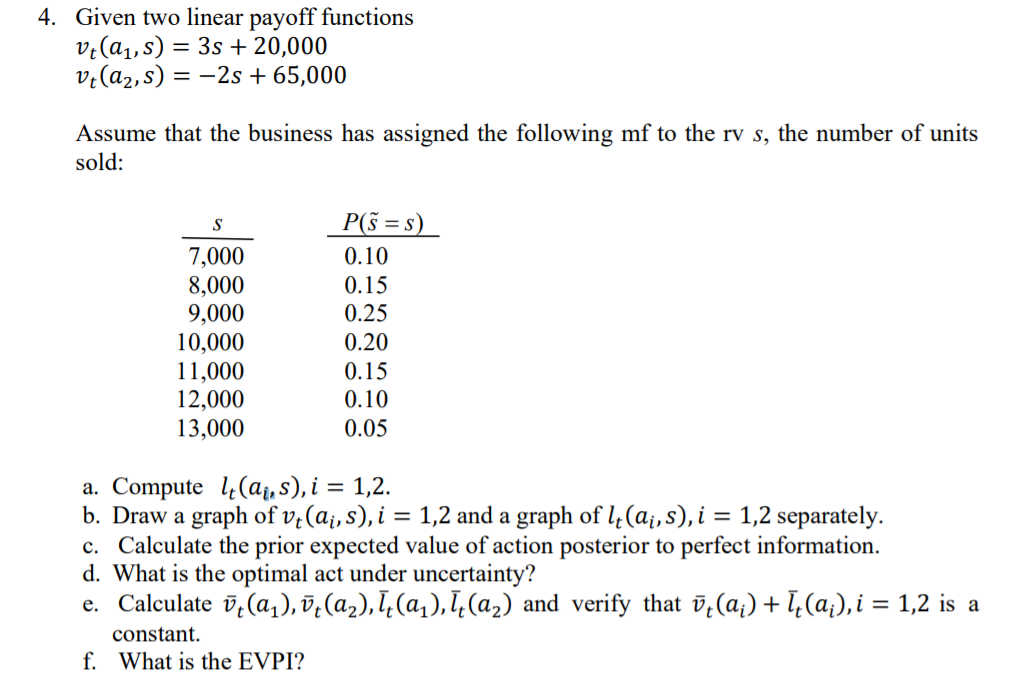
4. Given two linear payoff functions V7(a1,s) = 3s + 20,000 Vt(a,,s) = -2s + 65,000 Assume that the business has assigned the following mf to the rv s, the number of units sold: S 7,000 8,000 9,000 10,000 11,000 12,000 13,000 P( =s) 0.10 0.15 0.25 0.20 0.15 0.10 0.05 = = a. Compute 14(ai,s), i = 1,2. b. Draw a graph of v(ai,s), i = 1,2 and a graph of lt(ai,s), i = 1,2 separately. c. Calculate the prior expected value of action posterior to perfect information. d. What is the optimal act under uncertainty? e. Calculate r(ay), Dr(az),, (az), (az) and verify that 7(a;) + 7, (a;), i = 1,2 is a constant. f. What is the EVPI? = 4. Given two linear payoff functions V7(a1,s) = 3s + 20,000 Vt(a,,s) = -2s + 65,000 Assume that the business has assigned the following mf to the rv s, the number of units sold: S 7,000 8,000 9,000 10,000 11,000 12,000 13,000 P( =s) 0.10 0.15 0.25 0.20 0.15 0.10 0.05 = = a. Compute 14(ai,s), i = 1,2. b. Draw a graph of v(ai,s), i = 1,2 and a graph of lt(ai,s), i = 1,2 separately. c. Calculate the prior expected value of action posterior to perfect information. d. What is the optimal act under uncertainty? e. Calculate r(ay), Dr(az),, (az), (az) and verify that 7(a;) + 7, (a;), i = 1,2 is a constant. f. What is the EVPI? =
Step by Step Solution
There are 3 Steps involved in it

Get step-by-step solutions from verified subject matter experts
 Study Help