







Question: 4. Graded Problem (Page limit: 1 sheet; 2 sides) Suppose we have 2n students, partitioned into L and R, where = IR! = n. We
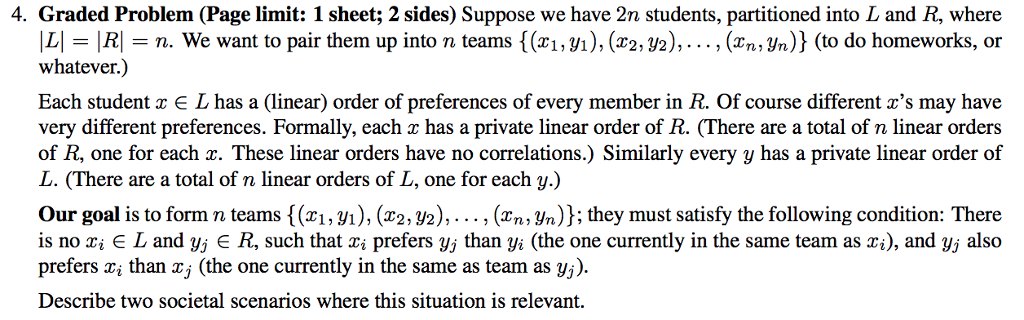
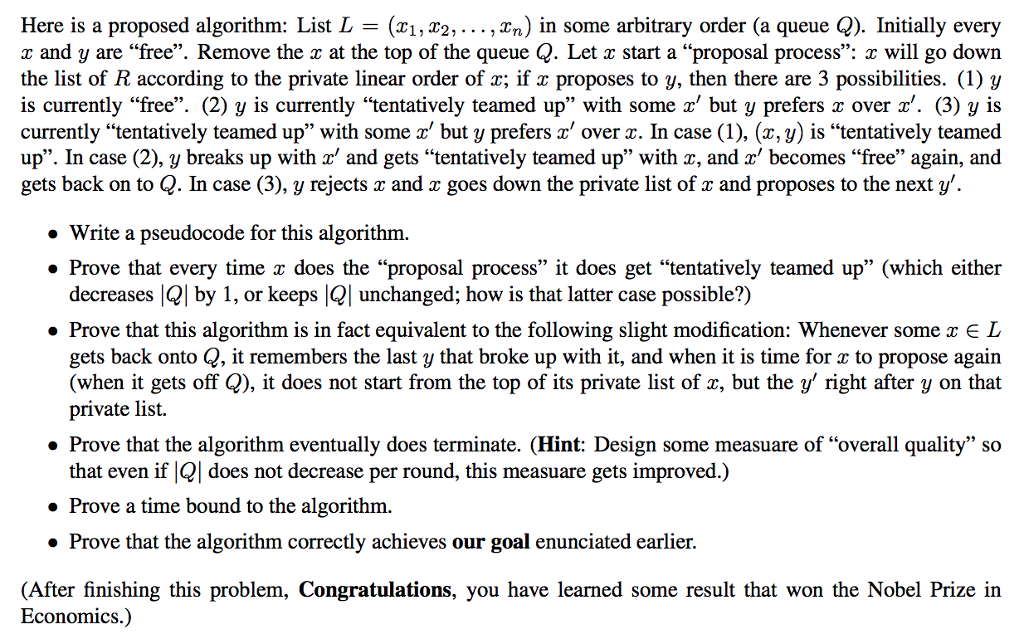
4. Graded Problem (Page limit: 1 sheet; 2 sides) Suppose we have 2n students, partitioned into L and R, where = IR! = n. We want to pair them up into n teams {(zi, yi), (D, y2), . . . , (zn,%)} (to do homeworks, or whatever.) Each student x E L has a (linear) order of preferences of every member in R. Of course different z's may have very different preferences. Formally, each x has a private linear order of R. (There are a total of n linear orders of R, one for each z. These linear orders have no correlations.) Similarly every y has a private linear order of L. (There are a total of n linear orders of L, one for each y.) Our goal is to form n teams (,1), (x2,y2),..., (xn,yn)); they must satisfy the following condition: There is no i E L and yj E R, such that xi prefers yj than gi (the one currently in the same team as xi), and yj also prefers ai than xj (the one currently in the same as team as yj). Describe two societal scenarios where this situation is relevant. 4. Graded Problem (Page limit: 1 sheet; 2 sides) Suppose we have 2n students, partitioned into L and R, where = IR! = n. We want to pair them up into n teams {(zi, yi), (D, y2), . . . , (zn,%)} (to do homeworks, or whatever.) Each student x E L has a (linear) order of preferences of every member in R. Of course different z's may have very different preferences. Formally, each x has a private linear order of R. (There are a total of n linear orders of R, one for each z. These linear orders have no correlations.) Similarly every y has a private linear order of L. (There are a total of n linear orders of L, one for each y.) Our goal is to form n teams (,1), (x2,y2),..., (xn,yn)); they must satisfy the following condition: There is no i E L and yj E R, such that xi prefers yj than gi (the one currently in the same team as xi), and yj also prefers ai than xj (the one currently in the same as team as yj). Describe two societal scenarios where this situation is relevant
Step by Step Solution
There are 3 Steps involved in it

Get step-by-step solutions from verified subject matter experts
 Study Help