







Question: 4 H H 2 0 t 1. Let A = , where t is a real number. 3 0 3 -1 -1 -t 1 2
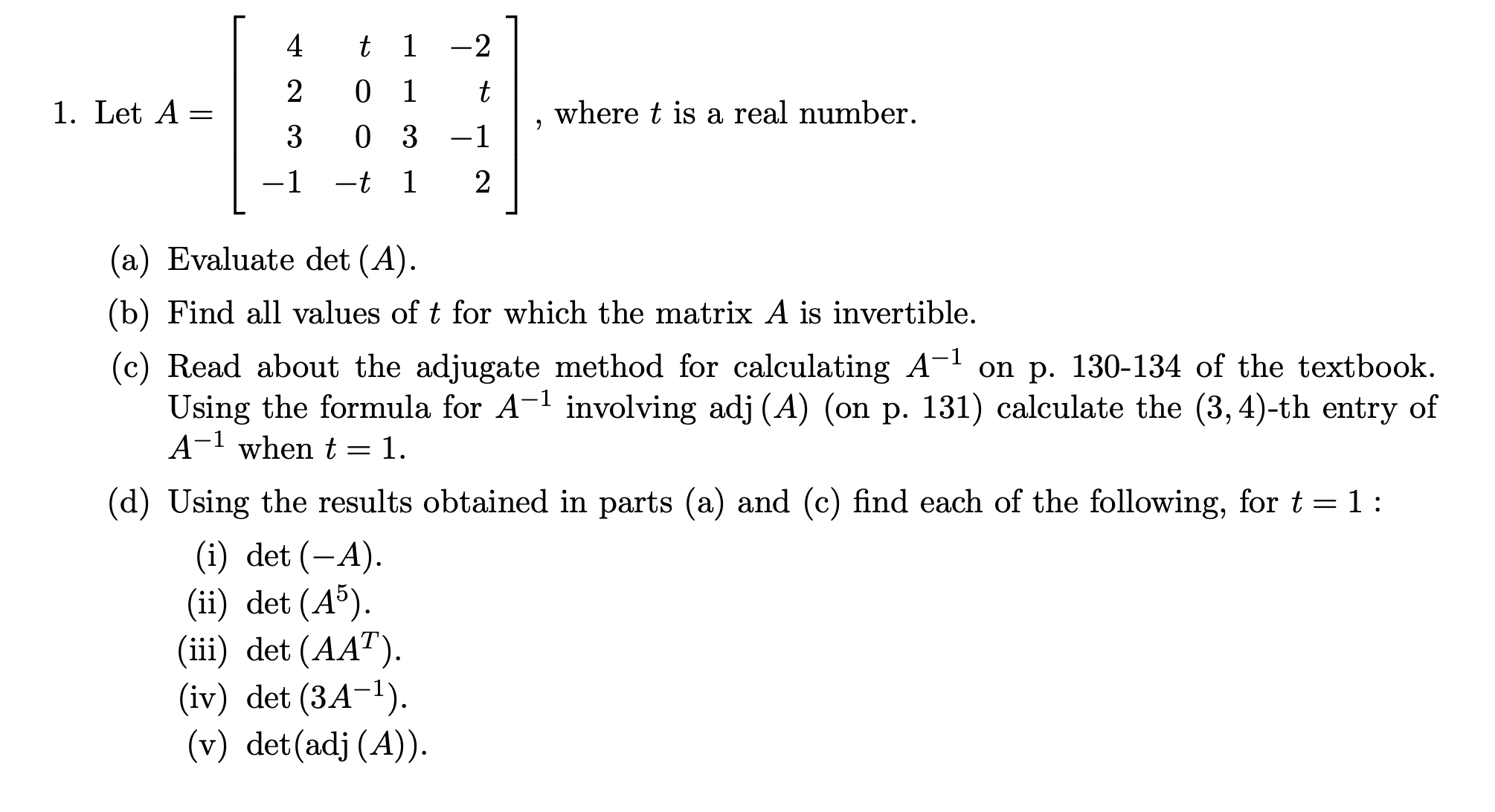
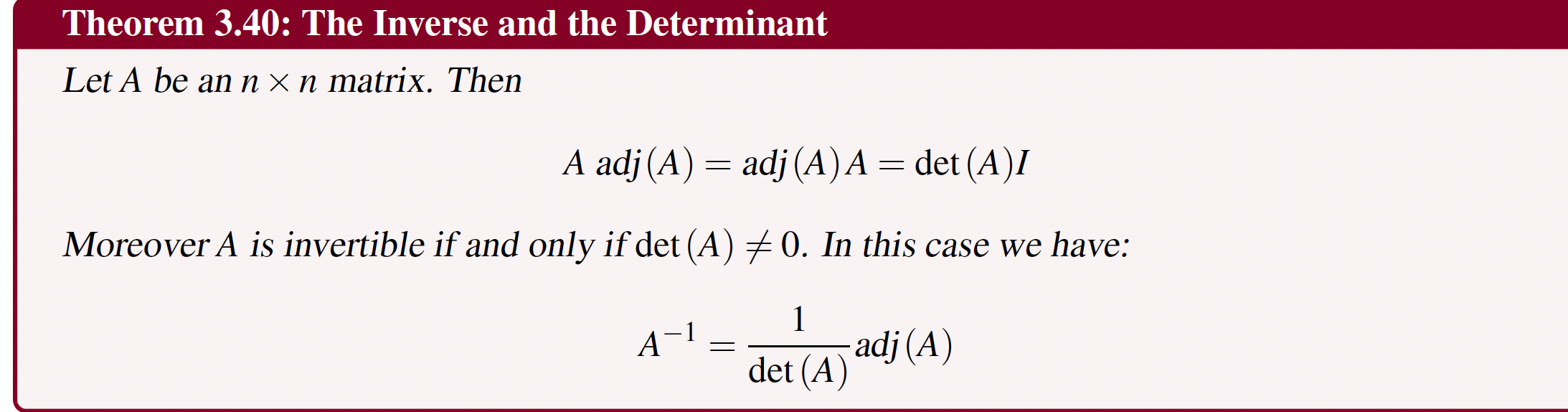
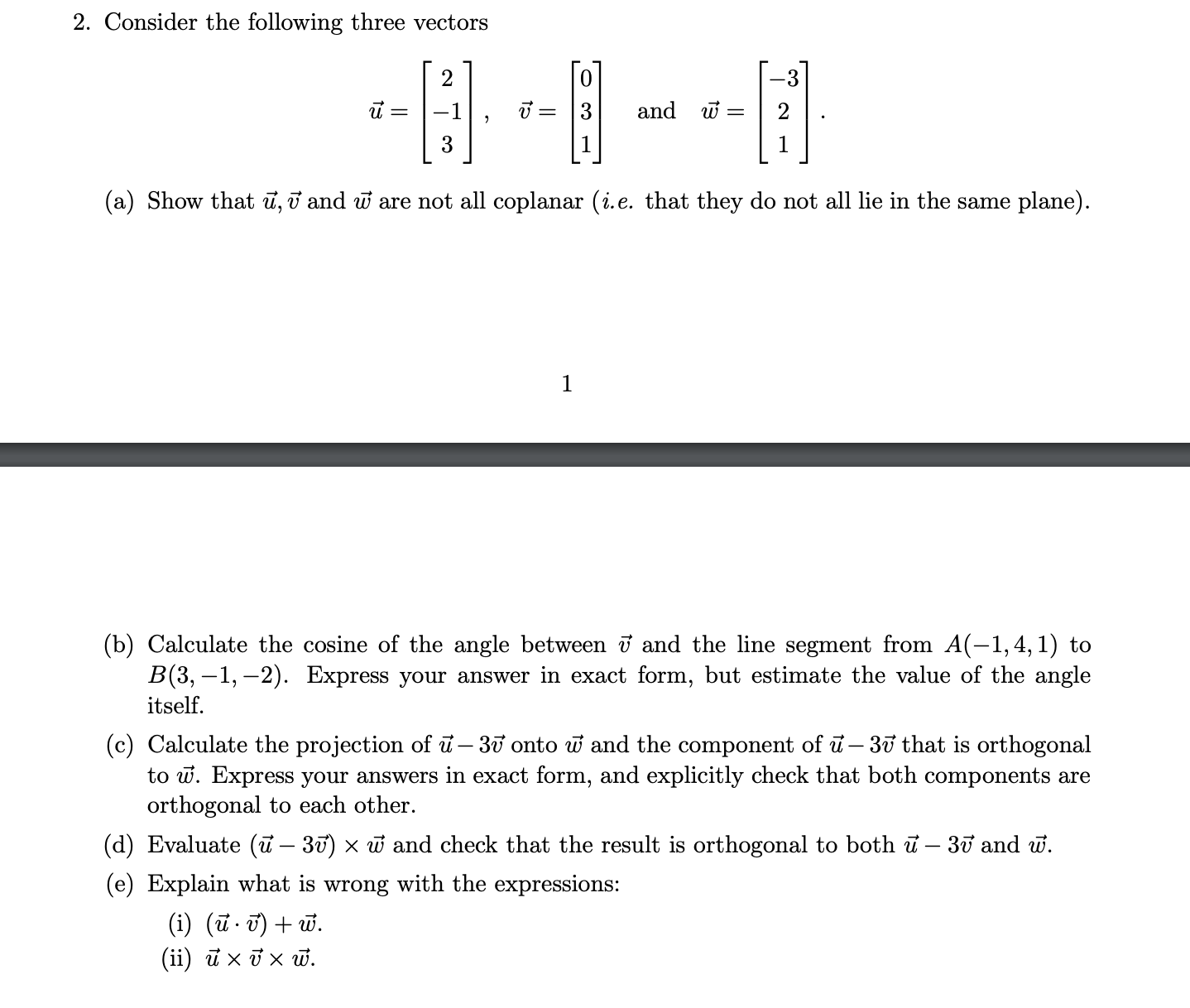
4 H H 2 0 t 1. Let A = , where t is a real number. 3 0 3 -1 -1 -t 1 2 (a) Evaluate det (A). (b) Find all values of t for which the matrix A is invertible. (c) Read about the adjugate method for calculating A- on p. 130-134 of the textbook. Using the formula for A involving adj (A) (on p. 131) calculate the (3, 4)-th entry of A- when t = 1. (d) Using the results obtained in parts (a) and (c) find each of the following, for t = 1 : (i) det (-A). (ii) det ( AS). (iii) det (AAT). (iv) det (3A-1). (v) det(adj (A)).Theorem 3.40: The Inverse and the Determinant Let A be an n x n matrix. Then A adj (A) = adj (A) A = det (A) I Moreover A is invertible if and only if det (A) + 0. In this case we have: A = det (A) adj ( A )2. Consider the following three vectors 2 0 3 a: *1 , a: 3 and a}: 2 3 1 1 (a) Show that 11,17 and n? are not all c0planar (ale. that they do not all lie in the same plane). Calculate the cosine of the angle between 17 and the line segment from A(l,4, 1) to 3(3, 1,2). Express your answer in exact form, but estimate the value of the angle itself. Calculate the projection of 11' i 31? onto 13 and the component of 11' 7 327 that is orthogonal to 175. Express your answers in exact form, and explicitly check that both components are orthogonal to each other. Evaluate (11' 31?) X 113 and check that the result is orthogonal to both 11' 31? and if}. Explain what is wrong with the expressions: (i) (1'5 - '5') + 73. (ii)11'>
Step by Step Solution
There are 3 Steps involved in it

Get step-by-step solutions from verified subject matter experts
 Study Help