







Question: ( 4 ) In a CBR test, the following data was collected and tabulated as follows. What is the CBR for this soil? ( 5
In a CBR test, the following data was collected and tabulated as follows. What is the CBR for this
soil?
A CU triaxial compression test was conducted on a saturated clay sample with a confining stress of
kPa. The sample failed when the axial stress deviator stress applied was kPa. The pore water
pressure at failure was measured to be kPa. Assume the cohesion intercepts kPa.
b Determine the effective angle of internal friction
c Determine the normal effective stress and shear stress on the plane of failure.
d The expected shear strength at failure if a direct shear test is conducted on the same sand with an
effective normal stress of kPa is conducted.
Note: If Mohr circle construction is used, it must be drawn to scale using a grid note.
a Derive the angle of failure plane in triaxial tests using a MohrCoulomb failure criteria.
b Compare drained shear behaviors of loose sands and dense sands in typical CD triaxial testing by
drawing stressstrain curves and volume changestrain curves. Explain whether the soil dilates or
contracts during shear.
c Explain using a sketch why it is not possible to determine the principal stresses in a direct shear test
specimen for an applied horizontal shear stress, which is not large enough to cause failure.
In a direct shear test on sand, the vertical normal stress on the specimen is kPa and the horizontal
shear stress at failure is kPa.
a Derive the friction angle of the sand and the magnitude and direction of the principal stresses at
failure.
b During a CD triaxial test, the sand specimen failed at a principal stress difference of kPa.
Determine the initial confining stress of the test.
c The stress conditions of the same sand behind a retaining wall are, vertical stress kPa and
horizontal stress kPa. Determine the factor of safety against failure. Is the wall safe?
d The horizontal stress oh in c reduces, as a result of the movement of the wall, while remains
unchanged. Determine the that will cause failure.
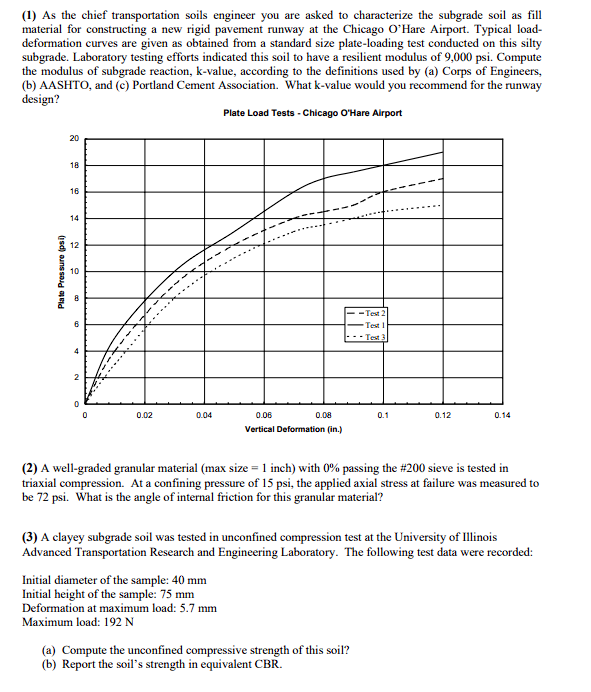
Note: If Mohr circle construction is used, it must be drawn to scale using a grid note. As the chief transportation soils engineer you are asked to characterize the subgrade soil as fill
material for constructing a new rigid pavement runway at the Chicago O'Hare Airport. Typical load
deformation curves are given as obtained from a standard size plateloading test conducted on this silty
subgrade. Laboratory testing efforts indicated this soil to have a resilient modulus of Compute
the modulus of subgrade reaction, kvalue, according to the definitions used by a Corps of Engineers,
b AASHTO, and c Portland Cement Association. What kvalue would you recommend for the runway
design?
Plate Load Tests Chicago O'Hare Alrport
A wellgraded granular material max size inch with passing the # sieve is tested in
triaxial compression. At a confining pressure of the applied axial stress at failure was measured to
be What is the angle of internal friction for this granular material?
A clayey subgrade soil was tested in unconfined compression test at the University of Illinois
Advanced Transportation Research and Engineering Laboratory. The following test data were recorded:
Initial diameter of the sample:
Initial height of the sample:
Deformation at maximum load:
Maximum load:
a Compute the unconfined compressive strength of this soil?
b Report the soil's strength in equivalent CBR
Step by Step Solution
There are 3 Steps involved in it
1 Expert Approved Answer
Step: 1 Unlock

Question Has Been Solved by an Expert!
Get step-by-step solutions from verified subject matter experts
Step: 2 Unlock
Step: 3 Unlock
 Study Help