







Question: 4) In class, we showed how round-off error can propagate through addition and division by relating the relative error of the result to the relative
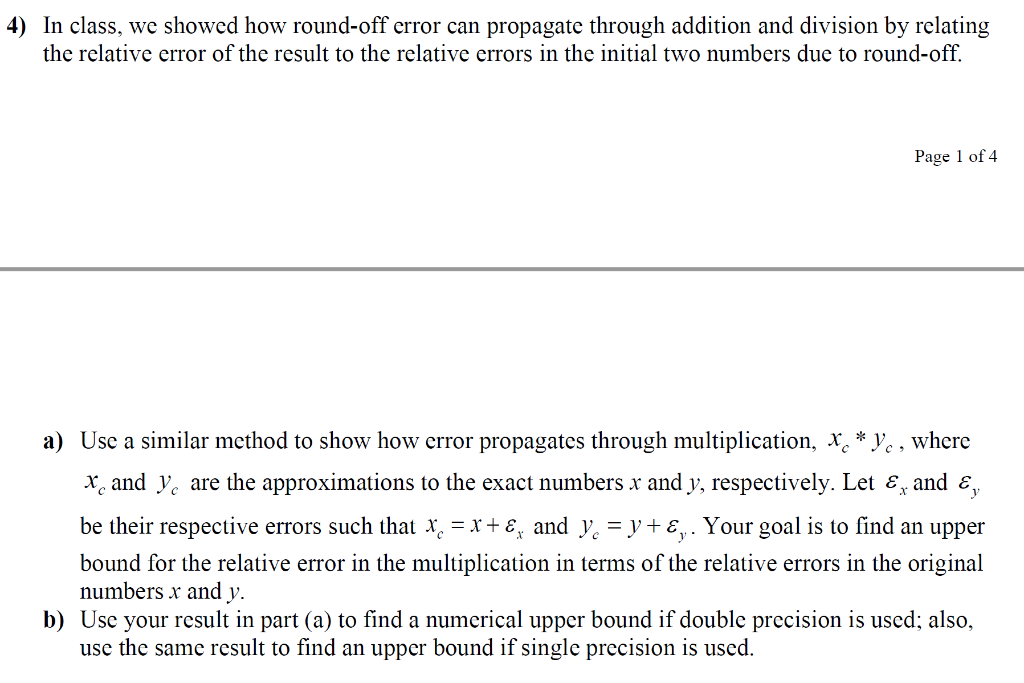
4) In class, we showed how round-off error can propagate through addition and division by relating the relative error of the result to the relative errors in the initial two numbers due to round-off. Page 1 of 4 a) Use a similar method to show how error propagates through multiplication, *. * Yc, where x, and y, are the approximations to the exact numbers x and y, respectively. Let ez and , be their respective errors such that x = x + &, and y. = y +,. Your goal is to find an upper bound for the relative error in the multiplication in terms of the relative errors in the original numbers x and y. b) Use your result in part (a) to find a numerical upper bound if double precision is used; also, use the same result to find an upper bound if single precision is used. 4) In class, we showed how round-off error can propagate through addition and division by relating the relative error of the result to the relative errors in the initial two numbers due to round-off. Page 1 of 4 a) Use a similar method to show how error propagates through multiplication, *. * Yc, where x, and y, are the approximations to the exact numbers x and y, respectively. Let ez and , be their respective errors such that x = x + &, and y. = y +,. Your goal is to find an upper bound for the relative error in the multiplication in terms of the relative errors in the original numbers x and y. b) Use your result in part (a) to find a numerical upper bound if double precision is used; also, use the same result to find an upper bound if single precision is used
Step by Step Solution
There are 3 Steps involved in it

Get step-by-step solutions from verified subject matter experts
 Study Help