







Question: 4. In the HSB data set test the null hypothesis that the mean of the population of self- concept score is zero at a =
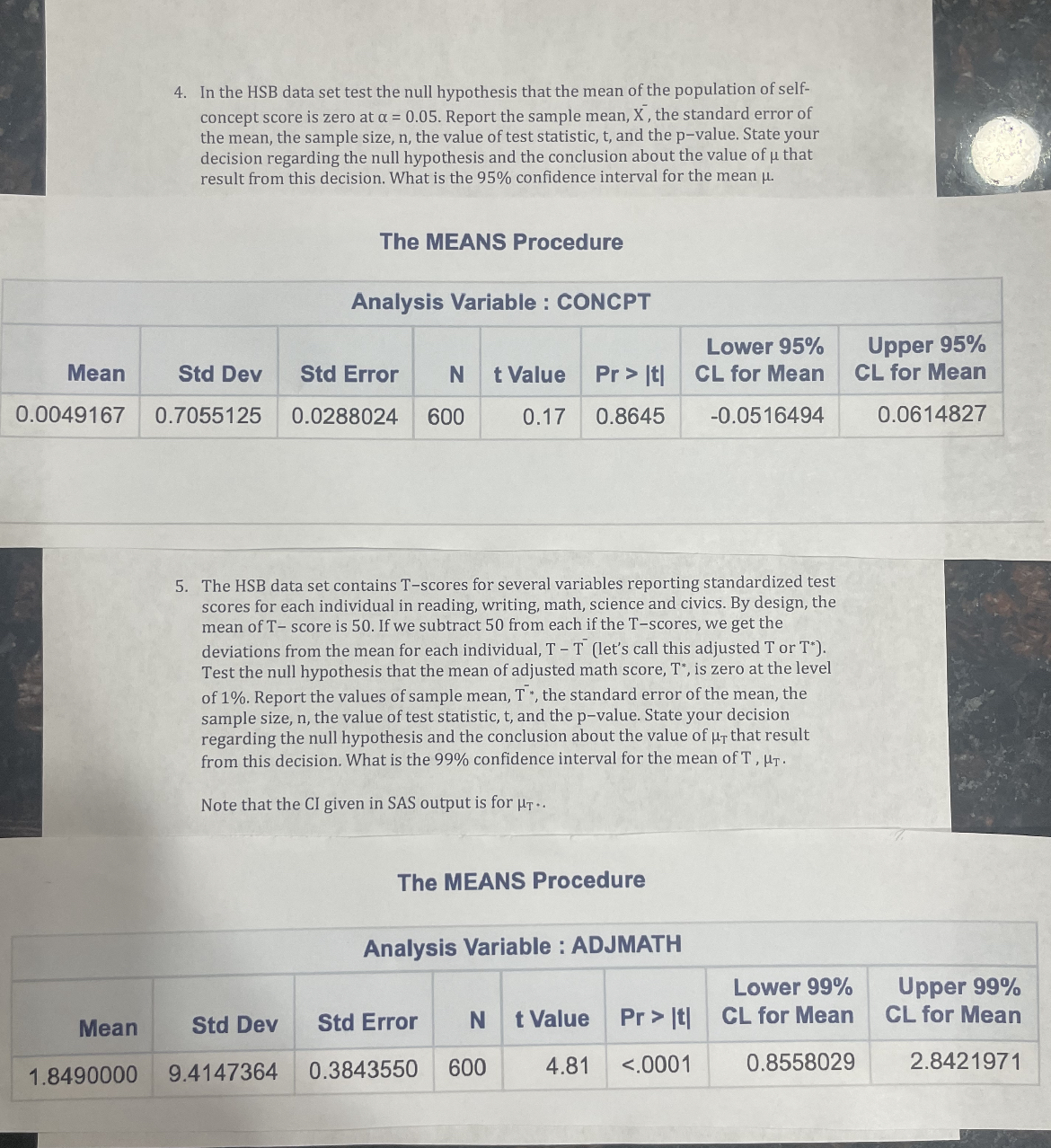
4. In the HSB data set test the null hypothesis that the mean of the population of self- concept score is zero at a = 0.05. Report the sample mean, X , the standard error of the mean, the sample size, n, the value of test statistic, t, and the p-value. State your decision regarding the null hypothesis and the conclusion about the value of u that result from this decision. What is the 95% confidence interval for the mean . The MEANS Procedure Analysis Variable : CONCPT Lower 95% Upper 95% Mean Std Dev Std Error N t Value Pr > It CL for Mean CL for Mean 0.0049167 0.7055125 0.0288024 600 0.17 0.8645 -0.0516494 0.0614827 5. The HSB data set contains T-scores for several variables reporting standardized test scores for each individual in reading, writing, math, science and civics. By design, the mean of T- score is 50. If we subtract 50 from each if the T-scores, we get the deviations from the mean for each individual, T - T (let's call this adjusted T or T*). Test the null hypothesis that the mean of adjusted math score, T*, is zero at the level of 1%. Report the values of sample mean, T *, the standard error of the mean, the sample size, n, the value of test statistic, t, and the p-value. State your decision regarding the null hypothesis and the conclusion about the value of ur that result from this decision. What is the 99% confidence interval for the mean of T, MT. Note that the CI given in SAS output is for UT.. The MEANS Procedure Analysis Variable : ADJMATH Lower 99% Upper 99% Mean Std Dev Std Error N t Value Pr > It| CL for Mean CL for Mean 1.8490000 9.4147364 0.3843550 600 4.81 <.0001>
Step by Step Solution
There are 3 Steps involved in it

Get step-by-step solutions from verified subject matter experts
 Study Help