







Question: 4. In the MS-DOS file system, a disk is prefaced with an array of values called the File Allocation Table (FAT). Each FAT entry corresponds
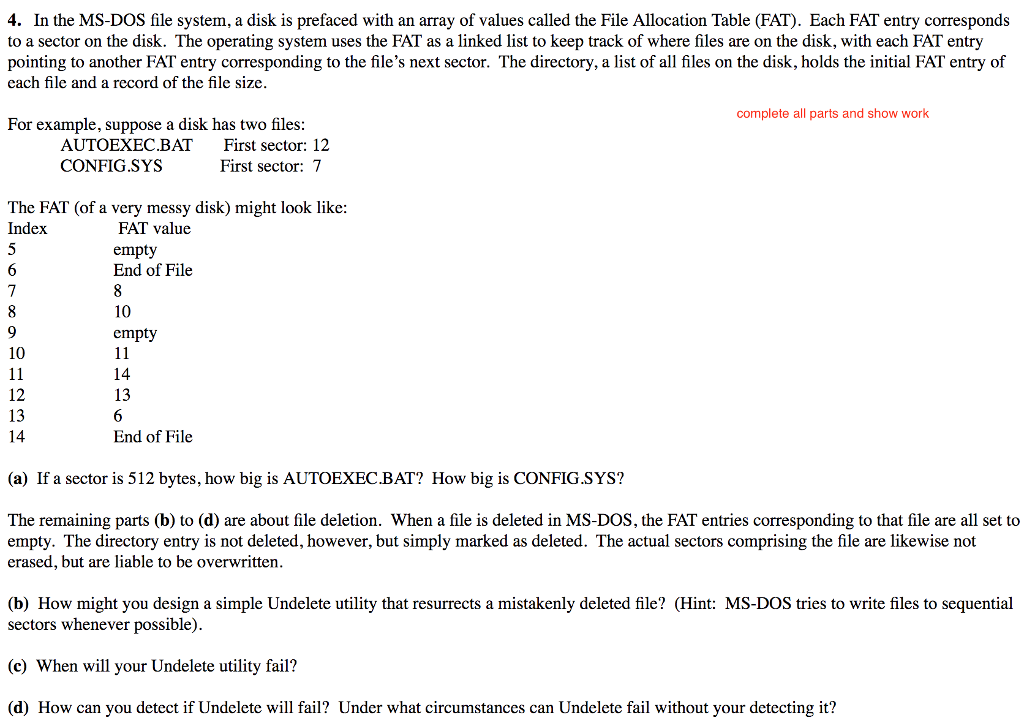
4. In the MS-DOS file system, a disk is prefaced with an array of values called the File Allocation Table (FAT). Each FAT entry corresponds to a sector on the disk. The operating system uses the FAT as a linked list to keep track of where files are on the disk, with each FAT entry pointing to another FAT entry corresponding to the file's next sector. The directory, a list of all files on the disk, holds the initial FAT entry of cach file and a record of the file size complete all parts and show work For example, suppose a disk has two files AUTOEXEC.BAT CONFIG.SYS First sector: 12 First sector: 7 The FAT (of a very messy disk) might look like Index FAT value empty End of File 10 empty 10 14 13 12 13 14 End of File (a) If a sector is 512 bytes, how big is AUTOEXEC.BAT? How big is CONFIG.SYS? The remaining parts (b) to (d) are about file deletion. When a file is deleted in MS-DOS, the FAT entries corresponding to that file are all set to empty. The directory entry is not deleted, however, but simply marked as deleted. The actual sectors comprising the file are likewise not erased, but are liable to be overwrittern (b) How might you design a simple Undelete utility that resurrects a mistakenly deleted file? (Hint: MS-DOS tries to write files to sequential sectors whenever possible) (c) When will your Undelete utility fail? (d) How can you detect if Undelete will fail? Under what circumstances can Undelete fail without your detecting it? 4. In the MS-DOS file system, a disk is prefaced with an array of values called the File Allocation Table (FAT). Each FAT entry corresponds to a sector on the disk. The operating system uses the FAT as a linked list to keep track of where files are on the disk, with each FAT entry pointing to another FAT entry corresponding to the file's next sector. The directory, a list of all files on the disk, holds the initial FAT entry of cach file and a record of the file size complete all parts and show work For example, suppose a disk has two files AUTOEXEC.BAT CONFIG.SYS First sector: 12 First sector: 7 The FAT (of a very messy disk) might look like Index FAT value empty End of File 10 empty 10 14 13 12 13 14 End of File (a) If a sector is 512 bytes, how big is AUTOEXEC.BAT? How big is CONFIG.SYS? The remaining parts (b) to (d) are about file deletion. When a file is deleted in MS-DOS, the FAT entries corresponding to that file are all set to empty. The directory entry is not deleted, however, but simply marked as deleted. The actual sectors comprising the file are likewise not erased, but are liable to be overwrittern (b) How might you design a simple Undelete utility that resurrects a mistakenly deleted file? (Hint: MS-DOS tries to write files to sequential sectors whenever possible) (c) When will your Undelete utility fail? (d) How can you detect if Undelete will fail? Under what circumstances can Undelete fail without your detecting it
Step by Step Solution
There are 3 Steps involved in it

Get step-by-step solutions from verified subject matter experts
 Study Help