







Question: 4. In this question, we will consider how many different pieces of information can be encoded with n neurons. (A piece of information can be
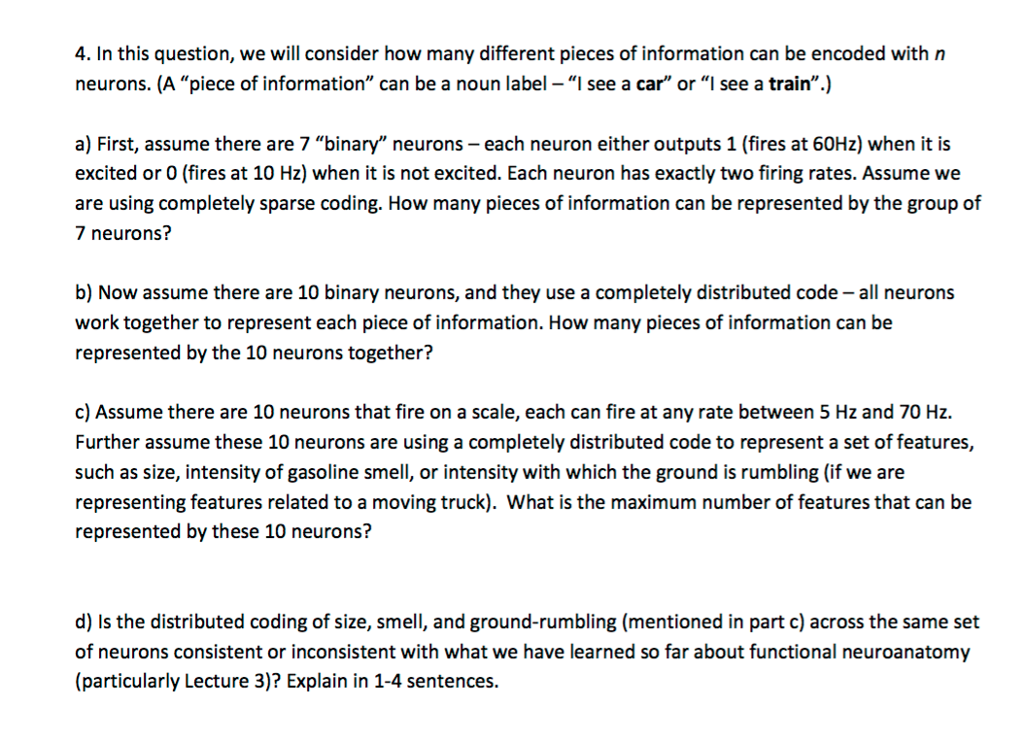
4. In this question, we will consider how many different pieces of information can be encoded with n neurons. (A "piece of information" can be a noun label-'1 see a car" or "I see a train".) a) First, assume there are 7 "binary" neurons each neuron either outputs 1 (fires at 60Hz) when it is excited or 0 (fires at 10 Hz) when it is not excited. Each neuron has exactly two firing rates. Assume we are using completely sparse coding. How many pieces of information can be represented by the group of 7 neurons? b) Now assume there are 10 binary neurons, and they use a completely distributed code - all neurons work together to represent each piece of information. How many pieces of information can be represented by the 10 neurons together? c) Assume there are 10 neurons that fire on a scale, each can fire at any rate between 5 Hz and 70 Hz. Further assume these 10 neurons are using a completely distributed code to represent a set of features, such as size, intensity of gasoline smell, or intensity with which the ground is rumbling (if we are representing features related to a moving truck). What is the maximum number of features that can be represented by these 10 neurons? d) Is the distributed coding of size, smell, and ground-rumbling (mentioned in part c) across the same set of neurons consistent or inconsistent with what we have learned so far about functional neuroanatomy (particularly Lecture 3)? Explain in 1-4 sentences. 4. In this question, we will consider how many different pieces of information can be encoded with n neurons. (A "piece of information" can be a noun label-'1 see a car" or "I see a train".) a) First, assume there are 7 "binary" neurons each neuron either outputs 1 (fires at 60Hz) when it is excited or 0 (fires at 10 Hz) when it is not excited. Each neuron has exactly two firing rates. Assume we are using completely sparse coding. How many pieces of information can be represented by the group of 7 neurons? b) Now assume there are 10 binary neurons, and they use a completely distributed code - all neurons work together to represent each piece of information. How many pieces of information can be represented by the 10 neurons together? c) Assume there are 10 neurons that fire on a scale, each can fire at any rate between 5 Hz and 70 Hz. Further assume these 10 neurons are using a completely distributed code to represent a set of features, such as size, intensity of gasoline smell, or intensity with which the ground is rumbling (if we are representing features related to a moving truck). What is the maximum number of features that can be represented by these 10 neurons? d) Is the distributed coding of size, smell, and ground-rumbling (mentioned in part c) across the same set of neurons consistent or inconsistent with what we have learned so far about functional neuroanatomy (particularly Lecture 3)? Explain in 1-4 sentences
Step by Step Solution
There are 3 Steps involved in it

Get step-by-step solutions from verified subject matter experts
 Study Help