







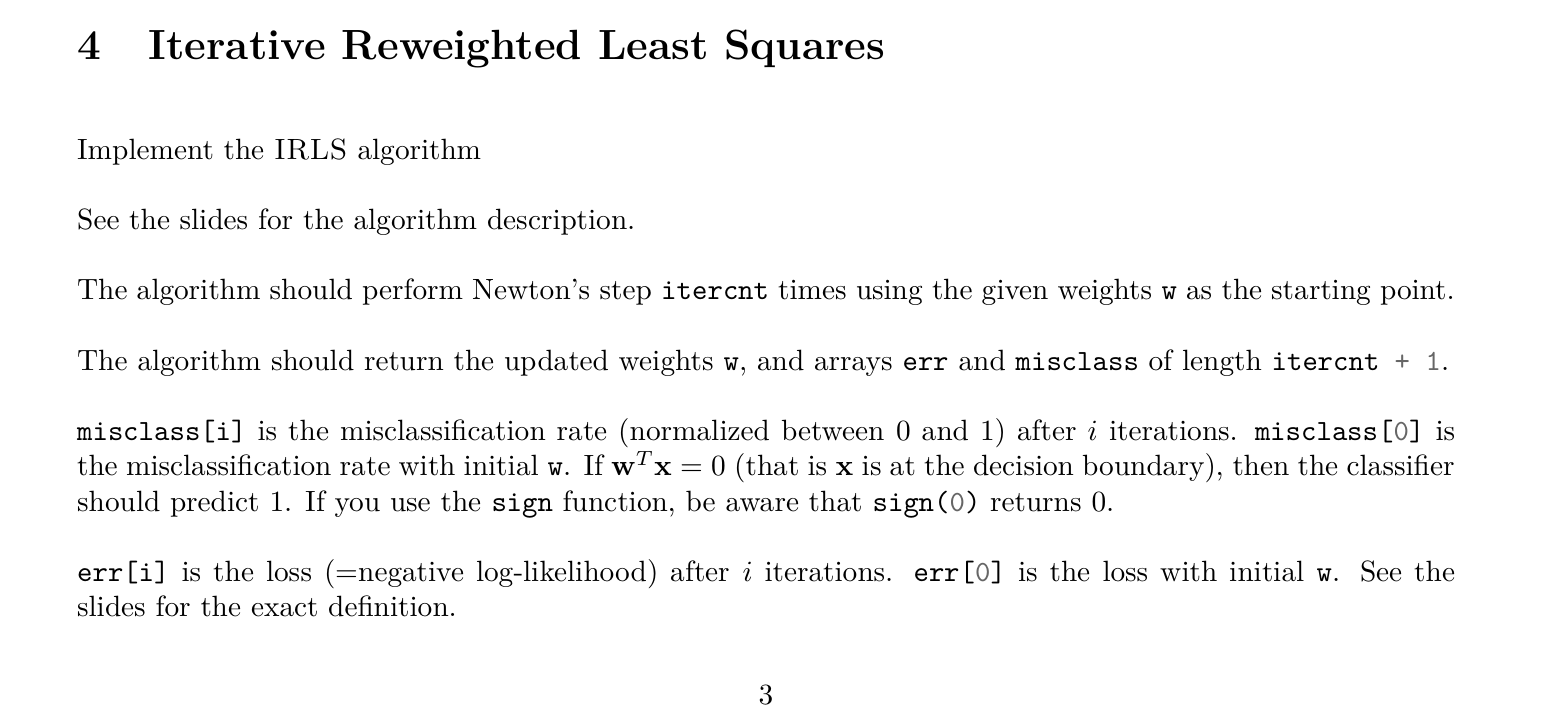
Question: 4 Iterative Reweighted Least Squares Implement the IRLS algorithm See the slides for the algorithm description. The algorithm should perform Newton's step itercnt times using
Iterative Reweighted Least Squares
Implement the IRLS algorithm
See the slides for the algorithm description.
The algorithm should perform Newton's step itercnt times using the given weights w as the starting point.
The algorithm should return the updated weights w and arrays err and misclass of length itercnt
misclass i is the misclassification rate normalized between and after i iterations. misclass is
the misclassification rate with initial w If that is is at the decision boundary then the classifier
should predict If you use the sign function, be aware that sign returns
err i is the loss negative loglikelihood after i iterations. err is the loss with initial w I will give the python code where you have to fill the blanks. Also I am attaching the python code which automatically corrects the answer. Answer: "import sys
import numpy as np
def irlsX labels, w itercnt:
IRLS algorithm
Parameters
X : an array of size n k
training input data for the classifier
labels : an array of size n
training labels for the classifier, elements must be
w : an array of size k
initial weights
itercnt : int
number of iterations
Returns
w : an array of size k
weights after itercnt iterations
err: an array of size itercnt
ith element correspongs to the error objective function minimized in
logistic regression after the ith iteration. The th entry is the
error with the initial weights.
misclass: an array of size itercnt
ith element correspongs to the misclassification proportion after the
ith iteration. The th entry is the misclassification proportion with
the initial weights.
err npzerositercnt
misclass npzerositercnt
y labels # label y label y
# place your code here
return w err, misclass
def mainargv:
D nploadtxtargv
labels D:copy # copy is needed, otherwise next line will mess up the splice
D: # replace the label column of D with constant, now the first feature gives us the bias term
itercnt intargv
w npzerosDshape
w err, misclass irlsD labels, w itercnt
printweights:
printw
printerror:
printerr
printmisclassification rate:
printmisclass
# This allows the script to be used as a module and as a standalone program
if namemain:
if lensysargv:
printusage: python s filename' sysargv
else:
mainsysargv Automatically correcting python code: #usrbinenv python
import sys
import unittest
from tmc import points
from tmcutils import load, getout
import numpy as np
from utils import errormsg, ApproxTest
@points
class IrlsTesterApproxTest:
def testirlsself:
irls loadsrcirls', 'irls'
D nploadtxttesttoytxt
labels D:copy # copy is needed, otherwise next line will mess up the splice
D: # replace the label column of D with constant, now the first feature gives us the bias term
w npzerosDshape
w err, misclass irlsD labels, w
w nparray
err nparray
misclass nparray
self.assertApproxw w errormsgIncorrect weights input toy.txt w itercnt w w
self.assertApproxerr err, errormsgIncorrect error input toy.txt w itercnt err err
self.assertApproxmisclass misclass, errormsgIncorrect misclassication rate input toy.txt w itercnt misclass misclass
Step by Step Solution
There are 3 Steps involved in it
1 Expert Approved Answer
Step: 1 Unlock

Question Has Been Solved by an Expert!
Get step-by-step solutions from verified subject matter experts
Step: 2 Unlock
Step: 3 Unlock
 Study Help