


Question: 4. Let A be a banded tridiagonal matrix: CI 0 0 O . . . d2 C2 O . . . f2 d3 C3 O
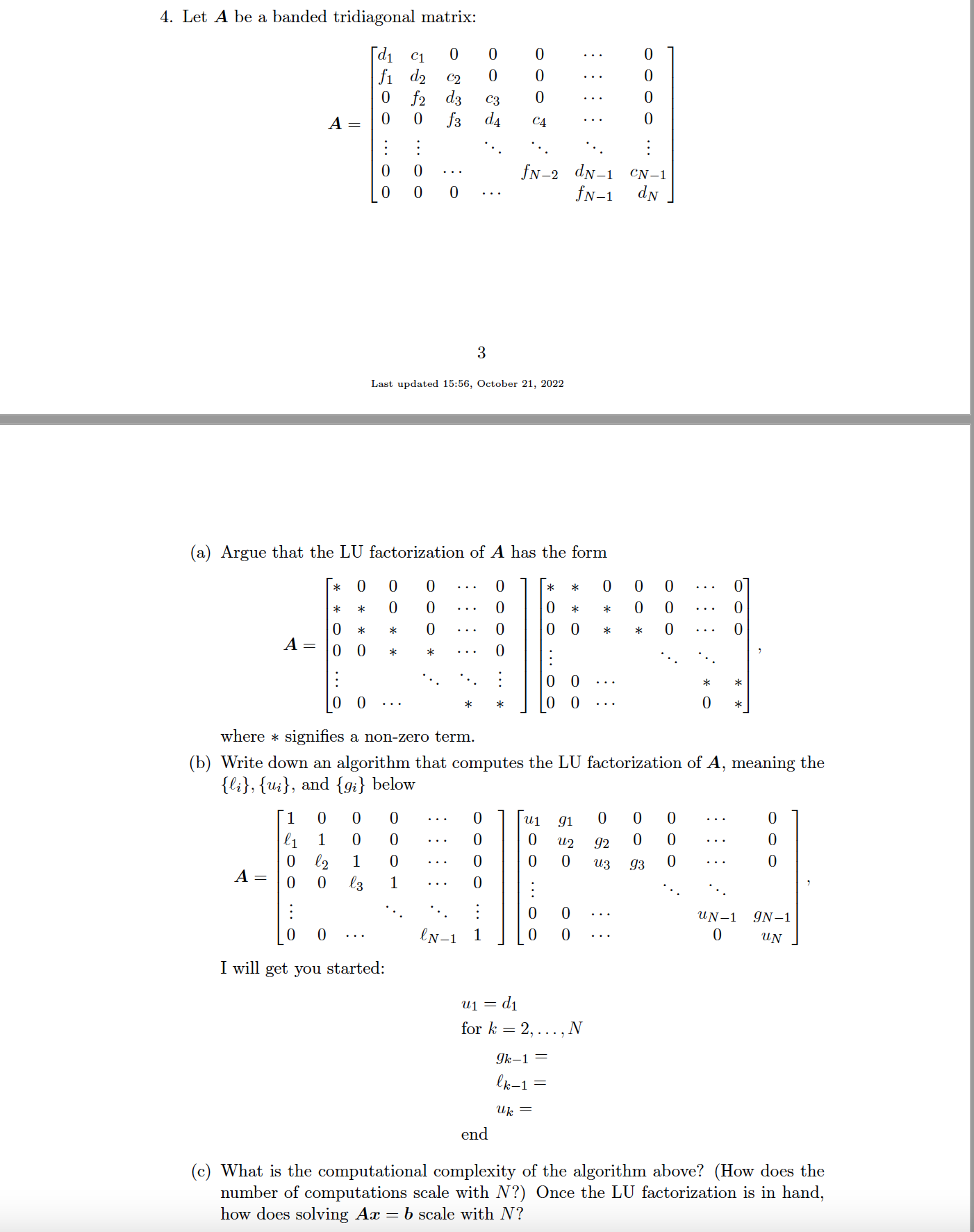
4. Let A be a banded tridiagonal matrix: CI 0 0 O
4. Let A be a banded tridiagonal matrix: CI 0 0 O . . . d2 C2 O . . . f2 d3 C3 O . . . A 0 f3 da CA . . . . . . O . . . . . O ... 0 . . fN-2 dN-1 CN-1 0 0 . . fN-1 dN 3 Last updated 15:56, October 21, 2022 (a) Argue that the LU factorization of A has the form [* 0 0 0 . . 0 * . . . O * . . . 0 . . . 0 O . . . O . . . A = 0 . . . . ..OO . . . . . . . . . . . 0 O* 0 0 * 0 0 . . . where * signifies a non-zero term. (b) Write down an algorithm that computes the LU factorization of A, meaning the {li}, fui}, and {gi} below 0 0 0 . . . 0 [u1 91 0 0 0 1 0 0 . . . 0 U2 92 0 O . . 0 0 . . . 0 O U3 . . . A = 0 0 . . . 0 . . . . . . . . . 0 0 . . UN-1 0 lN-1 1 0 . . . UN I will get you started: u1 = d1 for k = 2, ..., N gk -1 = (k-1 = uk = end (c) What is the computational complexity of the algorithm above? (How does the number of computations scale with N?) Once the LU factorization is in hand, how does solving Ax = b scale with N

Step by Step Solution

There are 3 Steps involved in it

1 Expert Approved Answer
Step: 1 Unlock blur-text-image
Question Has Been Solved by an Expert!

Get step-by-step solutions from verified subject matter experts

Step: 2 Unlock
Step: 3 Unlock

Students Have Also Explored These Related Mathematics Questions!