







Question: 4. Let C be the solid region above the graph of z= + y, let S be the boundary of C, and let F =
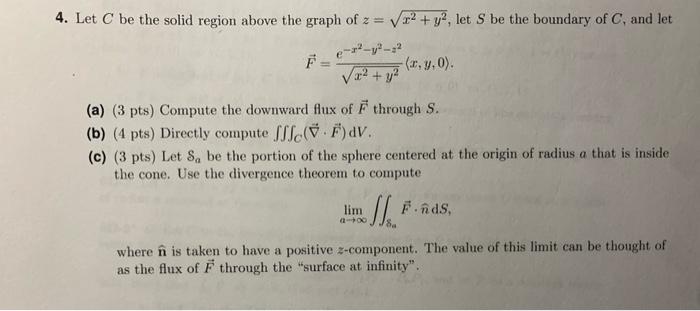
4. Let C be the solid region above the graph of z= + y, let S be the boundary of C, and let F = e--- x + y -(x, y,0). (a) (3 pts) Compute the downward flux of F through S. (b) (4 pts) Directly compute fff(F) dv. (c) (3 pts) Let Sa be the portion of the sphere centered at the origin of radius a that is inside the cone. Use the divergence theorem to compute lim JI F.nds, where in is taken to have a positive z-component. The value of this limit can be thought of as the flux of F through the "surface at infinity". 4. Let C be the solid region above the graph of z= + y, let S be the boundary of C, and let F = e--- x + y -(x, y,0). (a) (3 pts) Compute the downward flux of F through S. (b) (4 pts) Directly compute fff(F) dv. (c) (3 pts) Let Sa be the portion of the sphere centered at the origin of radius a that is inside the cone. Use the divergence theorem to compute lim JI F.nds, where in is taken to have a positive z-component. The value of this limit can be thought of as the flux of F through the "surface at infinity
Step by Step Solution
There are 3 Steps involved in it

Get step-by-step solutions from verified subject matter experts
 Study Help