







Question: 4. Let d be a positive integer that is greater than or equal to 2. (a) Let x and y be nonzero integers. Prove that
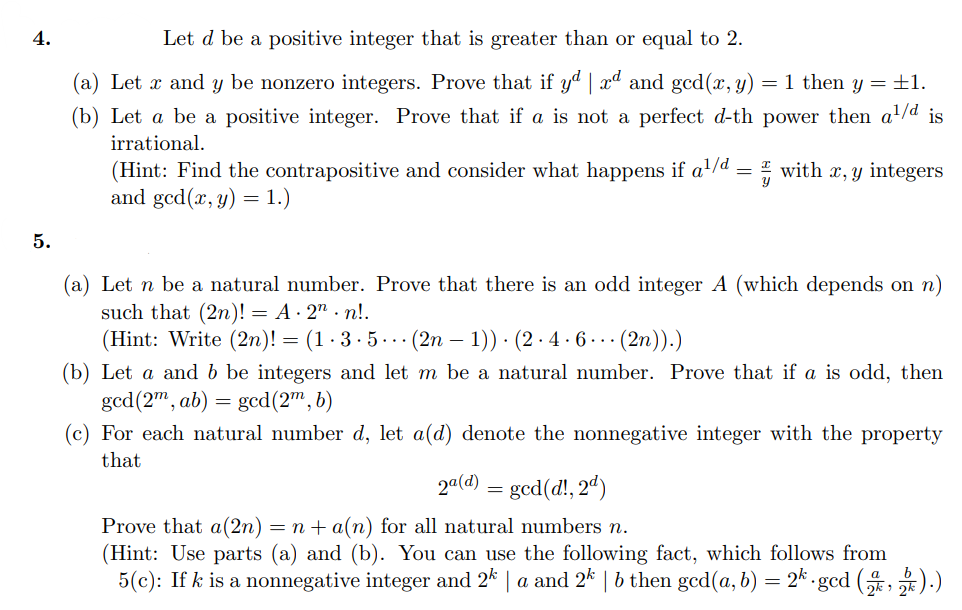
4. Let d be a positive integer that is greater than or equal to 2. (a) Let x and y be nonzero integers. Prove that if yd | ad and god(x, y) = 1 then y = 11. (b) Let a be a positive integer. Prove that if a is not a perfect d-th power then al/d is irrational. (Hint: Find the contrapositive and consider what happens if al/d = $ with x, y integers and god(x, y) = 1.) 5. (a) Let n be a natural number. Prove that there is an odd integer A (which depends on n) such that (2n)! = A . 2" . n!. (Hint: Write (2n)! = (1 . 3 . 5 . .. (2n -1)) . (2 . 4 . 6 .. . (2n)).) (b) Let a and b be integers and let m be a natural number. Prove that if a is odd, then god(2m, ab) = god(2m, b) (c) For each natural number d, let a(d) denote the nonnegative integer with the property that 2a(d) = god(d!, 2d) Prove that a(2n) = n + a(n) for all natural numbers n. (Hint: Use parts (a) and (b). You can use the following fact, which follows from 5(c): If k is a nonnegative integer and 2* | a and 2" | b then god(a, b) - 2k . god (#, 29).)
Step by Step Solution
There are 3 Steps involved in it

Get step-by-step solutions from verified subject matter experts
 Study Help